At a glance
In this article, discover the essential steps for reporting the loss or theft of your ID card, passport or driving licence, blocking your documents via DOCSTOP, contacting the consulate and preventing identity theft. We also share practical tips for securing your documents before you leave, so you can travel with peace of mind.
Losing your passport or ID card abroad is a common problem that can ruin a holiday.
What are the risks if your ID documents (ID card or passport) are lost or stolen?
- Identity theft: A fraudster can use your information to open bank accounts, take out loans, or commit crimes in your name.
- Financial fraud: The fraudster can use your data to access your accounts or carry out transactions in your name.
- Illegal travel: Your passport can be used (whether forged or not) to cross borders or take part in criminal activities.
- Administrative problems: You're exposed to difficulties proving your identity, travelling, or carrying out official procedures.
- Cybersecurity risks: If your documents are photographed or scanned, they can be sold and exploited on the dark web.
How can you protect yourself against having your ID documents stolen?
- Keep your original documents somewhere safe or secure. Don't let them out of your sight when you carry them with you.
- Photocopy or scan your documents and keep them somewhere secure (an encrypted cloud service or a digital safe).
- Set up banking alerts to detect any suspicious activity.
- Never share your documents online, except on secure platforms.
What should you do if your ID documents are lost or stolen?
Losing your official documents abroad can put you in complicated situations, such as identity theft or being unable to get back home. Follow these steps to handle it calmly.
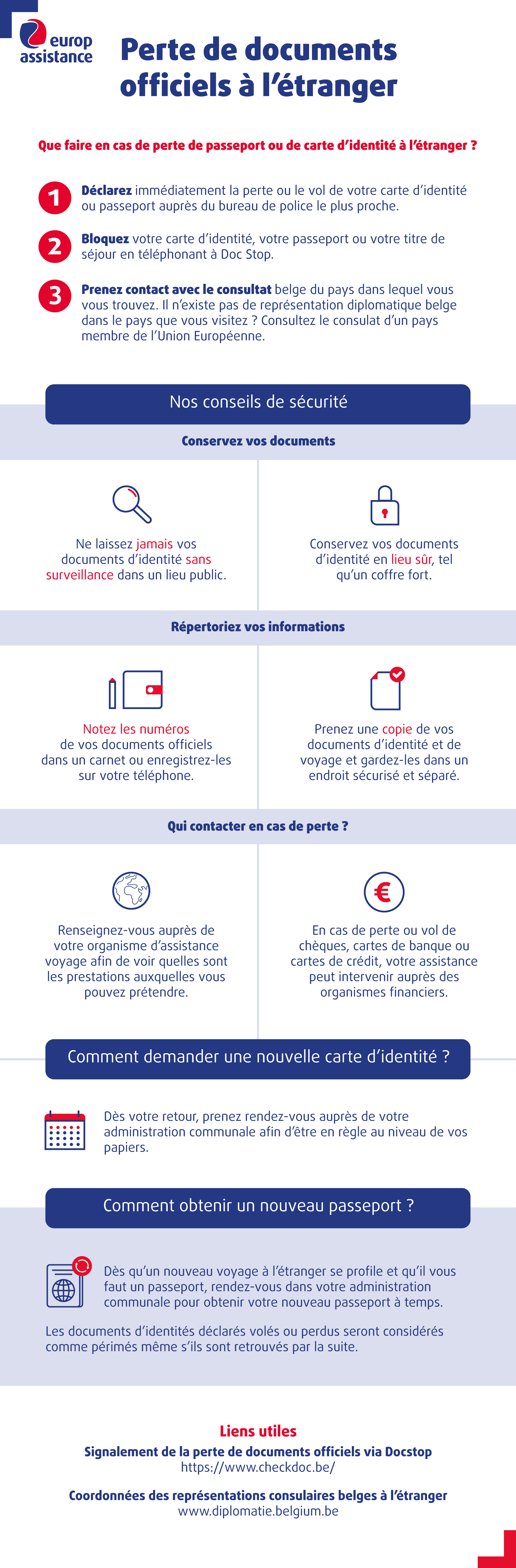
- Report the loss or theft of your ID card or passport immediately at the nearest police station. Don't forget to ask for a copy of the police report.
- Block your ID card, passport or residence permit by calling DOCSTOP on 0800 2123 2123 or +32 2 488.2123. This will help you avoid the risk of your official document being used fraudulently, along with possible financial consequences (e.g. a phone contract or other agreement being opened in your name, online purchases, etc). DOCSTOP is a free service set up by the official Belgian authorities, available 24/7.
- Go to the Belgian consulate in the country you're in. Bring two passport photos and all the documents you have to prove your identity (a copy of the stolen documents, your national register number, etc). The consulate can issue you an emergency passport (non-biometric) that will let you return to Belgium. However, this emergency document isn't always issued immediately.
Be careful, as some airlines apply specific rules regarding the acceptance of emergency documents. So check with your airline before starting your return journey.
Is there no Belgian diplomatic representation in the country you're visiting? Go to the consulate of a European Union member state instead.
Note that consular assistance doesn't cover every inconvenience linked to lost ID documents. For a cash advance to extend your stay, or to have extra luggage sent to you, turn to your travel insurance instead.
What should you do if your driving licence is lost or stolen abroad?
The consulate is not authorised to issue a duplicate of your driving licence. You must apply for a new national or European driving licence at the municipality where you're registered in Belgium.
How do I renew my ID card or passport?
Go to your local municipal administration in Belgium to renew your documents.
If you're heading abroad again soon, take the opportunity to find out about the documents you'll need to bring with you, such as a visa, ESTA or ETIAS.
Note that ID documents reported as stolen or lost will be considered invalid, even if they're later found.
A few good safety tips
To avoid losing or having your official documents and other valuables stolen, follow this advice:
- Never leave your ID documents unattended or somewhere they wouldn't be safe, such as in a car, a hotel room (without a safe), a changing room, or an unattended bag while you're at the pool or beach, etc.
- Be aware that leaving your documents or money in a locked suitcase in your hotel room offers no guarantee against theft.
- Watch out for pickpockets. Read here how to protect yourself from pickpocketing.
- Keep your ID documents somewhere safe. Many hotels offer a small safe for rent, to store valuable documents during your stay. Put in it the documents you don't strictly need with you.
- There are also pouches you can wear under your clothes. However, make sure you can easily access your documents in case of a check.
- Write down the numbers of your official documents in a notebook or save them on your phone.
- Make a copy of your ID and travel documents and keep them somewhere secure and separate. Even better: scan your documents and keep the copy in your personal email inbox. That way, you just need access to your email wherever you are to retrieve and print the scanned documents.
- Check with your travel assistance provider to see what services you're entitled to. For example, Redion's annual contracts let you get the contact details of the nearest Belgian embassy or consulate. They also provide reimbursement of administrative and transport costs linked to the loss or theft of your travel documents abroad.
- If your cheques, bank cards or credit cards are lost or stolen, your assistance provider can contact the relevant financial institutions to have the necessary protective measures applied.
Useful links
– Report the loss of official documents via Docstop: https://www.checkdoc.be/
– Contact details of Belgian consular representations abroad: www.diplomatie.belgium.be
– Blocking your payment card: Bancontact/Mister Cash, Visa, Mastercard www.cardstop.be or +32 78 170 170. Also read: “Cash and credit card payments abroad”
Don't forget either that your assistance company can help you find the contact details of Belgian diplomatic posts, block your credit cards, or advance you money abroad!
Also read our advice in the event of lost luggage.
Also read: “Consular assistance or travel assistance: what's the difference?”