At a glance
It's raining, or too cold to play outside. How do you keep your young children busy? Have you thought about salt dough?
It's raining, or it's too cold to play outside.
How do you find a simple, fun and educational activity to keep your young children busy?
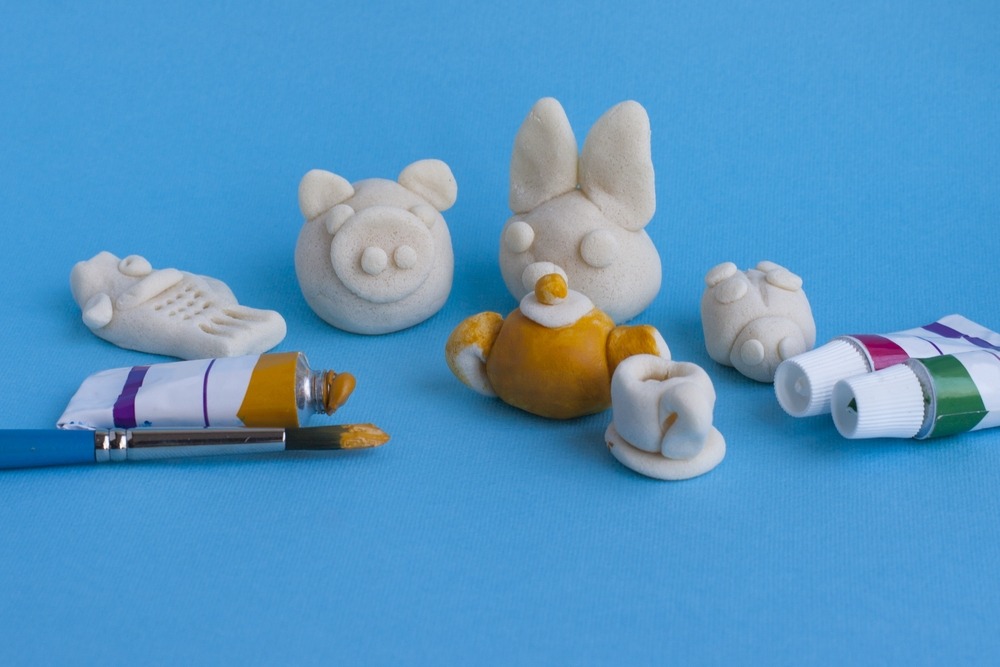
Have you ever thought about making figures out of salt dough?
Salt dough: easy to make but slow to dry
Ingredients:
To make salt dough, all you need is
- 1 glass of salt
- 3 glasses of flour (non-self-rising)
- 1 glass of water
- a spoonful of oil (peanut, corn or olive)
- a large, sturdy bowl
Preparation:
Mix the water and salt in a large bowl, then gradually add the flour, kneading well with clean hands. Of course, get your child involved. Add the oil. If the mixture is too grainy and dry, add a few drops of water. If the dough is too wet, add a pinch of flour.
Use moulds or cutters to create characters or shapes in the dough. Modelling clay moulds will also do the job, or use your imagination to cut out original shapes by hand (stars, fruit, little figures, objects, jewellery, etc…). You can join separate pieces together by pressing them against each other and sealing them using a brush dipped in water.
Colours:
You can add a natural or food colouring, or even some gouache paint to get coloured dough. Be careful, as it will probably fade a little during baking. After baking, you can of course paint the objects with paint or varnish.
Drying:
Drying time depends on the thickness of the dough. The most effective way to dry it is in an oven. Even so, allow for several hours to dry the object very gradually without causing cracks or breaks in the dough. Start with a slow bake of one hour at 80°C, followed straight away by one hour at 100°C (and possibly a third hour at 125°C).
Another way to dry it is to use a microwave for a few minutes at medium power, ideal for small objects.
If you choose to air-dry it without an oven (which takes a very long time), you can also mix a tablespoon of wallpaper paste into the dough. But be careful: don't use glue if you have very young children who might lick their fingers or eat a piece of dough!
Tip: Do you have leftover dough you haven't used? Keep it wrapped in a damp cloth.
The benefits of salt dough

- a simple, inexpensive activity that develops a child's sense of touch, creativity and imagination,
- the child works together with an adult on a task
- you create original objects to play with, to decorate the home (Christmas, birthdays, ...) or to give as gifts,
- your children will be kept busy for several hours and will be proud of what they've made.
Want to know more?
The information above is meant as a guide and a starting point. You'll find plenty of other websites online with salt dough recipes and ideas for objects to create!
Another idea: create objects with polymer clay. Click here to find out more.