
At a glance
- Timeshare gives you the right to occupy a vacation property for a fixed period each year without owning it.
- The arrangement can be worthwhile, but it involves heavy commitments and real risks of fraud.
- In Belgium, the law protects you: you have a 14-day cooling-off period after signing.
- Before signing anything, take the time to read this guide.
Imagine this: you're on vacation in Spain. A stranger approaches you on the beach and tells you that you've "won" a free stay at a resort. All you have to do is attend a short presentation the next morning. Two hours after that morning presentation, you sign a 20-year contract!
Thousands of Belgian vacationers have lived through this scenario. Timeshare is one of those arrangements that looks appealing on paper but can turn out to be very costly in reality.
Not all offers are scams, however. Some timeshares work well, for the right people, under the right conditions.
This guide gives you the keys to telling the difference: understanding how it works, spotting warning signs, knowing your rights in Belgium, and making an informed decision.
What Exactly Is Timeshare?
Definition and How It Works
Timeshare or time-sharing (i.e., "part-time use of real estate" in Belgian legal terminology) is an arrangement halfway between buying and renting.
In practice: you buy the right to occupy a furnished property (apartment, villa, vacation resort) for a specific period each year, for a term defined by contract. For example: the first two weeks of July, at a resort on the Costa del Sol, for 10 years.
You don't own the property. You're not responsible for its day-to-day management or maintenance. But you commit to paying fixed fees every year (management fees, co-ownership charges, insurance…) whether or not you actually use the property.
This is the nuance many signatories discover too late.
The Points System and Exchange Pools
Many modern contracts no longer offer a fixed week at a fixed location, but a points system. These points serve as an exchange currency: you can use them to book different accommodations, at different times, in different destinations affiliated with the network.
In theory, this is more flexible. In practice, exchange options depend heavily on the period purchased, the standard of the accommodation, and actual availability within the network. Joining an international exchange pool comes with additional fees, often poorly explained during the sales presentation.
The Real Advantages of Timeshare
Timeshare has a poor reputation, sometimes rightly so. But an honest account of it means acknowledging the cases where the arrangement delivers on its promises.
You return to the same place every year. If you have a favorite vacation spot that you return to regularly, timeshare can be a credible alternative to buying a property. You get a fully equipped home, without the burdens of ownership.
You delegate the management. Maintenance, repairs, rental management outside your periods: all of it remains the responsibility of the developer or manager. This is a real advantage for those who don't want to be involved in managing a property abroad.
You can exchange or resell. In some cases, particularly for upscale residences in sought-after destinations during favorable periods, exchanging or transferring the right of occupancy is possible. It's not guaranteed, but it does happen.
The cost can be competitive. Over the long term, and provided the annual fees remain reasonable, some timeshares end up cheaper than an equivalent rental repeated every year at the same location.
Bottom line: these advantages are quite real, but they assume the contract is legitimate, transparent, and suited to your situation. This is precisely where things often go wrong.
The Drawbacks and Risks to Know Before Signing
Commitments That Are Often Underestimated
The first trap of timeshare isn't fraud. It's the length of the commitment.
By signing, you commit for several years, sometimes several decades! Some contracts run for 50 years. The annual management fees, meanwhile, keep coming due whether or not you go on vacation. If you face personal financial difficulties, health problems, or simply a change in what you want, you remain bound.
On top of this come fees often poorly explained during the presentation, such as fixed charges, mandatory insurance, management fees, and exchange pool membership dues.
As a result, the real bill regularly exceeds what the salesperson highlighted.
Resale: A Common Illusion
Many signatories believe they can easily get out of their commitment by reselling their right of occupancy. But in practice, the resale market is extremely limited.
Only timeshares in upscale, well-located residences during attractive periods find buyers. The rest remain stuck in the hands of their holders, sometimes indefinitely.
Also be wary of intermediaries who offer to resell your timeshare in exchange for an upfront payment. This practice is itself a frequent source of scams: once the advance payment is made, the property is never resold and the intermediary disappears.
Classic Scams to Recognize
Certain signs should alert you immediately:
- You're told you've "won" a stay or a lottery prize.
- The sales presentation is held in a festive setting, with pressure to sign the same day.
- The contract is handed to you in a language you don't understand well.
- You're asked for a deposit before the cooling-off period has ended.
- A lawyer contacts you out of the blue offering to defend your interests in a timeshare dispute, in exchange for an advance on fees.
In all these cases, caution is warranted. The more aggressive the sales technique, the more legitimate your doubts should be.
Your Rights in Belgium: What the Law Says
In Belgium, the sale of timeshares is regulated by the Act of 28 August 2011 on consumer protection in relation to timeshare use contracts. This law transposes a European directive and offers you concrete protections.
The 14-Day Cooling-Off Period
This is the most important protection to know about. After signing a timeshare contract, you have 14 calendar days to withdraw, without having to justify your decision and without penalty.
During this period, the seller has no right to ask you for any payment whatsoever, whether a deposit or an advance. If you're asked for payment before this period expires, that's a violation of the law.
Did you sign under pressure and now regret it? Exercise your right of withdrawal in writing, within 14 days. Keep proof of sending.
The Seller's Obligations
Before any signature, the seller is legally required to give you complete pre-contractual information, in your language or in a language you understand. This document must specify, among other things:
- the exact nature of the right being sold
- the duration of the contract
- the total price, annual fees, and foreseeable charges
- the conditions for termination and resale
- the financial guarantees in case the developer goes bankrupt
A legitimate seller will hand over this document without hesitation. A seller who dodges the request or rushes you to sign deserves your full distrust.
Where to Get Help in Case of a Dispute
If you're in a dispute with a timeshare seller or developer, several avenues of recourse exist:
- The European Consumer Centre (ECC Belgium): the go-to contact for cross-border disputes. Free and accessible from Belgium: eccbe.eu/en/
Good to know: if a lawyer contacts you out of the blue offering to defend your interests in a timeshare dispute, be wary. This practice is itself listed as a common scam by ECC Belgium.
10 Practical Tips Before You Sign (or Don't)
The European Consumer Centre (ECC Belgium) has compiled the essential reflexes for approaching a timeshare offer without falling into a trap. Here they are, rephrased with the perspective such a binding decision deserves.
(click on the image to enlarge it)
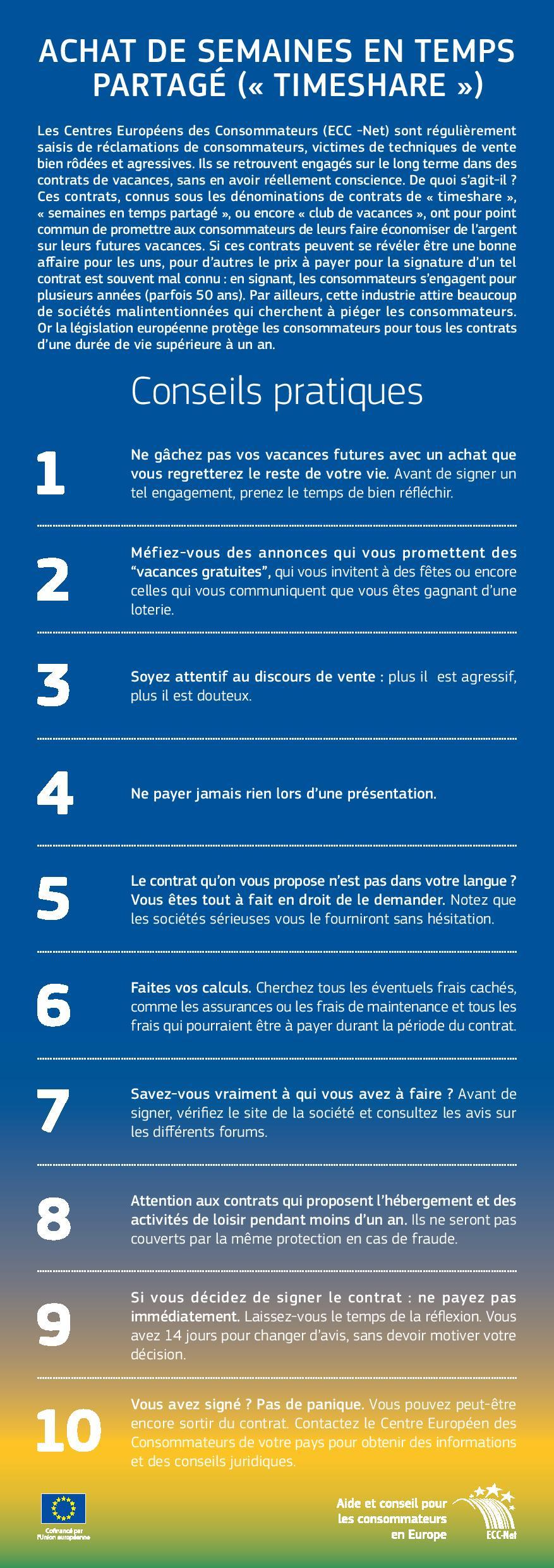
- Take the time to think it over. No legitimate offer disappears overnight. If you're pressured to sign immediately, that's a red flag.
- Don't pay anything during a presentation. No deposit, no registration fee, no "goodwill gesture" should be paid before the 14-day cooling-off period has expired. It's illegal.
- Check the seller's identity. Check online reviews, verify the company's legal existence, and look into its track record. Legitimate operators have nothing to hide.
- Demand the contract in your language. You have the right to receive all contractual documents in your own language. A seller who refuses or postpones this request isn't trustworthy.
- Do the full math. Purchase price, annual management fees, charges, mandatory insurance, exchange pool dues: add it all up. The real cost often far exceeds the advertised price.
- Be wary of contracts shorter than one year. They don't benefit from the same European legal protection. Some unscrupulous sellers deliberately exploit this loophole.
- Be alert to "gifts" and lotteries. A winning ticket, a free stay, an invitation to an exclusive presentation: these are classic aggressive sales techniques. They rarely bode well.
- Honestly assess your vacation habits. A timeshare only makes sense if you return to the same place every year, for many years. If your life is likely to change, the rigidity of the contract can become a burden.
- Don't count on an easy resale. The resale market is extremely limited. Don't sign banking on being able to get out quickly.
- If in doubt, get advice before signing. ECC Belgium offers free legal advice. A few days of reflection and an outside opinion can save you years of regret.
Timeshare: A Decision That Deserves Your Full Attention
Timeshare isn't an arrangement to systematically avoid. For certain profiles — vacationers loyal to a particular destination, comfortable with long contractual commitments, and attentive to financial details — it can deliver on its promises.
But it remains a major decision, often made under intense sales pressure. The traps are real, recourse can be complex, and regrets are common.
The best protection remains the same in every case: information before signing. Understanding what you're buying, knowing your rights, gauging the real commitment. That's what makes the difference between a contract you own and a constraint you endure for years.
If in doubt, don't wait. Check with the European Consumer Centre or the Federal Ministry of Economy before committing. These resources are free, reliable, and accessible to all Belgian consumers.
Already signed and have questions? You have 14 days to withdraw without justification. After that period, contact ECC Belgium to review your options.
Also read: A dispute while on vacation: how to react?
AI and Timeshare
Artificial Intelligence (AI) is making its way into every sector. In the timeshare industry, it offers several possibilities by improving offer personalization, booking optimization, customer service, fraud detection, and customer satisfaction analysis. It thus enables more efficient management and a better user experience.
However, it also carries significant risks. AI can reinforce aggressive sales techniques through consumer profiling, increase the collection of personal data, produce biased recommendations, and facilitate more sophisticated scams via fake websites, testimonials, or communications.
In short, AI can improve the efficiency and quality of timeshare-related services, but it doesn't solve the model's structural difficulties, such as contract complexity or the resale of shares. Its use should therefore be approached with caution and accompanied by guarantees of transparency, ethics, and consumer protection.
Frequently Asked Questions About Timeshare
First published: 04/2018 - Updated: 08/2026