At a glance
What are the regulatory dimensions for hand luggage? Which products are banned? What can you bring into the cabin?
What are the regulatory dimensions for hand luggage on a plane? What can you bring into the cabin? How do you choose a good hand-luggage bag? We give you some practical tips.
Hand luggage dimensions and weight
The IATA (International Air Transport Association) recommends that airlines apply the following criteria for the maximum dimensions of cabin baggage on a plane: a maximum height of 56 cm, a maximum length of 45 cm and a maximum width of 25 cm. These dimensions include pockets, wheels and handles. Ideally, the weight should not exceed 10 kg.
However, the size and weight of accepted hand luggage can vary depending on the airline, the type of aircraft, the seat class (business/economy) and the nature of the flight (short- or long-haul). It is therefore crucial to refer to the specific guidelines of the airline you are travelling with.
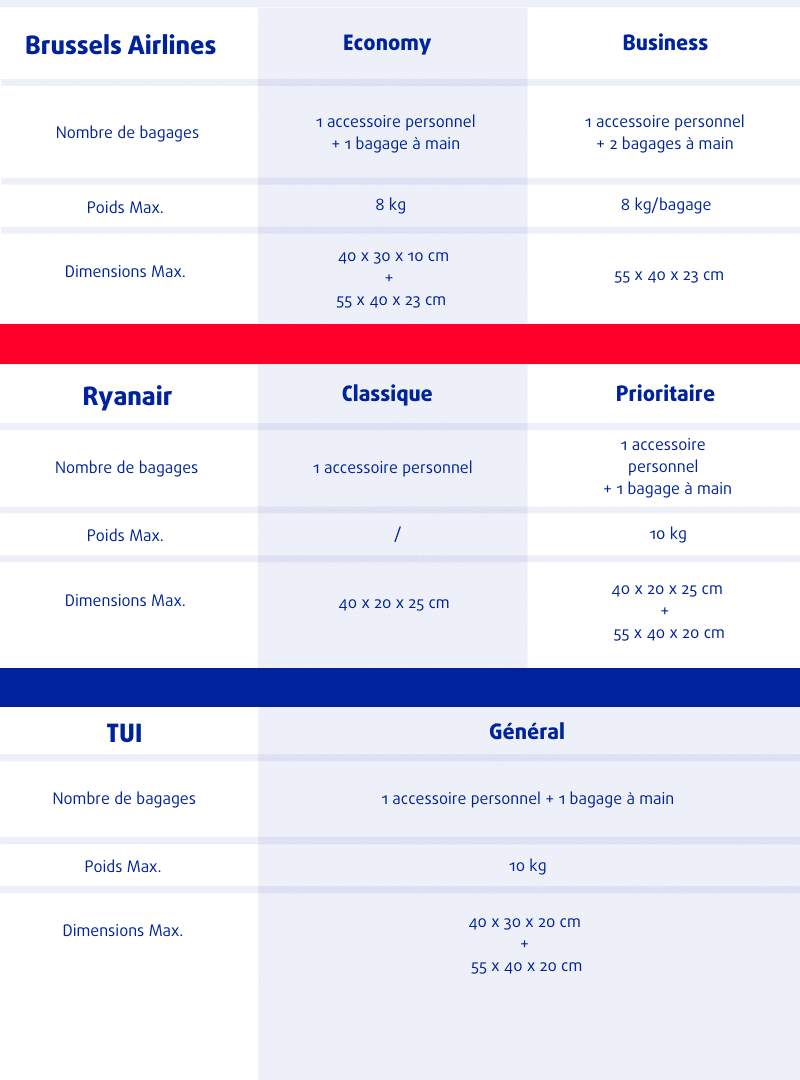
Here are the specific dimensions for a few major airlines in Belgium (valid at the time this article was published):
Types of cabin baggage and accessories
Handbags, laptop cases, and camera or video-equipment bags are considered "accessories". In some cases you are allowed to bring an accessory of less than 2 kg in addition to your hand luggage on the plane. But be careful, because here too there are exceptions. Some airlines, like many low-cost carriers, only allow a single piece of hand luggage, with any accessory counting as part of it. It is therefore advisable to check carefully before you leave. If that is the case, put any accessories into your hand luggage before boarding.
If you board with hand luggage that does not comply, you risk paying a penalty/surcharge or having it placed in the hold. Some airlines are also considering charging extra fees for cabin baggage, since many travellers now only travel with hand luggage and no longer check bags into the hold.
What can you put in your hand luggage on a plane?
Your medication: bring the medication you need for your trip in your hand luggage. Before you leave, check the recommendations of your airline or departure airport. Some (liquid) medications may be banned or subject to restrictions. The same applies to oxygen respirators and nebulisers.
Liquids, gels, shaving foam, etc. For safety reasons, several types of liquid products can only be carried in limited quantities and/or in specific containers. The rule given by Brussels Airport is not to exceed 100 ml per item and to place them in a resealable, transparent plastic bag with a total volume of 1 litre.
Items banned from the cabin
Certain products and items are banned from hand luggage. In most cases, the airline's or airport's website — for example Brussels Airport — will give you all the useful information.
Travelling with electronic devices? Be sure to follow these tips for security checks.
Bought some duty-free products?
If you carry them in their original packaging and they are properly sealed, they should not be counted as extra luggage.
Choosing good hand luggage for the plane
Good cabin baggage naturally meets the regulatory standards and dimensions (see above). Experience has also shown that, over time, a hard-shell bag is often sturdier and more resistant than a "soft" bag, sports bag or backpack. Choose hand luggage fitted with wheels so that you don't have to carry it throughout your journey through the airport.
Tip: when buying, check the number and usefulness of the bag's internal compartments, as well as the strength of its closure (especially if it is a zip) and of its wheels.
What about smart luggage?
Smart suitcases can recharge your electronic devices, act as a Wifi hotspot or connect via Bluetooth thanks to their built-in electronic system. Be careful if you are travelling with this type of luggage: some airlines ban them from the cabin because of their lithium battery, which can, among other things, cause overheating. Once again, check in advance to find out the conditions for accepting your bag or suitcase on the plane.
Keep your luggage within reach
Before you leave, make sure your hand luggage is labelled with a tag that can also include your address and phone number. This will help you find it again if it is lost.
*Also read: - "What to do in case of lost luggage?"
First published: 06/2016 - Updated: 04/2024