At a glance
What rules apply on cycle streets and in cycle zones? What should you watch out for when using them?
There are more and more cycle streets in our towns and cities. Specific traffic rules apply there.
What are these rules, and what should you watch out for when entering a cycle street or zone, whether as a cyclist or another motorised road user?
Our blogger Alain Dierckx explains.
What is a cycle street?
A cycle street is a street where cyclists can ride safely, because drivers of motor vehicles are not allowed to overtake them and must drive at a limited speed. Several adjoining cycle streets together form a cycle zone.
 How do you recognise a cycle street or cycle zone?
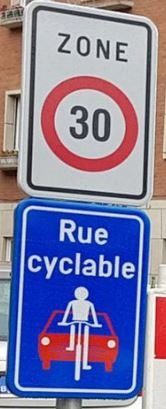
A cycle street is indicated by a specific road sign.
The end of a cycle street is generally no longer indicated by a specific road sign. A cycle street therefore always ends at the next intersection (or junction), unless it is located within a cycle zone.
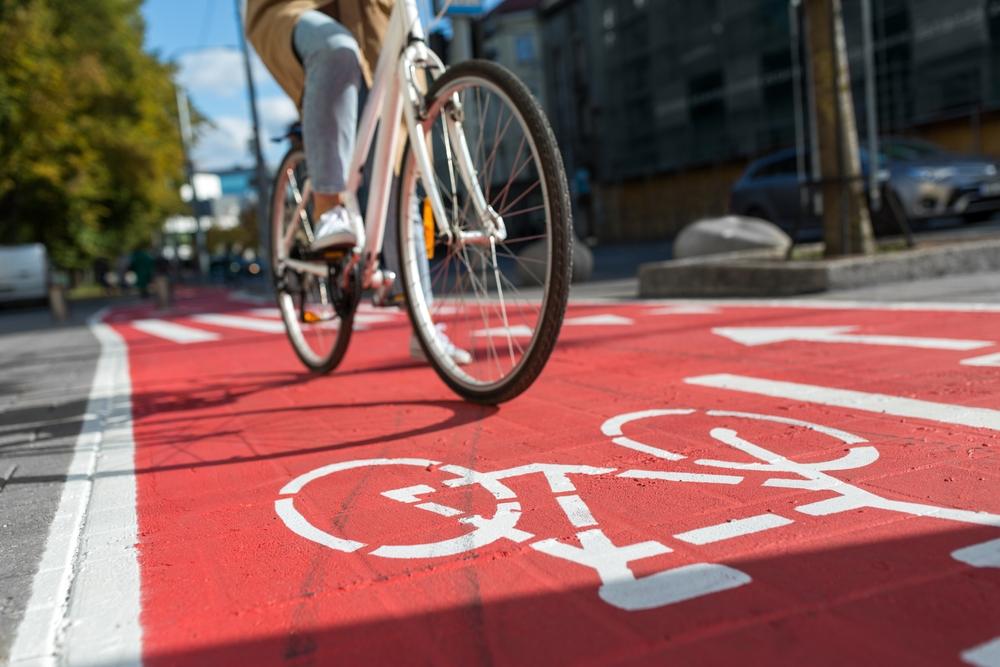
A cycle street can also often be recognised by the brown or red colour of the road surface and by the bicycle symbol painted on the road.
The difference between a cycle street and a cycle zone
A cycle zone is made up of several cycle streets. In some towns, these zones are quite large. In Kortrijk, for example, the entire town centre is one vast cycle zone made up of 75 adjoining cycle streets.
The start and end of a cycle zone are indicated by the road signs below.
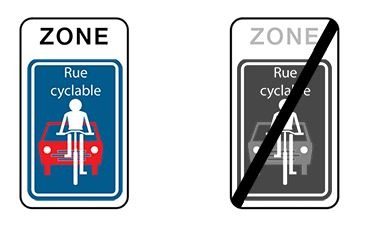
Traffic rules for drivers of motor vehicles
The 30km/h speed limit applies in every cycle zone/street.
Cars and other motor vehicles are allowed to enter them, but must therefore respect this speed limit in order to ensure cyclists' safety.
Overtaking cyclists is forbidden under all circumstances. Breaking this rule can result in a fine of 58 euros.
In a cycle street, normal parking rules apply, unless otherwise indicated by road markings or specific signs.
Traffic rules for cyclists
Cyclists don't have to ride one behind the other, and may use the full width of the road if they are riding in a one-way street. In a two-way street, they may use the full width of the right-hand lane.
Cyclists are allowed to overtake motor vehicles and other cyclists, but they must keep to the 30 km/h speed limit. This rule also applies to electric bikes, including speed pedelecs.
Right of way applies everywhere on cycle streets. A vehicle entering a cycle street from the right therefore has priority over cyclists, unless otherwise indicated by a road sign.
What are cycle streets for?
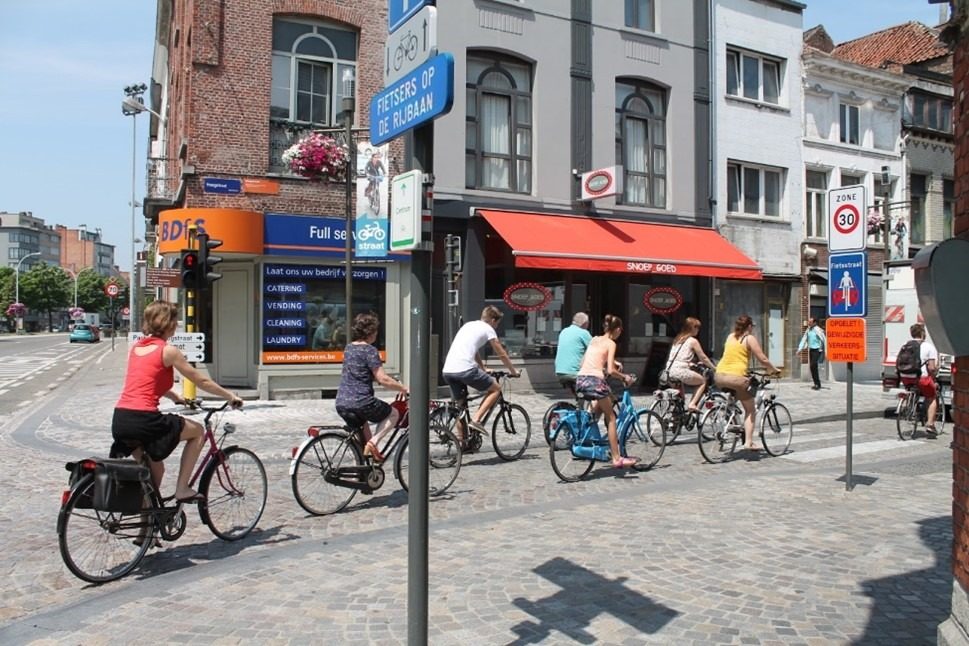 The aim of a cycle street is to improve the safety and comfort of cyclists in built-up areas. In some streets, it's impossible to create a separate cycle lane or widen an existing one. A cycle street can solve this problem. Creating cycle streets is of course also aimed at encouraging more people to cycle in towns and cities.
Slower traffic leads to a better quality of life and reduced air pollution.
Cycle streets in Belgium
In Dutch (and therefore in Flanders), a cycle street is called a "fietsstraat".
Cycle streets are appearing in more and more towns, including:
- In Brussels, the first cycle street was introduced on Avenue Louise (between rue Dalstraat and Place Stéphanie) in 2013. In 2024, a large cycle zone will be built in the neighbourhoods around the city's administrative centre. You can find more information here.
- In Ghent, Belgium's very first cycle street was built in 2011.
- There are also several cycle streets in Antwerp, Mechelen and Leuven.
- In Bruges, a cycle zone made up of 90 adjoining cycle streets has been created in the town centre.
- In Wallonia, cycle streets aren't yet as well established, but the concept is gradually gaining popularity. Cycle streets have already been built in Ottignies (1), Namur (more information here) and Liège (more information here), as well as in Mons.
Cycle streets abroad
- By 2013, Germany already had 140 cycle streets (Fahrradstrasse), making it Europe's pioneer in this field. The number has only kept growing since.
- In France, a cycle street is called a "vélorue", but there are still very few of them. Strasbourg, Bordeaux and Dijon are a few towns that have tried out the concept.
- Other countries such as the Netherlands, Switzerland and Spain are also increasingly developing this concept within their urban areas.
Want to be well protected while cycling? Then discover Redion's Bike assistance cover.