At a glance
Every year, Redion carries out a wide-ranging survey on how mobility is evolving among Belgians. Discover the latest results here.
The use of electric cars and soft mobility keeps growing in Belgium, but obstacles are still slowing down the transition.
Every year, Belgians' attitudes shift along with economic events, technological advances, and initiatives put in place by public authorities. That's why, since launching its first "Mobility Barometer" in March 2022, Redion has set itself the goal of surveying how Belgians perceive sustainable mobility and how willing they are to embrace the shift toward alternative modes of transport. The study takes into account the general perception of the population, as well as the differences between residents of urban and non-urban areas, and between different age groups.
Here are a few findings from the survey.
A few figures from the Mobility Barometer worth noting
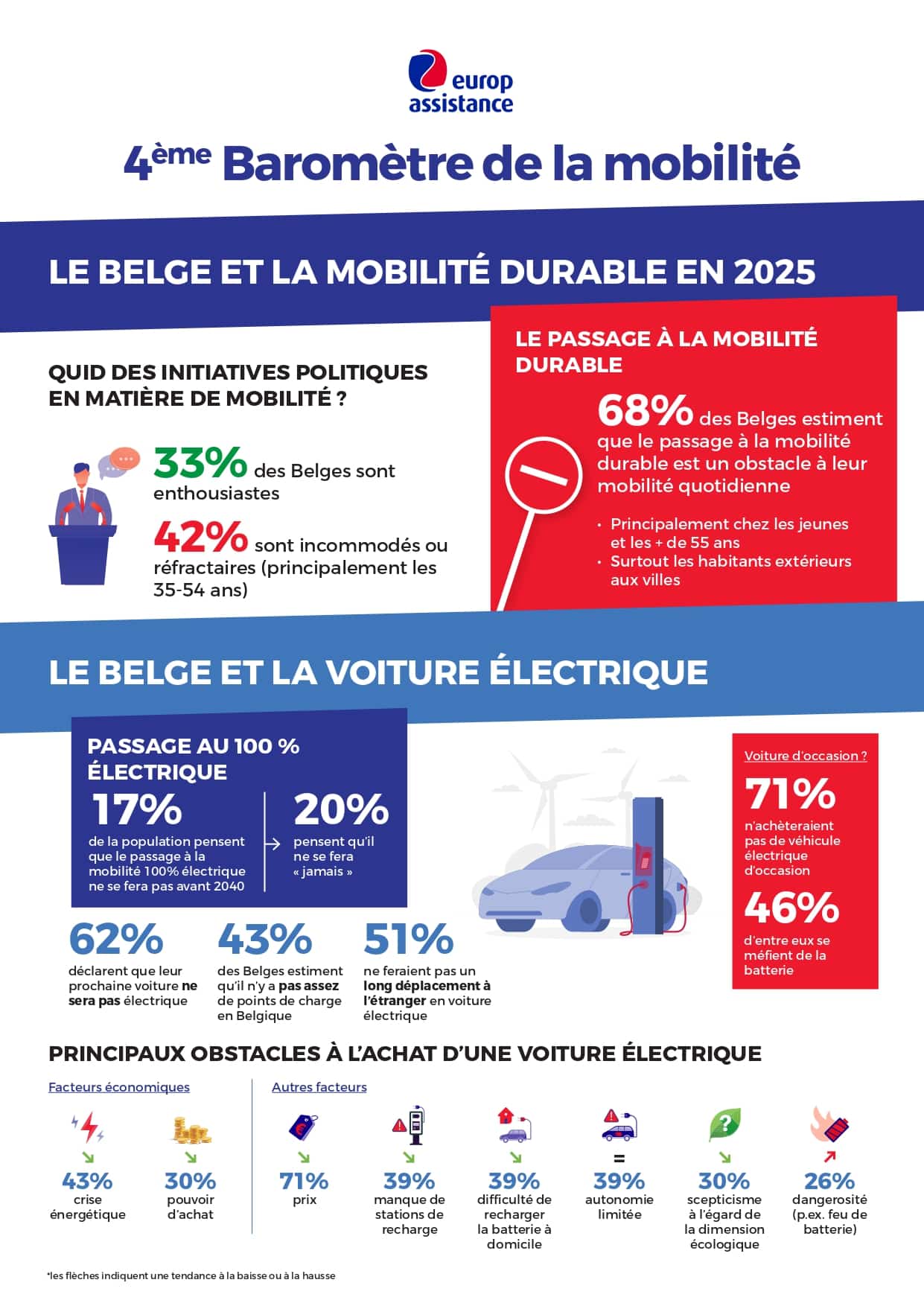
- 42% of Belgians are rather opposed to the political decisions taken regarding alternative mobility.
- 17% of Belgians think the shift to 100% electric mobility will happen by 2040.
- 62% of Belgians say their next car will not be electric.
- 71% of Belgians would not buy a used electric car.
- 43% of Belgians notice that the number of public charging points has increased in Belgium, but still find that number insufficient.
- 50% of Belgians find that soft mobility has improved in cities in recent years.
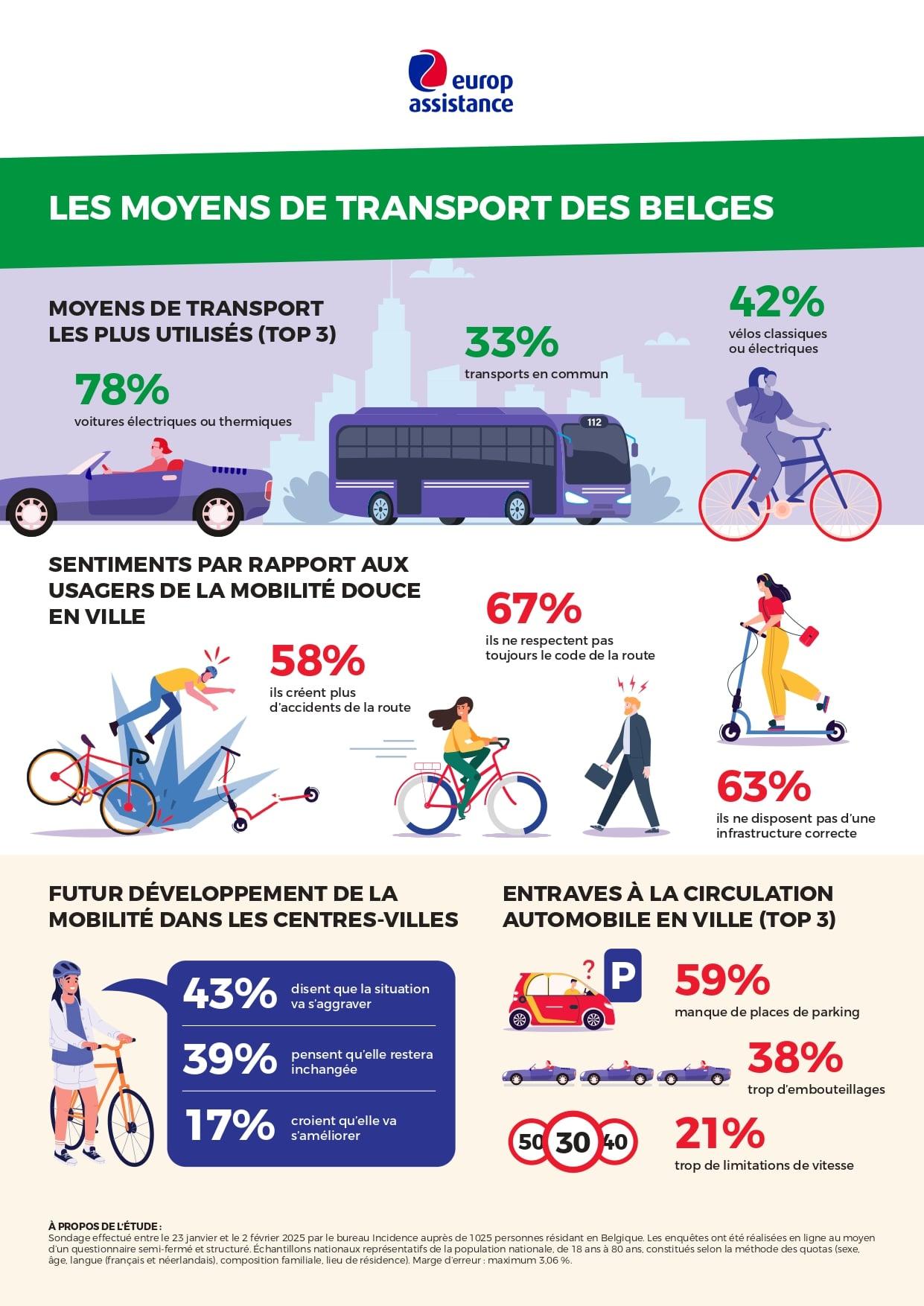
- 43% of Belgians believe that mobility in cities will get worse over the coming years.
Focus on the electric car
- 20% of Belgians believe the shift to electric mobility for new vehicles won't happen before 2035. The other respondents expect this transition to happen much later (2040: 17% / 2045: 12% / 2050: 10% / "never": 20%). Younger people are significantly the most optimistic, while over-55s are the most pessimistic.
- The next car for 38% of Belgians will be electric (-10 pts vs. 2024!). The majority will therefore continue to turn to combustion vehicles for their next purchase (62%, +10 pts). Those tempted by an electric vehicle make this choice out of environmental conviction (51%), because of a legal requirement (36%), or for professional reasons (15%). The difference in cost per kilometer also plays a role in this choice (17%, +9 pts).
- Belgians' reliance on their car remains high: 74% (+3 pts) of the population who own a car say they cannot do without it. And 52% (+5 pts) do not (yet) plan to make a long trip (such as a holiday) in an electric vehicle.
- The main obstacles to purchasing an electric car remain by far its price (71%, -4 pts), followed by the lack of charging stations (39%, -3 pts, an obstacle that is less pronounced year after year), and the difficulty of charging the car at home (39%, -3 pts). 26% (+5 pts) point to the "danger" of an electric vehicle (e.g. a battery fire) as an obstacle, a figure that rises as this type of problem is increasingly reported by users.
- The main incentive for taking the step toward buying an electric car is a lower purchase price (at the time of deciding to change vehicles) for 34% of Belgians (-13 pts). The price argument therefore carries less weight than last year. The same goes for government financial support (cited by 21% of respondents, i.e. -18 pts). Better road infrastructure could persuade 26% of respondents (-14 pts).
- The number of public charging points has increased in recent months. 43% of Belgians welcome this increase but still don't consider it sufficient. This perception is more pronounced on the Dutch-speaking side (47%) than on the French-speaking side (37%) of the country. 29% of Belgians see no difference in the number of charging points compared to last year. Access to a charging point abroad seems to have improved for only about a third of respondents.
- Are Belgians interested in a used electric car? To this question, 71% of Belgians say "no". 46% of them are wary of the condition of the used vehicle's battery, 41% simply don't want this type of vehicle, and 21% never buy used. The 29% of Belgians who say "yes" do so for budget reasons (85%), 23% out of trust in their garage/dealer, and 18% out of habit of buying used.
How is mobility evolving in urban areas?
-
Half of the Belgians surveyed find that soft mobility has improved in cities in recent years. 39% disagree. Those who note an improvement attribute it to changes to public roads (49%, -3 pts), to greater awareness among drivers (43%, +6 pts), to stronger enforcement against offenders (16%), and to safer means of transport (16%). However, safety in cities remains a sensitive point that deserves a great deal of attention from decision-makers.
-
24% of people do not feel safe in the city when getting around by soft mobility.
-
34% say they constantly have to watch out for drivers' behavior.
-
Only 11% have a genuine feeling of safety.
-
63% of users say that the layout of city roads doesn't allow soft mobility users to get around safely.
-
67% of survey respondents feel that soft mobility users don't always follow the highway code correctly.
-
As for drivers getting around in cities, the biggest obstacles to their trips are the lack of parking spaces (59%), traffic jams (38%), having to drive through zones with (strict) speed limits (21%), or having to follow imposed routes (19%). Overall, 43% of respondents believe that mobility will get worse in cities over the coming years.
The full press release as well as the complete presentation are available on request.