At a glance
Throughout this guide, you'll discover all our tips for a stress-free trip. Activities by age group (including for babies), screen-free games that will captivate your little ones, and how to prepare a memorable travel bag: we hope you'll find plenty of inspiration along the way!
The countdown has begun. The suitcase is in the boot, the kids are strapped into their seats, everything's ready to go... And ten minutes after leaving, that dreaded question inevitably comes up: "Are we there yet?" You know it as well as we do: keeping kids entertained in the car is a real challenge. Yet with a bit of organisation and a few ideas, the journey can become part of the holiday itself, and something everyone enjoys.
The best activities to keep kids entertained in the car, by age
1. How to keep a baby entertained in the car (up to 2 years old)
This is the age group that guides most often overlook, probably because the solutions are less spectacular. A baby has a very short attention span and can't yet take part in verbal games. The main challenge is simply not letting discomfort set in.
Here are a few approaches that work well to keep a baby entertained in the car:
- Sensory toys. Rattles, teething toys, fabric books with different textures: what matters is that baby can grab and handle them alone, without the object disappearing under the seat at the first bump;
- Nursery rhymes and a parent's voice. At this age, a parent's voice remains one of the best tools there is for capturing a baby's interest. Singing, naming what you see through the window, talking about anything at all: this often captivates far more than a toy;
- Watching through the window. The passing scenery, the changing light, the trees going by: even a very young baby can stay fascinated for quite a while. Pointing at and naming things is enough to turn this into a real activity;
- Respecting sleep cycles. On a long trip, the steady rhythm of the road often helps babies drift off to sleep. Leaving at nap time and recreating the usual conditions (dim light, white noise, soft music) is also a good idea.
2. Keeping 2 to 4 year olds entertained in the car: stimulating without exhausting
At this age, five to ten minutes on the same activity is already a lot. Children need guidance and to change stimulation regularly: the goal isn't to find the miracle activity that keeps them busy for two hours, but to have enough in reserve to move smoothly from one to the next.
- Water colouring books. These books, which use a felt pen filled with water, make colours appear as if by magic, with no risk of staining the back seat. And once the water evaporates, you can start all over again!
- Reusable stickers. They can be used quietly and many times over, and are also good for fine motor skills. They can keep a child busy far longer than you'd think, especially if the themes change throughout the trip;
- Narrated window-watching. "Do you see the red tractor? And the horse over there?" These simple, free interactions are remarkably effective at an age when anything that moves is fascinating;
- Family singing. Repeating, clapping, acting out the lyrics: at 3 years old, singing together is a real activity in its own right. A well-chosen playlist of nursery rhymes can carry an entire trip;
- Compact toys to handle. Figurines, small cars, soft toys: these are also very popular.
3. Car games for 5-8 year olds: the golden age of verbal games
This is the ideal age for chatting and imagining. Children can stay focused for longer than toddlers, they like challenges, and they can play without any equipment. For example, you could try:
- "In my suitcase, I have..." A classic memory game that can go on for a long time and works with the whole family, whatever the age gap between players;
- The story you finish. An adult starts a sentence, the child continues it. The result is almost always unexpected, often absurd, and children usually love it;
- Guess what I'm thinking of. You think of an animal, an object or a character, and the others ask questions that can only be answered with yes or no. This equivalent of 20 Questions is perfect for learning to reason by deduction;
- The surprise bag. You can hand out small objects wrapped in kraft paper throughout the trip, to keep that sense of discovery going and captivate the children;
- The erasable whiteboard. A must-have, as it allows for endless drawing, erasing and starting over. If you have several children, this even lets you play a kind of Pictionary, with everyone trying to guess what the artist was drawing;
- Magnetic games. Tackling a magnetic tangram, whose pieces won't scatter around the car, is a way to get creativity flowing even on the road.
4. How to keep 9-12 year olds entertained: challenges that get them thinking
At this age, children can occupy themselves far more independently and enjoy activities that really challenge them. It's the perfect time to appeal to their curiosity and competitive streak.
- The homemade quiz. Prepare several questions in advance on different topics (geography, animals, sport, cinema) and play in teams or head-to-head for miles! Apps can also be used for this;
- The number plate game. Forming words from the letters, adding up the numbers, finding a celebrity matching the initials: the same plate can fuel three different games depending on the mood;
- Categories, spoken aloud. A letter is picked at random and a category announced: the first to find a valid word scores a point. You don't need any paper or equipment: only your reflexes count;
- Audiobooks and podcasts. From around age 8-9, a good story can easily become an enjoyable activity in itself. Indeed, many children's literature classics are now available in very well-produced audio versions;
- Activity books and holiday workbooks. Mazes, word searches, spot-the-difference, logic puzzles: you can buy books in shops or print out loose sheets the night before departure, and that's it sorted!
5. Keeping teens entertained in the car: involve them without forcing them
If you try to force activities on your teens to keep them entertained in the car, you risk putting them off entirely. The key is to offer, not impose. Shared music where everyone picks a song in turn, the family blind test, card games and podcasts are all opportunities for moments together that don't feel like organised activities.
And periods of "everyone in their own bubble" (a book, an e-reader, music with headphones, handheld consoles) are just as valid. A teen quietly reading for two hours is a great outcome too!
Verbal games to play in the car: free, screen-free, no preparation needed
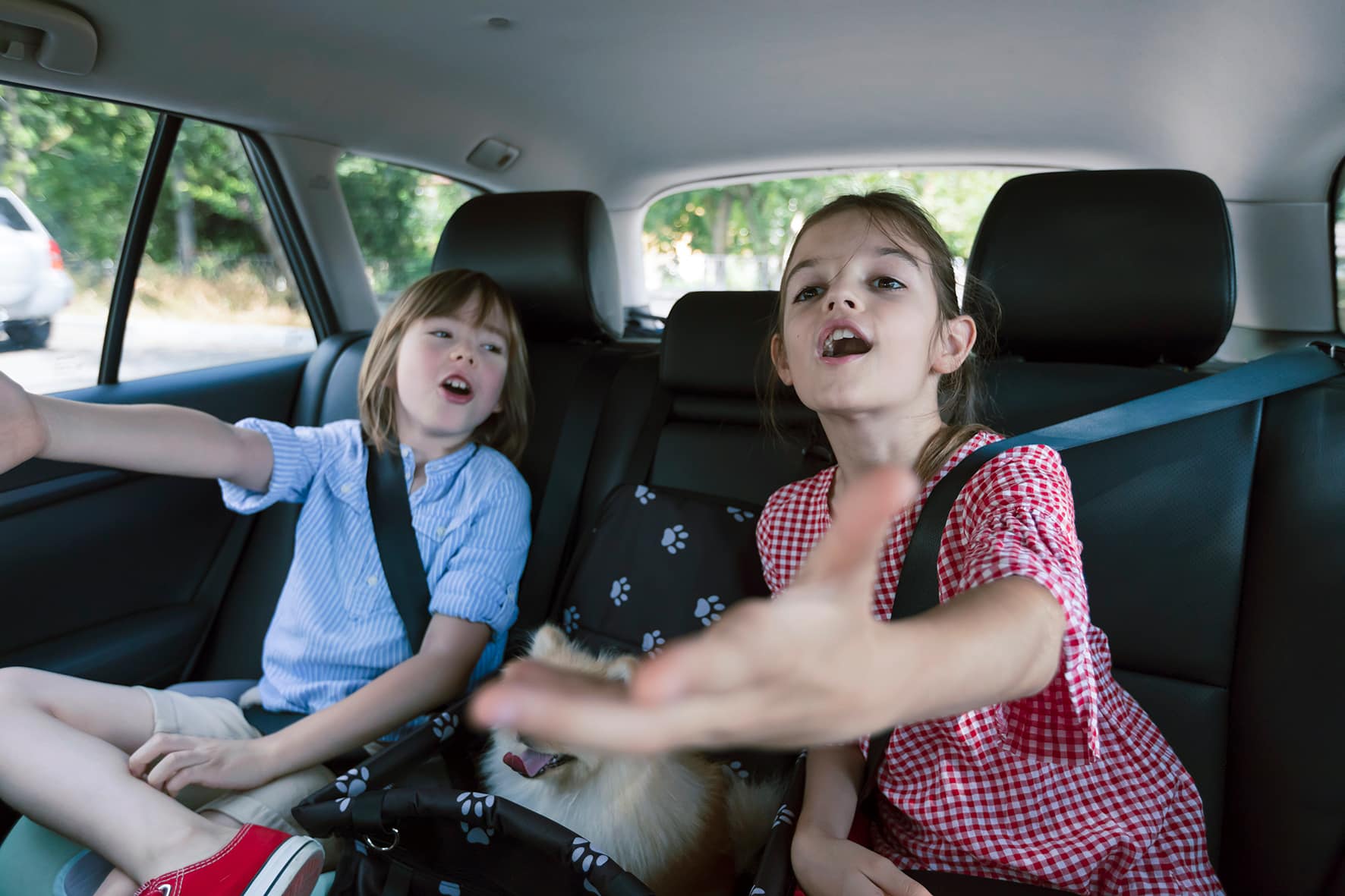 These are probably the most popular screen-free car activities, because they involve everyone and literally require nothing. Here are eight tried-and-tested favourites:
- In my suitcase... The first player says "In my suitcase, I have an apple." The next repeats it and adds an item, and so on until someone gets muddled. How long a round lasts depends entirely on everyone's memory;
- The never-ending story. One player says a sentence, the next adds another: the result is always unexpected, often absurd, and children keep asking for more;
- Guess what I'm thinking of. Someone thinks of something (animal, object, character) and the others ask closed questions (yes/no). This is perfect from age 4 with simple themes, and allows for more creativity if you're playing with teens.
- The silence game. Who can last the longest without saying a single word? It's fun, and children love the competitive side. Even better? For adults, it often means three minutes of hoped-for peace and quiet.
- Neither yes nor no. Questions are asked to everyone in the car, who must answer without ever using "yes" or "no". You're likely to have a good laugh!
- Categories, spoken aloud. A letter and a category are given (an animal starting with B, a name starting with I, a country starting with T...): the first person to find a valid word scores a point;
- First one to spot... This observation challenge is called out to everyone (the first person to spot a black and white cow, an orange car, and so on).
Creative and hands-on activities to bring in the car
For children who need to do something with their hands, a few objects can make all the difference:
- The erasable whiteboard or LCD tablet. These allow for endless drawing, writing and erasing, with no loose sheets flying around or lost caps. They can be used from a very young age and are appreciated well beyond that;
- Magnetic games. Tangrams, puzzles, mazes: the pieces stay together, nothing falls, no one cries. It's an investment that pays for itself many times over on a holiday trip;
- Reusable stickers. They can really last a long time, especially if the themes change throughout the trip. Bring a generous supply so the activity genuinely lasts;
- A bought activity book or sheets printed at home. Mazes, spot-the-difference, word searches, themed colouring pages: ten minutes of printing the night before is enough to put together a small personalised booklet suited to the age group;
- Water colouring books. They carry no risk of staining and produce an almost magical effect that 2-6 year olds never tire of rediscovering.
Be careful if your child is prone to motion sickness: activities that involve a fixed gaze, such as reading or colouring, can make symptoms worse. In that case, favour verbal games and audio stories (see the dedicated section below).
Audiobooks and podcasts: the screen alternative that really works
Audio stories in the car are often a top choice for the road, and not just for children. They leave the eyes free to look out the window (which is helpful for avoiding car sickness) and create a pleasant, shared atmosphere in the car, far removed from the "everyone on their own screen" approach.
A few formats that work well:
- Digital storytellers. Children choose their own stories on these, giving them real independence and keeping them entertained far longer than if you chose for them;
- Podcasts for children. There are many available in French, covering a wide range of topics (science, mythology, history, adventure). Remember to download episodes before you leave in case the connection is unreliable on the road;
- Audiobooks. For 9-12 year olds and teens, a good story can easily hold their attention for two to three hours. Many children's literature classics are now available in very well-produced audio versions;
- The shared playlist. Each family member picks a song in turn. It's simple, fair, and often brings everyone together.
Should you avoid screens in the car? What you really need to know
The honest answer is that you can use screens, with discernment.
They are indeed convenient and effective at holding children's attention. However, watching a tablet or phone in the car fixes the gaze on a static object while the body and inner ear perceive movement: this is exactly what can cause motion sickness in children. For those who are prone to it, a tablet on a winding mountain road can quickly turn into a disaster.
For those who tolerate them well, a few practical principles apply:
- alternate 30 to 40 minutes of screen time with a verbal or hands-on activity, as children are generally much less restless on arrival with this rhythm;
- offer interesting content that has been chosen in advance by parents, if it's aimed at young children;
- favour audio content over visual content if the route is winding or motion sickness is a possibility.
In short, it's all a matter of balance. Even though screens can overstimulate a child over a long period, if their use is kept in check, they still offer some quiet time for the driver.
Preparing well for a car trip with children
Preparing the travel bag
A few minutes of preparation the night before can change the whole dynamic of the trip. The idea is simple: a bag, or a pouch hung on the back of the front seat, that brings together everything the children will need, within easy reach, without having to dig through the boot at the first red light.
The surprise bag trick deserves a special mention. It involves wrapping 3 or 4 small items (toys, activities, even new snacks) and handing them out throughout the trip. The novelty effect works even with very cheap items: it's the surprise that creates the excitement.
Organising the space inside the car
A well-organised car interior avoids a good deal of tension. Each child has their own space and their own things, which is especially important when there are several children of similar ages, where the slightest encroachment can turn into a conflict. Seat organisers, those pouches that hang on the back of the front seat, are very useful for keeping toys, water bottles and snacks within reach of little hands without constantly needing an adult.
Choosing the right time to leave
Leaving at nap time for younger children, or in the evening for families with babies, lets you cover a good part of the trip while the children sleep. This is particularly effective up to the age of 4 or 5. For night trips, remember to set up a minimum of comfort in the back: a blanket, a soft night light, a favourite cuddly toy.
For daytime departures, planning regular breaks in the car every 1.5 to 2 hours is essential with young children (and for adults too!). Children need to burn off physical energy, and pushing on without breaks often creates tension that isn't worth the time saved. At motorway service areas, some play spaces let children really let off steam: scouting out these areas in advance on your route only takes a few minutes.
Breaks on the road: why they're essential (and how to make the most of them)
Breaks aren't wasted time: they're an integral part of the trip. Sitting still for too long creates frustration and restlessness, and in adults, a driving fatigue that isn't always felt. We recommend taking a break of at least 15 minutes every two hours at most.
With children, planning a break every 1.5 hours is more realistic. To stop the break itself becoming a source of frustration, you can turn it into a mini-adventure with an observation challenge at the rest area, an improvised gym session on the grass, or a picnic. Remember to scout out rest areas with play equipment for children along your route in advance, as they really aren't all equal.
Protect yourself in case something unexpected happens!
A family car trip also comes with unexpected events. A breakdown on the motorway, a minor collision, a child getting hurt while running around at a rest area, a stomach bug striking at the worst possible moment: all of these can quickly become stressful, especially away from home or abroad.
Thinking about how to organise the trip is good. Thinking about cover in case something goes wrong is just as important, and it's something you sort out before you leave.
Going away as a family this summer? Before hitting the road, check your travel assistance cover. In the event of an accident, illness or unexpected medical issue during the trip, Redion arranges your care 24/7.
To go further in preparing your family trip with children, also read our other articles:
FAQ - your questions about long car trips with children
At 2 years old, attention spans are relatively short and impatience can set in quickly. So focus on sensory objects to handle (fabric toys, small figurines, board books, plastic keys and musical toys, if your ears can take it), family sing-alongs, or narrated observation of the scenery and vehicles. Water colouring books are also suited to this age, and thankfully, mess-free!