At a glance
The car insurance certificate (green card) has changed colour. Which countries does it cover? Should you always keep it in the car?
The international motor insurance certificate, better known as the "green card", became a white document as of 1 July 2020. Since that date, it can also be issued in digital format.
What is the car insurance certificate?
Which countries does it cover?
Should you always have it with you when driving?
What is the car insurance certificate?
Before 1 July 2020, the car insurance card or certificate was a green document, printed on both sides. Since that date, the document has become white and is only printed on one side.
Insurers may issue this document in digital form.
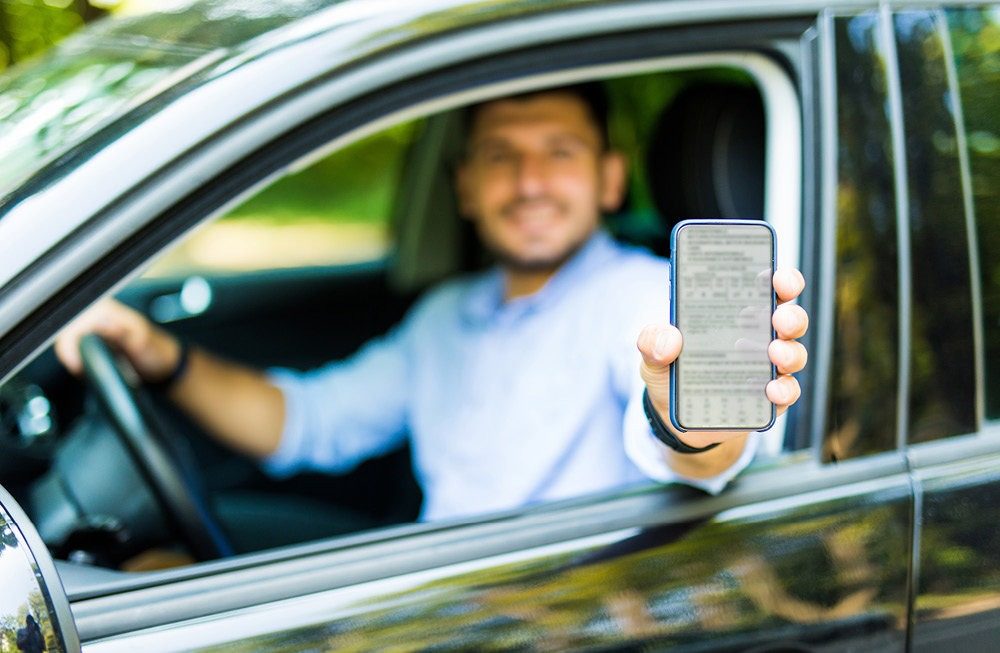
This certificate is proof that you are covered by car insurance. It is issued by your insurer once your premium payments are up to date. As with the old green card, the car insurance certificate is only valid for a limited period, stated on the document. It lists the countries in which your insurer covers your liability. It also states your insurance contract number, which will be useful in the event of an accident when filling in the accident report.
It is one of the documents that may be checked directly by local authorities, both in Belgium and in the countries you travel through with your vehicle.
Some countries (including Spain, Poland, Croatia and Germany) require this certificate to cover trailers and caravans weighing more than 750 kg.
The old "green cards" and the new white certificates will coexist until 31 December 2021. If you still have a green card after 1st July 2020, there is no need to worry. Your insurer will give you a white copy or a digital version at the next renewal of your contract, once you have paid the premium.
Where is the insurance card valid?
Motor insurance certificates issued for vehicles registered in one of the member states of the European Economic Area (EEA) must cover the entire EEA territory. However, your insurer may cross out certain countries.
The member countries of the European Economic Area: Austria (A), Belgium (B), Bulgaria (BG), Cyprus (CY), Czech Republic (CZ), Denmark (D), Spain (E), Estonia (EST), Finland (FIN), France (F), Germany (D), Greece (GR), Hungary (H), Ireland (IRL), Italy (I), Latvia (LV), Lithuania (LT), Luxembourg (L), Malta (M), Netherlands (NL), Poland (PL), Portugal (P), Romania (RO), Slovakia (SK), Slovenia (SLO), Spain (E), Sweden (S), United Kingdom (GB), Norway (N), Iceland (ISL) and Liechtenstein (FL).
For the following countries, there are bilateral agreements with Belgium regarding car insurance (they must therefore also be covered by the insurance card of a vehicle registered in Belgium): Croatia (HR), Morocco (MA), Switzerland (CH), Tunisia (TN), Turkey (TR), Serbia (SRB).
What if the country I'm travelling to isn't covered?
If the name of the country you want to travel through is crossed out on the insurance certificate, we recommend contacting your insurer to check whether it is possible to take out an extension of cover.
In some countries, it is possible to take out temporary car insurance at the border. If you would like to use this option, make sure to enquire well in advance with the authorities of the country concerned (consulate) about rates, deadlines and procedures. This will help you avoid being caught off guard.
Do I always need to carry the insurance card with me?
- In the event of a check, you must always be able to present the insurance card. It is a mandatory on-board document, just like the vehicle registration certificate, the certificate of conformity and the roadworthiness test certificate. In practical terms, this means you must always be able to present the certificate, either as a printed copy (paper version) or in digital format (e.g. on your smartphone).
However, we recommend always keeping a printed version in the vehicle, as some countries do not recognise the digital version or are very reluctant to accept it. In addition, you could run into trouble if the digital document saved on your smartphone or other digital system is inaccessible or has been deleted, or if another driver uses the vehicle without access to this document.
Note: Also keep the certificate with you if you ride a moped or motorcycle.
- If you receive the card in digital form, print it out and make sure that every potential driver of your vehicle has or has access to a (digital) copy.
- The insurance card is also one of the documents you must be able to present during the vehicle's roadworthiness test.
- Always travel with your European driving licence, or – if necessary – an international driving licence.
- Don't forget to bring one or more copies of the European accident statement form.
- Make sure you have good cover for you and your vehicle in case you are left stranded following an accident.
Useful link: https://economie.fgov.be/fr/themes/services-financiers/assurances/auto/rc-auto/preuve-dassurance-la-carte
Photo © FPS Economy