At a glance
Discover the results of Redion's 25th Holiday Barometer: where Belgians will spend their holidays and what their budget will be.
For the 25th time, Redion, in partnership with the polling institute Ipsos*, has carried out a major survey on the intentions and concerns of Belgians and Europeans regarding their summer 2026 holidays. Discover the main results below.
They cover:
- Travel plans, duration and frequency
- The enthusiasm of Belgian holidaymakers
- Criteria for choosing travel destinations
- Destinations and types of holidays
- The average holiday budget
- AI use, the impact of ecology and taking out insurance
- Survey results at international level
Travel plans, duration and frequency
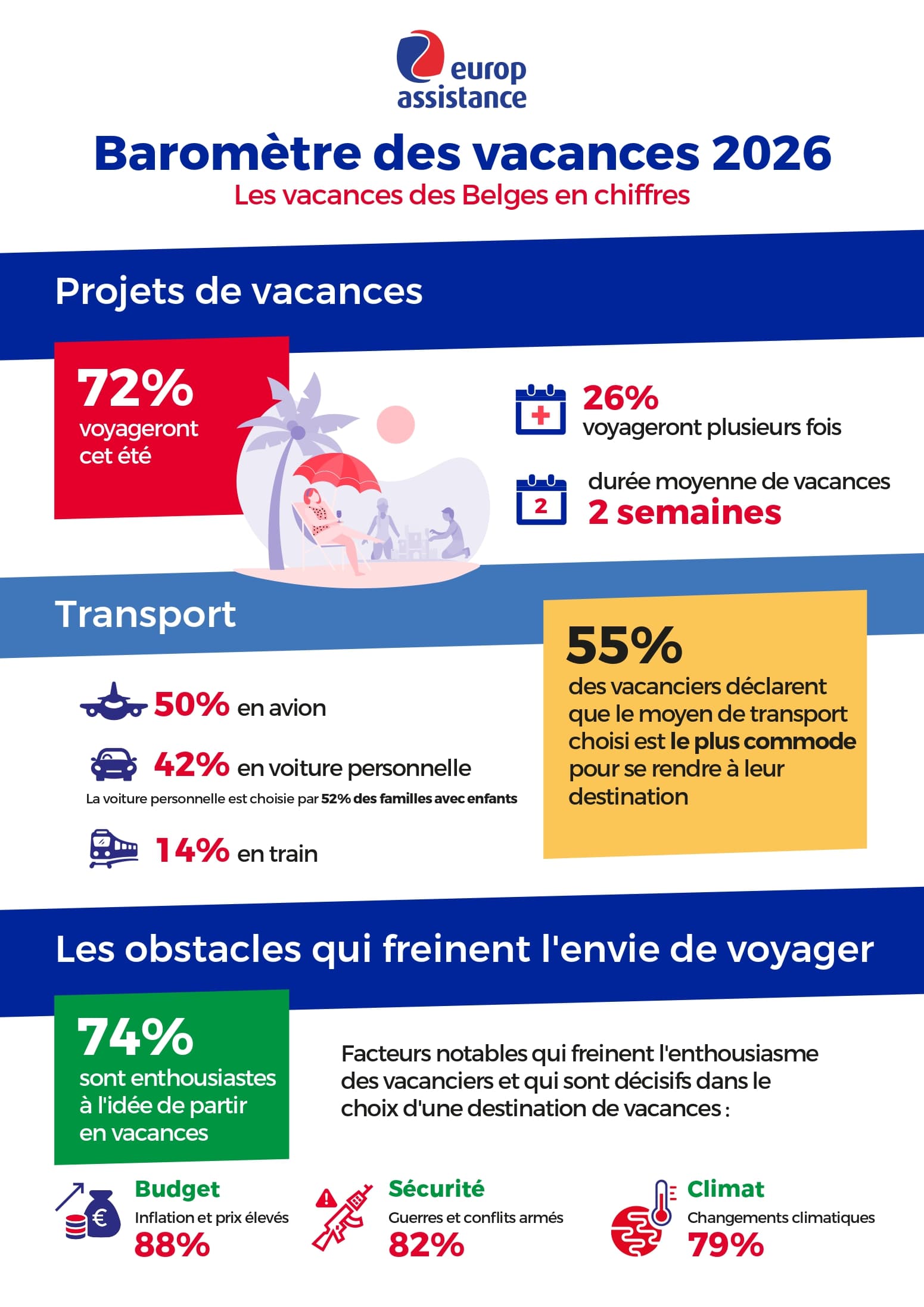
- Holiday plans: 72% of Belgians say they will travel during summer 2026. This percentage remains high despite the uncertain geopolitical period (conflict in the Middle East). It stood at 73% in 2025.
- Length of trip: short holidays (one week maximum) are popular with 42% of Belgian travellers, followed by two-week holidays (38%) and holidays of three weeks or more (23%).
- Frequency of travel: among the 72% of Belgians planning to go on holiday this summer, the majority (46%) say they will only go away once. 26% of travellers will go on holiday several times. 28% say they will not travel between June and September. July is the preferred holiday month for 38% of travellers.
The enthusiasm of Belgian holidaymakers
-
Belgians are still just as enthusiastic about going on holiday: no less than 74% of Belgians say they are (very) enthusiastic about going on holiday in summer 2026, although this figure is slightly lower than last year's. Some factors nevertheless have a direct impact on this enthusiasm.
-
First, the impact of inflation and high prices (for 88% of Belgians).
-
Second, geopolitical reasons (including armed conflicts), which have taken precedence over other types of concerns (82%).
-
Climate change is the third factor (79%). Many Belgians fear that their holiday destination will be affected by heatwaves, extreme weather conditions and the resulting inconveniences.
-
Finally, other inhibiting factors, such as personal or family reasons (78%), are also mentioned. These reasons are traditionally cited every year.
Criteria for choosing travel destinations
Three key factors determine the choice of holiday destination:
- Safety (general and personal) and the associated geopolitical context. This criterion has become more of a priority than ever in the current global climate.
- Climate: Belgians are looking for sunshine, but global warming and the risk of extreme weather conditions are also influencing their choices.
- Cost of living, crowds and local language or culture are more traditional criteria that also influence the choice of holiday destination, particularly when these costs have a direct impact on the holiday budget.
Destinations and types of holidays
- 76% of Europeans surveyed say they will spend their holidays in Europe.
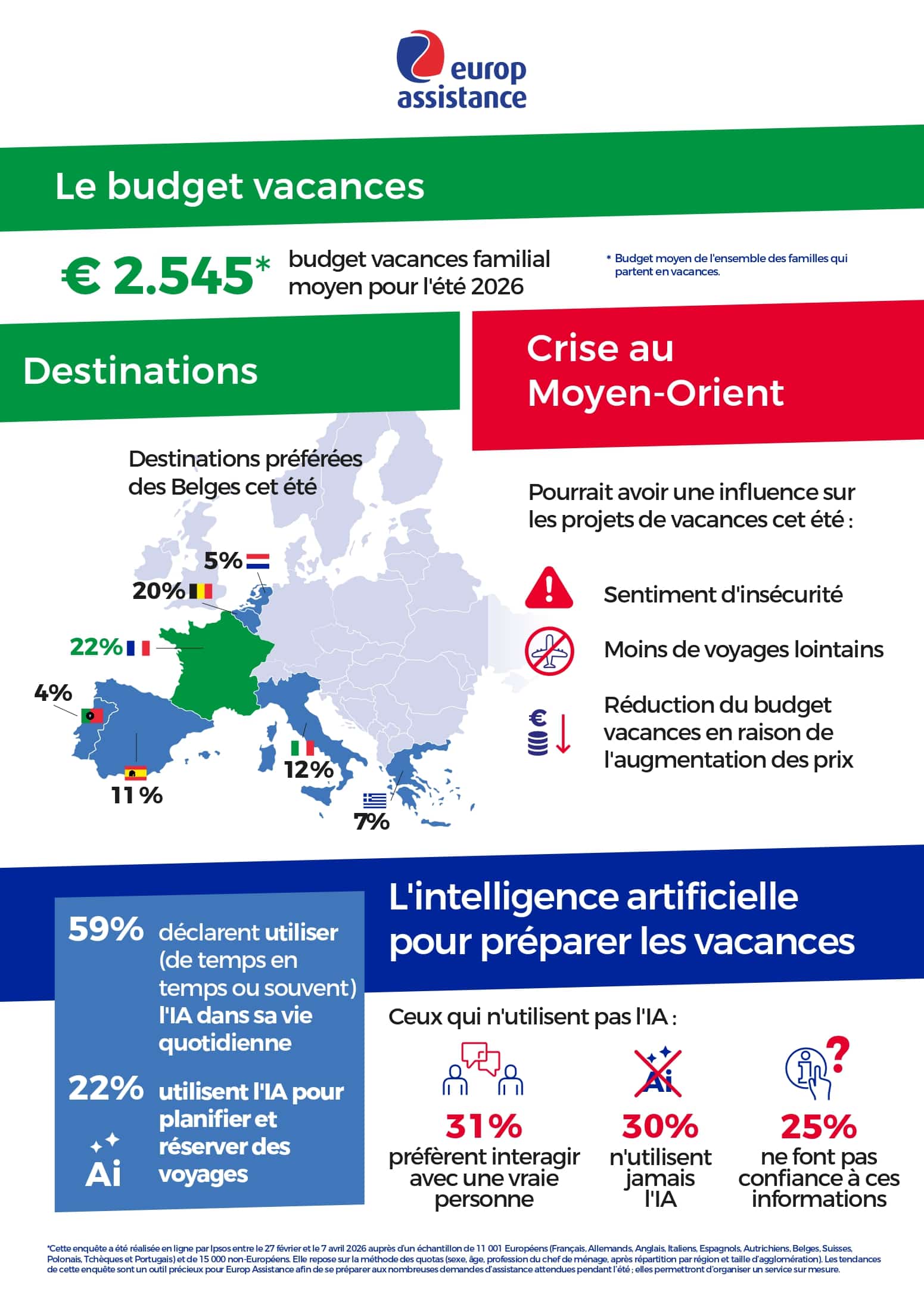
- Among the most popular destinations for Belgians, we invariably find France (22%), Belgium (20%), Italy (12%), Spain (11%) and Greece (7%).
- 40% of Belgians choose a holiday destination because they like its favourable climate. 39% say they systematically choose the same holiday destination because it is familiar to them. 31% choose their destination based on the range of leisure activities on offer.
- Among the destinations Belgians want to avoid this year, we find countries currently experiencing armed conflict or an unstable political situation: Iran (15%), Israel (11%), Russia (8%) and Afghanistan (7%). The United States is also explicitly avoided by some (10%).
- Belgians still prefer to spend their holidays at the coast (64%). City trips attract 29% of holidaymakers this year. Countryside holidays (22%) and mountain holidays (20%) are also popular with Belgians.
- Modes of transport to reach the holiday destination: a personal car is the most popular mode of transport for 42% of Belgians. Air travel is used by 50% of holidaymakers. 14% choose the train and 10% the bus.
The average holiday budget
- The average holiday budget for Belgians in summer 2026 (i.e. the average across all types of households) is €2,545. In 2025, it was €2,710. The average holiday budget in Europe is €2,089.
Travel, artificial intelligence and ecology
AI in holiday preparation:
- 22% actually use AI to plan and book trips, an increase of 5 points compared to last year.
- Some people remain very reluctant to use AI, either because they prefer to interact with a real person (31%), because they never use AI (30%), or because they don't trust AI (25%).
- Travellers who use AI to plan and book their holidays do so to get information about their activities (87%), their destination (85%), their travel itinerary (85%), their transport (71%) and/or their accommodation (66%).
- Ecological footprint: 29% of Belgians are concerned about their ecological footprint when travelling and therefore choose more environmentally friendly travel service providers, accommodation or modes of transport.
Travel and insurance
- Insurance/assistance cover for Belgian travellers: the majority of Belgians are insured in case of medical problems during their trip (81%) and for issues related to their (holiday) accommodation (72%) or a breakdown of their vehicle (76%).
Survey results at international level
Globally, holidaymakers' travel intentions remain strong, even though safety concerns are playing an increasingly important role in travel decisions.
- Globally, around 8 out of 10 respondents say they are enthusiastic about travelling this year. After last year's record figures, travel intentions have stabilised at a high level in 2026 and remain well above those of 2022 and 2023.
- The peak reached last year is therefore holding steady, despite an unstable global geopolitical context and the fact that the cost of living remains a major concern worldwide.
- In Europe, 30% of respondents cite safety as one of the reasons motivating their choice of destination. Safety has now become the most important criterion in choosing a destination for respondents in North America (32%) and North Asia (37%).
- The United Arab Emirates is among the top 5 destinations travellers would avoid because of the political climate. Asia is losing ground as a destination region among Europeans. The same trend is observed for North America. These developments most likely reflect the direct impact of tensions in the Middle East, particularly the conflict in Iran, as well as the disruption affecting several major airport hubs in the Gulf region.
Artificial intelligence is reaching new heights in travel planning, with its adoption accelerating considerably across all markets, confirming its growing role in travel planning worldwide.
- In India, around seven out of ten respondents say they have already used AI to prepare a trip. This figure stands at 60% in the United Arab Emirates, 54% in Malaysia and 54% in Saudi Arabia, but the percentages remain significantly lower in Europe and North America (24% in each region).
- This trend is also reflected in future usage intentions: 79% of respondents in India and 70% in the Middle East say they are considering relying exclusively on AI to plan their trips, compared to just 26% in Western Europe and 27% in Oceania.
Ms Virginie Babinet, CEO of Travel Insurance & Assistance at Redion, states: "Continuing the record figures of last year, the desire to travel remains strong and unchanged, despite tougher choices and the fact that the cost of living remains one of the main concerns worldwide. What is changing, however, is the travel landscape itself. Safety considerations weigh more heavily in the choice of destinations, with decisions increasingly being driven by risk awareness. At the same time, artificial intelligence has now become a fully-fledged planning tool for a growing share of travellers around the world, and it is rapidly gaining popularity, particularly in emerging, high-growth markets."
*About the survey: This survey was carried out online by Ipsos between 27 February and 7 April 2026 among a sample of 11,001 Europeans (French, German, English, Italian, Spanish, Austrian, Belgian, Swiss, Polish, Czech and Portuguese) and 15,000 non-Europeans. It is based on the quota method (gender, age, occupation of the head of household, after distribution by region and town size).