At a glance
What is a roof tent? Can it be fitted on any car? Can you sleep in it anywhere? Here are a few tips and tricks.
What is a "roof tent"? Is it easy to set up? Can it be put on any car? Can you spend the night in it anywhere?
Our blogger Alain Dierckx gives us some good advice.
A roof tent perched above your car
If you enjoy travelling by car and don't want to spend the night in a hotel or rent an expensive motorhome, a roof tent can offer you an alternative.
A roof tent is a sleeping tent fixed to the roof of the vehicle. This option gives you a lot of freedom when travelling.
Roof tents are becoming increasingly popular, especially since many people are buying larger vehicles. Below, we give you some useful information to help you decide whether this way of travelling and camping suits you.
What is a roof tent?
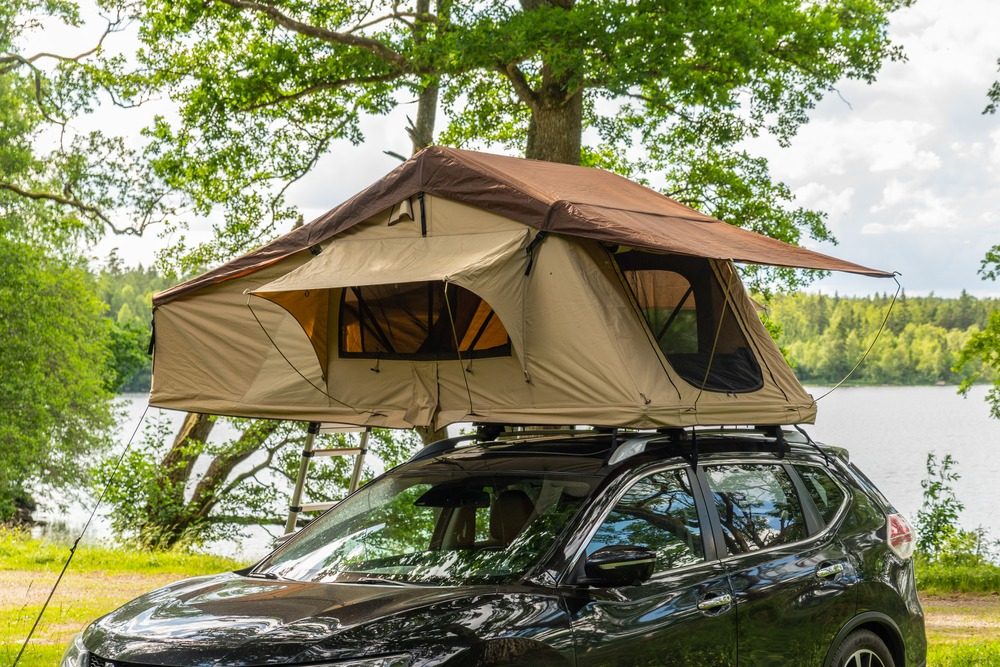
 A roof tent is literally "a tent you place on the roof of your car" and in which you can spend the night.
The tent rests partly on your roof and partly on a ladder that extends down to the ground. It's generally designed for two people, but there are also larger models designed for four people. The tents all come with a floor, a waterproof tent fabric and a mattress with a mattress cover. You can choose between soft-shell or hard-shell tents, for warm or cold countries. Many tents have storage compartments inside, and the windows can be closed individually.
The tent can be fitted on any type of car (city car, estate, 4x4, van, etc.). However, you'll need roof bars. Please note that these roof bars can generally only support a maximum weight of 300 kg (when the vehicle is stationary). While driving, the maximum load weight cannot exceed 75 kg.
How do you set up a roof tent?
Setting up a tent on a car roof is very easy. The first step is to loosen and remove the travel cover. Next, you extend the telescopic ladder, on which the roof tent will partly rest. Finally, you open the tent using the ladder as a lever and put up the awnings. And that's it!
A roof tent combined with an under-tent
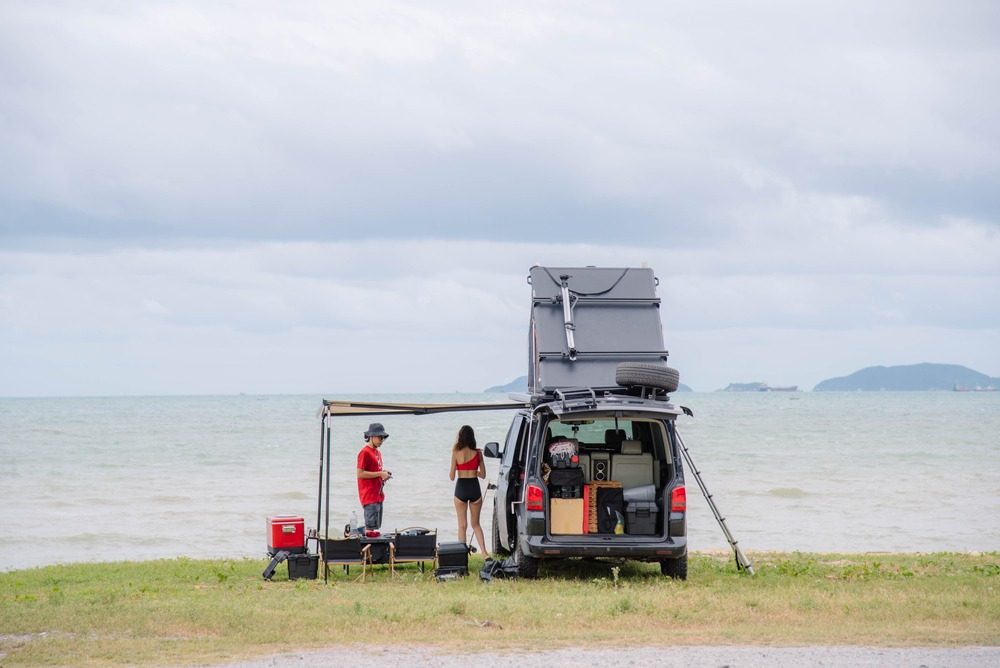
If your family has more than four people, you can complete your setup with an awning or a (classic) tent placed under the roof tent. This is set up at ground level, right below the overhanging part of the roof tent and against your car.
It can be used as a living space during the day and as a sleeping area at night. The only requirement: using this type of tent requires your car to have a height between 1.65 and 2.3 m.
Can I spend the night anywhere in a roof tent?
Almost all campsites allow you to spend the night in a roof tent. However, it's not impossible that you won't be allowed to park among the "classic" tents set up on the ground, and that you'll be directed to a spot away from other campers.
Campsite rules differ from country to country. In Belgium and Germany, you're allowed to spend the night in your roof tent in "regular" car parks, but you can't stay there for more than twenty-four hours.
As a general rule, wild camping is only allowed in most European countries if you have the landowner's permission. In some Scandinavian countries, wild camping is (still) allowed, except in national parks. We recommend checking the exact rules for each country before you leave.
Buy or rent a roof tent?
To buy, expect to pay between €1,000 and €4,500. Prices for roof tents with an under-tent range from around €2,200 to €5,000 depending on the brand.
Renting a roof tent is also possible. Budget around €125 for a two-person tent and up to €185 for a four-person tent (price per week).
"Weekend" packages are also available. Prices then range between €80 and €110.
Setting up the roof tent is usually offered free of charge for rentals of two weeks or more. You can also rent a roof rack from most rental companies (+/- €25).
10 tips and tricks about roof tents
- Limit your speed to 120 km/h if you're driving with a roof tent fitted. Read our tips about roof boxes by clicking here.
- Choose (or test) a good mattress (good thickness, quality and foam density).
- Opt for a tent with a roof window if you want to gaze at the stars at night.
- Tents with a mosquito net are recommended.
- Complete your setup with an awning to create a shaded area under the tent.
- A double-layer tent protects you better from rain and keeps you cool in hot weather.
- If you're using a thick mattress, don't forget to remove it before folding the tent back down.
- Protect your roof tent against theft by, for example, fitting lock nuts on the roof rack (cost around €50) and an anti-theft system. Never leave valuables in your roof tent.
- Some models leave space on the roof to carry a bike/bikes or a kayak.
- Some shops offer (secure) storage space or will buy back your roof tent when you want to get rid of it.