At a glance
What types of autonomous driving exist? Are we ready to see self-driving cars on the road? Who is liable in the event of an accident?
The media regularly report on experiments carried out with self-driving vehicles. Tesla is the big pioneer in this field, but other car makers are also developing fully autonomous vehicles. Where does this new technology stand today, and who is legally liable in the event of a (technical) problem?
Our blogger Alain Dierckx helps us understand better.
What is autonomous driving?
SAE International, a leading global association bringing together more than 128,000 engineers, distinguishes six levels of autonomous driving:
- Level 0: the driver has full control of the vehicle (no autonomy).
- Level 1: the driver has full control of the vehicle, but is assisted by simple assistance systems such as cruise control.
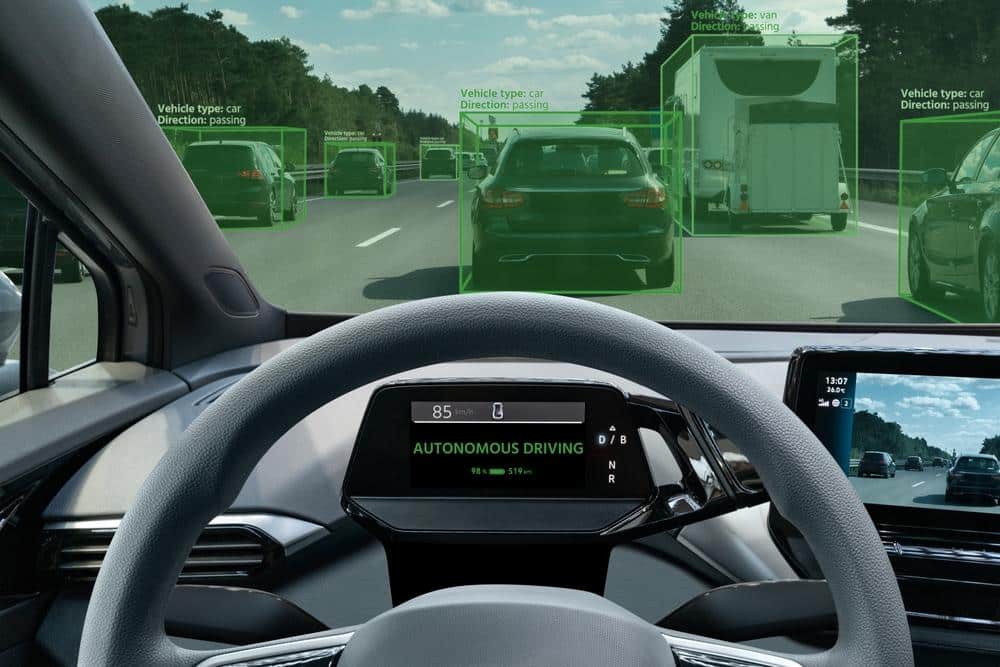
- Level 2: the car can steer, accelerate, and brake autonomously, but the driver must remain alert at all times and be able to intervene immediately (semi-autonomous driving).
- Level 3: the car can control itself entirely in certain situations, but the driver must always stay alert and be ready to take over (conditionally autonomous driving).
- Level 4: the car can drive fully autonomously under specific conditions (for example, in certain areas), without any driver intervention.
- Level 5: the car can drive anywhere and in any conditions with no human intervention whatsoever (full autonomy).
What are the benefits of autonomous vehicles?
Safety
The number of accidents decreases by eliminating human errors, such as distraction or fatigue. The advanced sensors and algorithms built into the vehicles help avoid accidents.
Efficiency and time savings
Traffic flows better because autonomous vehicles maintain predictable driving patterns, which can lead to reduced traffic jams and shorter travel times.
Accessibility
Autonomous vehicles are a solution for people who can't drive, such as elderly people and people with reduced mobility.
Environment
Self-driving vehicles are - in principle - electric vehicles, which reduces or eliminates fuel consumption and greenhouse gas emissions.
Cost reduction
The biggest savings involve reduced fuel consumption, lower insurance premiums, and reduced accident-related costs. However, the cost of "self-driving" software must also be factored in.
Liability: what does the law say in Belgium?
In Belgium, since 2022, the use of self-driving vehicles has been authorized at level 3, meaning the driver can let go of the wheel but must remain alert and keep an eye on the situation at all times.
What's more, there is still no specific legislation on self-driving vehicles. It's still unclear who will be held liable if a problem leads to an accident. Will it be the manufacturer, the owner, the road authorities, or the software developer?
The government is looking to Europe to initiate comprehensive legislation.
How much does a self-driving vehicle cost?
Self-driving vehicles are more expensive than traditional models. This is due to the cost of the sophisticated technology built in, including smart sensors and cameras. Prices vary from one brand to another, and the extra cost increases with the level of autonomy. In the end, this amounts to an added cost of several thousand euros. Generally speaking, the "premium" models of car brands will be equipped with it first.
Why is road infrastructure important for autonomous vehicles?
- Road markings, traffic lights, and road signs must be in perfect condition (visible, legible, and suited to sensors) so that self-driving vehicles' software can respond optimally.
- Separate lanes for self-driving vehicles improve traffic flow.
- Suitable traffic infrastructure, capable of communicating with autonomous vehicles, helps improve traffic efficiency.
In Belgium, the current traffic infrastructure isn't optimal, due to complex intersections, narrow streets, and road signs that aren't always legible and are sometimes even hidden by vegetation and other similar factors.
Which vehicles could become autonomous?
Besides passenger cars, other types of autonomous vehicles are being developed:
- Taxis: Tesla has announced the upcoming release of the Cybercab, a taxi with no steering wheel or pedals.
- Industrial vehicles: Kumatech is developing autonomous forklifts and pallet trucks.
- Heavy goods vehicles: Several brands are currently testing self-driving trucks. "Truck Platooning" is also being trialled: several self-driving trucks travel in a convoy with a minimal distance between them.
- Buses: At Terhills, a tourist experience site, shuttles run fully autonomously, with no attendant on board. These shuttles carry visitors between the site's various attractions. A pilot project for self-driving electric buses is underway at Zaventem airport, and Volvo is also working on a project.