At a glance
Find out how useful the European Health Insurance Card is and what to do if you have medical expenses abroad.
The European Health Insurance Card (EHIC) makes it easier to access healthcare in several countries, as well as to have it billed.
What should you do if you have medical expenses abroad?
What is the EHIC?
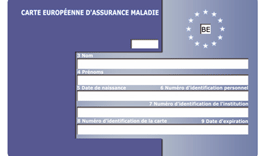 The European Health Insurance Card is issued free of charge to anyone who is up to date with their social security contributions, by their health insurance fund (the "mutuelle"). Don't forget it if you're traveling to a member state of the European Economic Area or certain other countries (see below). It will make it easier for you to access healthcare there and to have the medical expenses you incur billed at the same rates that apply to residents of the country you're visiting.
Request the card a few weeks before you leave! The card can also be downloaded to your smartphone via an app.
In which countries is the EHIC valid?
The card is valid in the 28 member states of the European Union, plus Norway, Liechtenstein, Iceland, Monaco, Andorra, San Marino, Vatican City, as well as Switzerland, North Macedonia, and Australia.
Please note: the card cannot be used in the overseas territories of certain member states. If you're traveling to one of these territories, check with your health insurance fund.
For the following countries, bilateral agreements exist and it's possible to obtain special forms to cover a temporary stay: Algeria, Australia, Bosnia and Herzegovina, Kosovo, Morocco, Montenegro, Serbia, Tunisia, Turkey.
If you're traveling to one of these countries, check with your health insurance fund or click here.
For other countries around the world there are no bilateral agreements (e.g. the USA, Canada, Cuba, the Dominican Republic, Thailand, …). In this case, it's essential to be covered by supplementary hospitalization insurance or by a travel assistance contract that covers medical or hospitalization costs up to a sufficiently high amount.
How do you use the EHIC?
In the event of urgent medical problems, show the EHIC to hospitals or healthcare providers in the country you're in.
Also get in touch with your medical assistance company.
Private or public healthcare providers: watch out for medical costs!
Be careful, the rules differ depending on the type of healthcare provider:
-
Hospitalization or treatment by public healthcare providers: on presentation of the EHIC, medical costs will be billed directly to your health insurance fund at the rates in force in the country where you're staying. However, it's not out of the question that you may still have to pay an amount corresponding to the co-payment.
-
Hospitalization or treatment by private hospitals or private healthcare providers: the EHIC will not be accepted! In that case, contact your assistance company's call center as soon as possible.
Refusals and abuse
For some time now, there have occasionally been reports of abuse in (public) hospitals in certain countries which — contrary to international agreements — do not accept the EHIC, or which overcharge for hospitalization costs, or which require a credit card as a guarantee.
In some cases, costs covered by the EHIC are then billed directly to the insurer or to the travel assistance company.
European authorities have grown concerned about this phenomenon and are taking action against member states that breach European regulations on the matter.
Whatever the case, thanks to an assistance contract, you're assured of reimbursement for medical expenses incurred abroad, in accordance with the contractual terms of the type of assistance contract you have taken out (maximum reimbursement amount for medical expenses).
The travel insurance contract covers the repatriation of the victim and their relatives (or their vehicle, provided it is covered by the contract taken out). Repatriation may also be considered in the event of hospitalization or the death of a relative in Belgium, or following significant damage to your home.
More information
For any information about the EHIC, see this link or check with your health insurance fund.
You will also find useful information on this topic on the "Your Europe" website.\
Also read: Medical costs in the United States