
At a glance
- Travel assistance necessarily brings to mind potential medical problems abroad that may lead to a medical repatriation.
- How does the assistance company go about determining the type of medical repatriation?
- What's the difference between an escorted and a non-escorted repatriation?
What should you do if you have a medical problem abroad?
If you're faced with a medical problem abroad, first contact a doctor or medical service on site (a hospital), or in an emergency, alert the local emergency service (via the emergency number, most often 112).
Then notify your assistance company as quickly as possible. Follow the advice given in the article "Requesting medical assistance from Redion".
Based on your medical file on site, the assistance company's doctor will decide (in consultation with the doctor treating you locally) whether an escorted or non-escorted medical repatriation is necessary and possible, using the most appropriate means of transport.
The goal is always to provide the solution best suited to the patient's state of health.
Non-escorted repatriation
This is the most common type of medical repatriation, and concerns minor conditions.
Did you sprain your foot, break your arm, fracture your wrist...?
After being treated locally, and depending on your medical condition and where you were hospitalized, if your medical file requires you to return home and you're unable to do so under your own means, we cover your transport by taxi, ambulance, train or plane.
In the latter two cases, a taxi or ambulance will take you to the station or airport. Once you arrive at your destination, a taxi or ambulance will take you home or to a hospital of your choice.
This type of repatriation is more complicated if you're unable to remain seated or to move around (for example, following a broken leg). In that case, we arrange transport seating that guarantees you optimal comfort (for example, a seat that lets you keep your leg extended, or an extra seat if you have a broken arm).
If your condition requires it, a nurse will accompany you to look after you or administer the necessary care.
Escorted repatriation
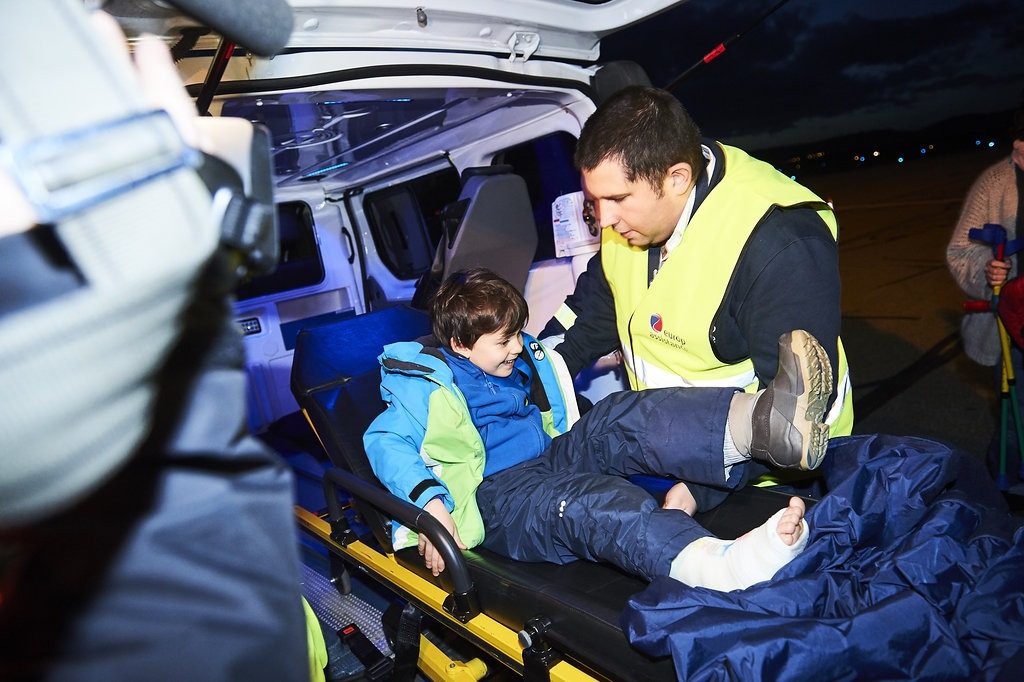 This type of repatriation requires the essential presence of a doctor or a nurse by your side.
If the type of condition requires it, or if the condition affects vital organs (for example a stroke or cardiovascular disease), and if your state of health has stabilized enough to allow an early return, you will be repatriated (by ambulance or scheduled flight) accompanied by a doctor or nurse who will take care of you, monitor your health and administer the necessary medical treatment throughout your return trip.
If necessary, repatriation will take place on a stretcher.
Repatriation by medical evacuation aircraft
This type of escorted repatriation is the one that most easily comes to mind when talking about medical assistance.
However, it is reserved for the most acute conditions, for which patients cannot be medically treated at the place where the problem occurred. For example, following severe multiple trauma in a distant country that lacks the necessary medical infrastructure to treat you, it may be decided to repatriate you by medical evacuation aircraft to a place that has this infrastructure, or to your home country.
In these serious cases, only the patient's best interests guide the final decision.
A medical team (emergency physician, nurse) is present on board a specially chartered aircraft, equipped with state-of-the-art equipment, to carry out the safe transport of the patient. A specially equipped ambulance picks up the patient for transfers from the hospital to the airport (where boarding takes place on the tarmac near the plane) and from the destination airport to the hospital where a bed has been reserved.
The patient is monitored throughout the journey as if they were in the hospital's emergency care unit.
The vehicle and travel companions
- If you traveled by car and your condition doesn't allow you to drive your vehicle back, or none of your travel companions can bring your vehicle home, we will send a replacement driver on site or a transport company to bring your car back home.
- If we organize an escorted return, we cover the return trip of another insured person traveling with you so that they can accompany you all the way to your final destination.
- As for your other travel companions, if they are insured and cannot continue their trip by the means initially planned, we cover their return home or the continuation of their trip in accordance with the terms of the assistance contract. In that case, the costs covered correspond to those we would have agreed to for their return home.
- Finally, if you're traveling with a pet and are repatriated, we will cover its return to your home. The same applies to your luggage.
Also read:
- The mobile app for a technical or medical problem
- The cost of medical assistance
- What does travel insurance cover?
First published: 02/2017 - Updated: 06/2025