At a glance
What should you watch out for when flying with a baby or young child? Discover our practical tips.
Flying with a young child or baby to a nearby or distant destination is now easy.
However, parents of newborns or young children often have a lot of questions when they want to fly with their child:
- When can my baby travel by plane?
- What documents do I need?
- Do I always need to book a seat for my child?
- Can I bring baby food on the plane?
- Is flying risk-free for babies?
In this article, we try to provide some answers to these various questions.
From what age can a baby fly?
Each airline decides the age from which it allows babies on board. It's therefore important to always check your airline's website for this information. In any case, your baby must be older than 48 hours.
If your baby is less than a week old, you will need a medical certificate. Many airlines allow babies to board from the age of 1 to 2 weeks. From a paediatric point of view, however, it is recommended to wait until the age of 6 weeks.
Is flying dangerous for babies?
First of all, always ask yourself whether flying with your baby really makes sense.
Where possible, newborns under 6 weeks old should not fly, because the oxygen saturation in the cabin is lower at high altitude than on the ground. Since very young infants' lungs are not always fully developed, low oxygen saturation can cause problems.
Flying can also be a source of stress for babies and young children. Fluctuations in oxygen levels can be one reason, as can the noise of and inside the plane, as well as pressurisation.
The risk of increased exposure to radiation is sometimes mentioned. But this risk isn't really justified, as this exposure is harmless for occasional trips, whether for adults, babies or young children.
Consult your paediatrician before planning your flight. They will tell you whether your child is fit to fly or not.
Destination-related risks
Are you travelling to a tropical country? In that case, also think about the food, which can be very different there, and the local temperature, which can be tropical. All of these are factors that can stress your baby and cause health issues.
Also find out about vaccination requirements at your holiday destination. Some countries recommend, or even require, specific vaccinations.
Cabin pressurisation during the flight
During the flight, the pressure in the aircraft cabin changes rapidly. These changes are strongest during take-off and landing. Since their sinuses aren't yet fully developed, babies can't compensate for these pressure differences on their own. This results in ear pain.
To avoid ear pain during take-off or landing, let your child suck, chew or swallow as soon as the plane accelerates. This stimulates pressure equalisation. In infants, pressure equalisation can be helped by a dummy. For young children, give them something to drink or eat. For older children, chewing gum or sweets are helpful.
Is your child over 1 year old? Pharmacies sell special earplugs that ensure slow pressure equalisation.
Be careful if your child has an ear infection: flying is then not recommended!
Tip: Keep your child awake during take-off and landing.
Landing can be particularly unpleasant for young children. Keep an eye on the landing time and make sure pressure equalisation starts from 20 minutes before landing.
In case of a cold, pressure equalisation problems can also occur. In that case, it's helpful to use a nasal spray or nasal drops. If your child has a bad cold accompanied by fever, ask your paediatrician or doctor for advice. They will be able to determine whether your child is fit to fly.
What is the recommended maximum flight duration for a young child?
No maximum flight duration with a baby has been officially set.
As a parent, you know your child best.
- How well do they cope with stress?
- How long can they manage with limited space and little movement?
If in doubt, ask your paediatrician or doctor for advice.
Prefer longer non-stop flights over several plane changes. Even though the flight time will be longer, the stress linked to connections is lower.
How much does a flight cost for a baby or young child?
The cost of flights for babies and young children depends on their age.
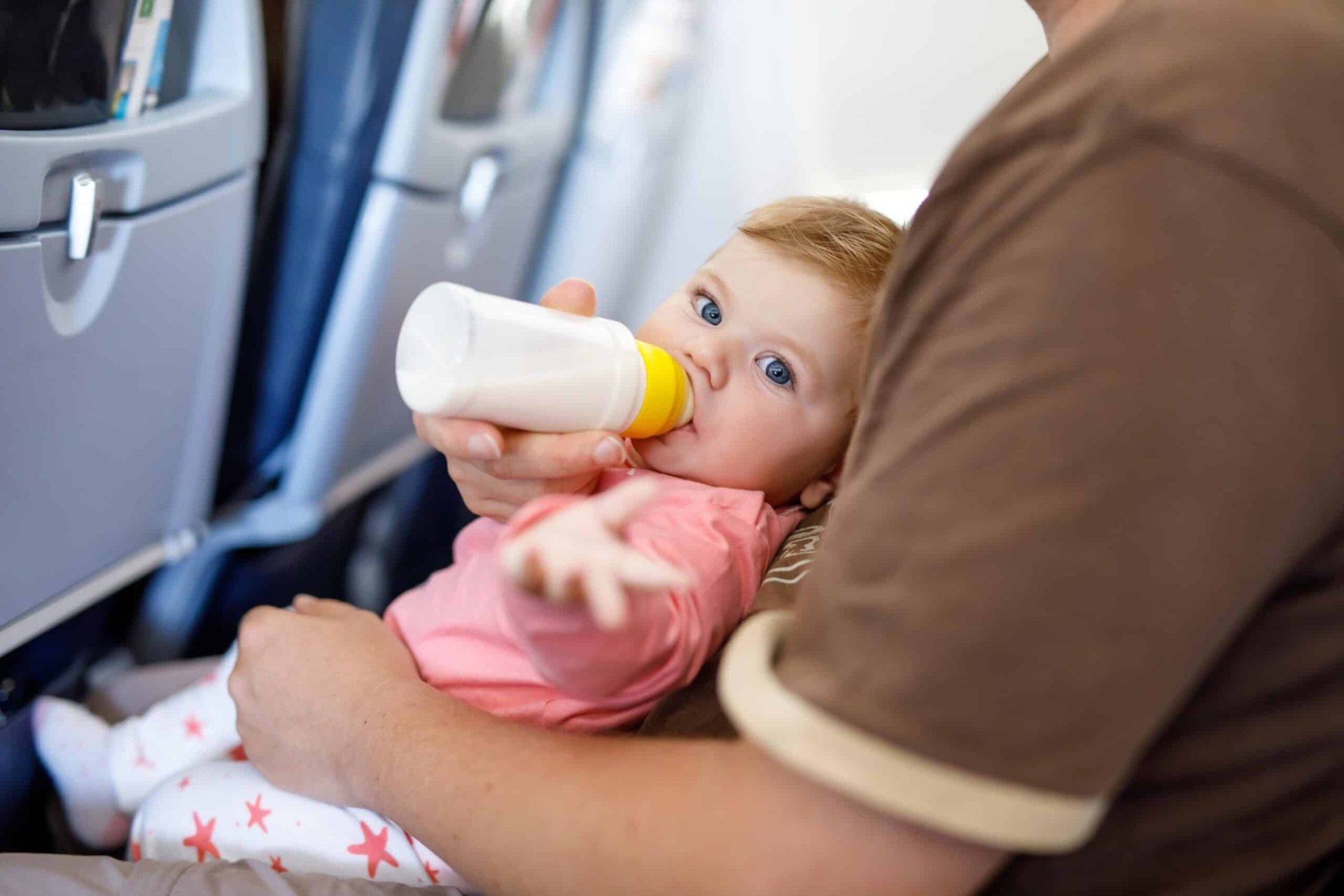
Children under 2 don't need their own seat. They're allowed to sit on their parents' lap during the flight. You usually only pay a small supplement for this. If you prefer to book a separate seat for your child under 2, you'll generally pay a fare of 75 to 100% of the adult price.
Children over 2 must have their own seat.
Good to know: Families with children are usually given priority boarding. This means they're allowed to board before other passengers. Flying with children therefore sometimes has its advantages!
Flying with a baby: safety
If your baby sits on your lap during the flight, they must be secured with a seatbelt extension that you attach to your own belt. However, the safety of this lap belt is controversial. It's therefore safer and more comfortable for your baby to have their own seat (a baby seat or car seat). Make sure the seat carries the label "For use on aircraft".
Book your seats in advance if you're travelling as a family. It's recommended to choose seats that offer enough legroom. These seats are often located along partitions or next to emergency exits.
Read more on this topic: the best seats on the plane
Are you planning a long-haul flight? Then rent a baby bassinet. These bassinets are specially designed for air travel. They attach to a partition. Be careful though, as using a bassinet isn't possible everywhere. Make sure to book the bassinet and corresponding seats with the airline in good time. Using a bassinet is subject to certain restrictions, such as the baby's age, weight and height. Check with the airline.
Tip: Choose a night flight for long distances. This is often the best way for your baby to stay calm and sleep, without disrupting their sleep rhythm.
How much luggage can a child bring?
The amount of luggage you can bring is determined by the airline. Find out beforehand about the number, dimensions and weight of allowed luggage. In most cases, children are allowed to bring as much luggage as adults. This also applies if the child doesn't have their own seat on the plane. If your child is over 2 and must have their own seat anyway, they can bring as much luggage as adults. Be careful with low-cost flights though: adults and children usually have to book and pay for their luggage separately.
Can you bring a stroller or buggy on a plane?
Almost all airlines let you bring a buggy, stroller or car seat carrier free of charge. Make sure you have a foldable buggy or stroller. In principle, you can use it right up to the boarding gate. It will then be taken and stored by the aircraft crew. After landing, you'll get it back at the boarding gate. When checking in your luggage, ask whether you can keep it with you until departure. In some cases, small foldable strollers or buggies are allowed in the cabin free of charge.
Is priority boarding available for families with young children?
Many airlines offer priority boarding for families. This means you're the first to board the plane and don't have to queue for long. Check with your airline whether they offer this option.
Our checklist for a flight with a baby or child
Here are a few things to check before you leave:
Passport (for children) / ID card: Make sure you have the required identity documents: the kids-ID and/or passport. Find out in good time about the specific entry requirements of your destination (or transit) country.
Please note that babies' and young children's faces can change considerably within a few months. This means that clear identification may no longer be possible well before the document's validity period ends (max. 6 years). In that case, an identity document becomes invalid prematurely. Don't forget to apply for a new identity document in good time before your trip.
Visa: Also check in good time with the Federal Foreign Affairs Department (SPF) about the entry requirements for your travel destination regarding visas. Please note: travel documents or visas must be valid for at least six months at the time of entry.
Travel authorisation: Is your child travelling with an adult who doesn't officially have legal custody? In that case, the adult must have a travel authorisation.
Baby food: Milk, baby food and bottles aren't subject to the strict hand luggage security rules. However, you can only bring the amount of baby food you think you'll need during the flight. Ask your airline whether you can pre-order baby food or baby menus, and whether you can heat up the food you've brought. Always pack a few favourite snacks in your cabin bag.
Baby seat or car seat if your child needs one.
Changing supplies: Bring a changing mat, wet wipes, nappies, nappy bags, usual creams and spare clothes in your hand luggage. Ideally, pack enough to last two days, just to be well prepared in case of diarrhoea or flight cancellation.
Most planes also have a changing table in the toilets.
Clothing: Dress your child in loose, comfortable clothing. Bring an extra jacket or jumper in case it's cold on the plane, and for your baby, an extra blanket.
Toys: Picture books, stuffed animals, puzzle blocks and other toys help pass the time. Especially on long flights.
First aid kit: Bring any medication you would use at home. Make sure to bring pain and fever medication. Nasal drops or earplugs can help with pressure equalisation.
However, be mindful of the regulations regarding medication to leave in your checked luggage.
\