At a glance
In which countries and cities are there rules regarding "Environmental Zones" or "Low Emission Zones" (LEZ)?
Taking a road trip, whether for work or on holiday, always gives a great sense of freedom. However, certain restrictions may force you to change your route. For example, "Low Emission Zones" (LEZ) or "Environmental Zones".
What do they correspond to? Where can you find them in other European countries? Is car traffic allowed in these zones?
Our blogger Alain Dierckx gives us an overview.\
What is an "Environmental Zone"?
An Environmental Zone is an urban area where polluting motor vehicles are banned. The aim is to protect the environment from the emissions (exhaust gases) of the most polluting older means of transport (for example, old diesel and old petrol cars).
There are two types of environmental zones: Low Emission Zones (LEZ) and Zero Emission Zones (ZEZ). Whether or not you can access an environmental zone depends on the Euro standard your vehicle belongs to. You will find this information on the vehicle registration certificate next to the heading "environmental class" (new vehicles) or on the Car-Pass (used vehicles).
Where can you find information on Environmental Zones in Europe?
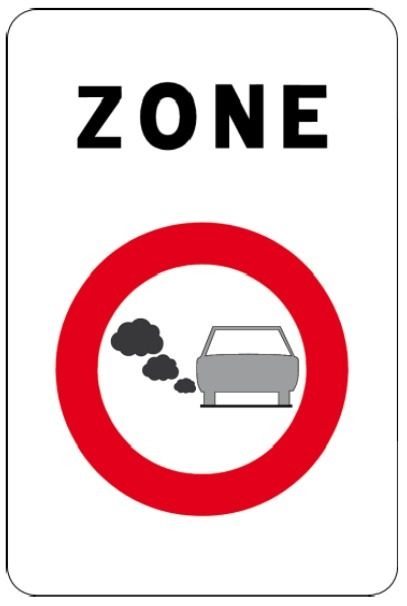 Unfortunately, in Europe there is no identical system applied in every country. The rules can therefore be very different from one country to another, as can the fines, road signage and types of vehicle allowed. In some countries, such as Italy, there are even differences between the environmental zones on the islands and those on the mainland. It is therefore important to be well informed before you leave and to obtain any required stickers in time. Below you will find a list of environmental zones in the European countries most popular with Belgian tourists.
The information we provide is valid as of the publication date of this article and may therefore change.
Below are two useful websites that can give you helpful information:
- Regulations by country (urbanaccessregulations.eu) You can also search by city.
- Driving in an environmental zone in Europe (europe-consommateurs.eu) You can search by country and click through to specific websites.
A brief overview by country
1. Environmental zones in Germany
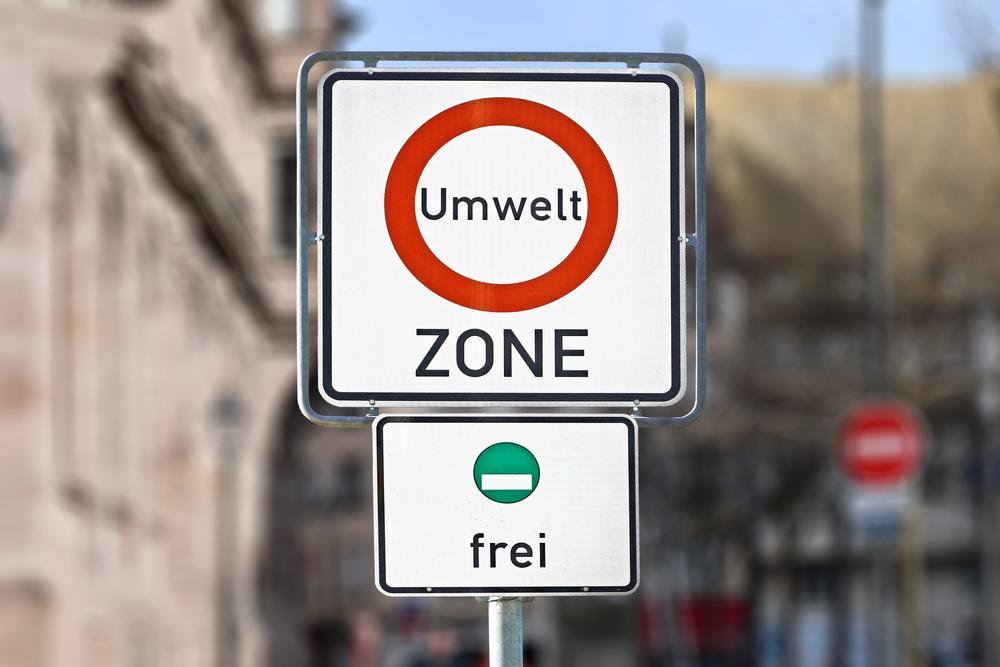
Name: Umweltzone
Application: There are currently no fewer than 82 environmental zones in Germany, with different rules and deadlines. You can find an overview here.
Rules: To enter these low emission zones, you need a sticker. This sticker can be ordered online and is valid for all LEZs in Germany. The price is 6 euros if you order directly from a city, but can be higher if you buy it at petrol stations or motoring clubs. Very old diesel cars are sometimes refused entry to "Umweltzonen", so check the regulations for your destination before you leave.
2. Environmental zones in Denmark
Name: Miljøzone
Application: Denmark has four low emission zones: Aalborg, Aarhus, København (Copenhagen) + Frederiksberg, and Odense.
Rules: In Denmark, the LEZ only applies to heavy goods vehicles and vans. Since 2 July 2022, buses and trucks must comply at least with the Euro 6 standard, and diesel vans with the Euro 5 standard.
3. Environmental zones in Spain
Name: Zona de Bajas Emisiones (ZBE)
Application: In several Spanish cities: Barcelona, Madrid, Madrid Central, Madrid Emission Based Parking, Madrid LEZs, Sant Cugat.
This number will increase significantly in 2023, as municipalities with more than 50,000 inhabitants will be required to introduce a ZBE by then. This rule concerns 7 out of 10 Spanish cities.
Rules: Without an environmental badge, your vehicle is not allowed to enter these zones. The rule applies to both Spanish and foreign vehicles.
To access the ZBEs, you must obtain a "Distintivo Ambiental" sticker, which you stick on your windscreen. This sticker exists for several vehicle categories. You can order it online on the official website, but also at post offices and other locations. The minimum price is €5.
In Spain, there is currently no zero emission zone, but as in France, emergency anti-pollution zones can be created by the government at any time, depending on the air pollution level.
At the time of publication of this article, this is the case for four major cities: Madrid, Seville, Valencia and Valladolid, but check this website for any possible changes.
4. Environmental zones in France
Name: Zone à Faible Emission (ZFE)
Application: In several French cities: Aix-Marseille-Provence, Grand Grenoble, Grand Lyon, Grand Nancy, Grand Saint-Etienne, Lille, Lyon, Montpellier Méditerranée Métropole, Nice, Reims, Rouen, Strasbourg, Strasbourg - delivery, Toulouse and Greater Paris.
You can find specific information about Paris on our blog.
Rules: Without an environmental sticker, you are not allowed to bring your vehicle into these ZFEs, and this rule applies to both French and foreign vehicles. The environmental badge is called the Crit'Air sticker and is divided into six different categories based on Euro standards. At the time of publication of this article, the sticker costs 4.51 euros. It can only be requested online on the official French government website and is only valid for the vehicle for which it was requested.
At any time — depending on the level of air pollution — the government can also declare a pollution emergency zone, bringing stricter but temporary rules into force.
By 2030, France plans to introduce a zero emission zone in Paris. This means that from that point on, no diesel or petrol vehicle will be allowed to drive within the city's urban limits.
5. Environmental zones in Greece
Name: Low Emission Zone
Application: There are currently two low emission zones in Greece: in Athens and Thessaloniki.
Rules: The rule applies to Greek vehicles over 2.2 tonnes and buses. It therefore does not apply to foreign vehicles. Exception: rental cars hired for more than forty days.
6. Environmental zones in Italy
Name: Zona Traffico Limitato (ZTL)
Application: There are several ZTLs in Italy, and the terms differ from one region to another and even from one city to another. On some Italian islands, tourists are not allowed to bring in any motor vehicle during the summer months, so it is best to check in advance.
Rules: Each "Low Emission Zone" has different standards and durations. Mainly in northern Italy, but also in central Italy and Sicily, LEZs have been combined with urban tolls (Milan and Palermo). There are also more than 200 camera-based access controls throughout Italy. We recommend doing a very targeted search on this website before you leave.
In Italy, there is currently no zero emission zone, but as in France, emergency anti-pollution zones can be introduced by the government at any time, depending on the level of air pollution.
7. Environmental zones in Norway
Name: Low Emission Zone
Application: There are currently three low emission zones in Norway: in Bergen, Kristiansand and Oslo.
Rules: If you want to enter a low emission zone, the toll you have to pay will be calculated based on the level of pollution caused by the vehicle.
Emergency measures exist for two cities in Norway. The city of Oslo can impose a temporary ban on driving for diesel cars, vans, trucks and buses that do not meet Euro 6 standards if air quality is poor.
The city of Bergen can decide to increase tolls or temporarily introduce an odd/even number plate system in the event of prolonged air pollution.
8. Environmental zones in the Netherlands
Name: Milieuzone
Application: Currently, an environmental zone exists in Amsterdam, Arnhem, The Hague and Utrecht. These zones are not accessible to light diesel vehicles with a Euro standard lower than Euro 4.
Rules: In the Netherlands, low emission zones only apply to diesel vehicles. Vehicles running on other types of fuel are always allowed. Access is regulated based on the Euro standard, separately for light vehicles on the one hand and heavy vehicles and/or coaches on the other. No sticker is required and there is no need to register. Cameras and police services enforce compliance with the rules.
9. Environmental zones in Portugal
Name: Zona de Emissões Reduzidas (ZER)
Application: At the time of publication of this article, there is only one low emission zone in Portugal, namely in Lisbon.
Rules: Lisbon's ZER is divided into two areas. One area has a minimum standard of Euro 2, and the other a minimum standard of Euro 3.
10. Environmental zones in the United Kingdom
Name: Low Emission Zone (LEZ) or Zero Emission Zone (ZEZ)
Application: At the time of publication of this article, there are 22 low emission zones in the United Kingdom. You can find the overview here. London also has a zero emission zone.
Rules: To be allowed to drive in London/central London, your car must meet emission standards, or you must pay a daily charge. You can find the information here.
The Greater London boroughs of Islington and Hackney have a zero emission zone. Petrol and diesel vehicles are banned Monday to Friday from 7am to 10am and from 4pm to 7pm.
A zero emission zone (ZEZ) has been introduced in the historic City of London and its financial district, banning all vehicles at certain times of day in London.
As with other UK cities, standards and deadlines vary. Check your destination here.
11. Environmental zones in Sweden
Name: Miljözon
Application: In Sweden, there are low emission zones in Gothenburg, Helsingborg, Lund, Malmö, Mölndal, Stockholm, Umeå and Uppsala.
Rules: These LEZs only concern trucks and buses. The only exception to this national framework is Stockholm, which has introduced an LEZ for passenger cars. Until 30 June, Euro 5 cars are still allowed there; from 1 July 2022, the minimum is the Euro 6 standard.
12. Environmental zones in Switzerland
Name: Pollution emergency zone
Application: In Switzerland, there are no low or zero emission zones, but emergency regulations due to air quality, and only in the city of Geneva.
Rules: Depending on the level of air pollution between 6am and 10pm, only vehicles with the appropriate sticker can enter Geneva. This sticker, called Stick'air, can be ordered online, costs 5 euros and is valid for the entire lifetime of the vehicle. However, French stickers are also valid there.
Safe travels!