At a glance
What should you do if you come face to face with an aggressive dog during a walk? How should you behave?
While out on a walk, an outing or during the holidays, you might come across an aggressive dog.
Every year, assistance companies open medical files abroad following dog bites.
What should you do if you come face to face with an aggressive dog?
First rule: don't provoke it
- Don't wander onto private property where a (dominant) dog is keeping watch. It's quite likely that it has been trained to chase off or deter any intruder.
- Don't touch a dog you don't know, unless it's under its owner's watch and they give you permission. Always stay alert! A bite from a small dog can be just as serious as one from a large one!
- Don't provoke a dog that's threatening you by adopting an aggressive or dominant attitude towards it.
Recognising a dog's hostile attitude
- A dominant dog, or one trained to attack, is confident, stands upright, with ears and fur raised, eyes fixed on its target.
- A fearful or anxious dog is more likely to attack to defend itself. It will be hunched over, with ears and tail lowered.
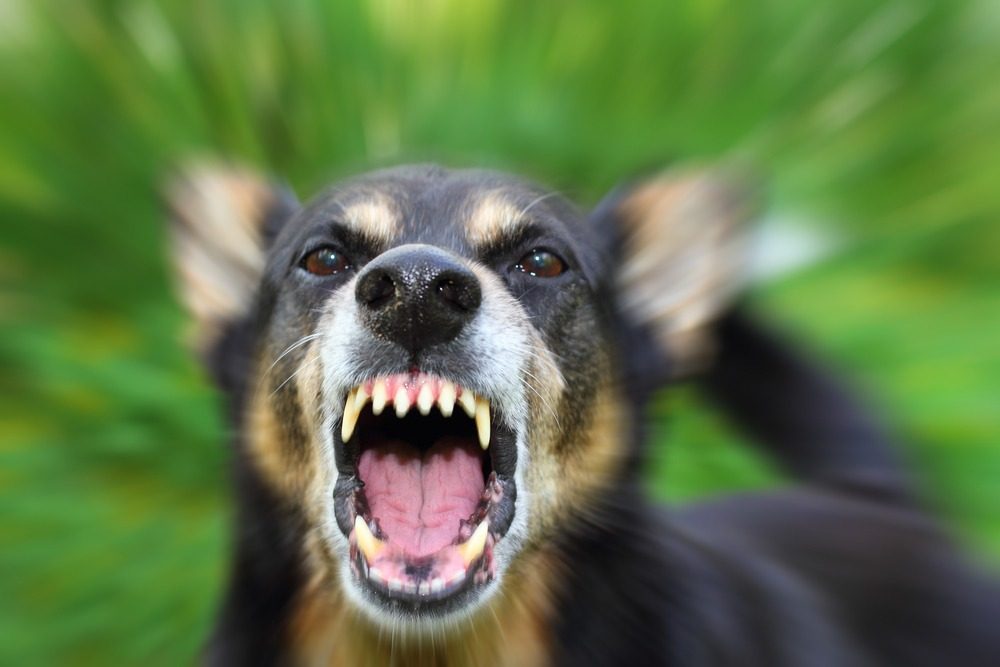
The dog will always show its hostility by growling and/or baring its teeth.
(As a result, baring your own teeth could be misread by an aggressive dog!)
Intimidation first, then aggression
- Unless the dog is specifically trained to attack, the aggression will start with intimidation. The dog bares its teeth, growls and/or barks, stares at its target while moving towards it.
- Intimidation is followed by aggression. This can be limited to a minor bite, but can also lead to a violent attack.
How should you react?
A defensive, withdrawing attitude
- Avoid provoking the dog by becoming aggressive yourself or showing that you're afraid.
- Don't stare at the animal, don't look it in the eyes.
- Keep your arms by your sides.
- Don't make any sudden movements.
- Don't shout, but don't try to win it over either.
- Don't turn your back on it.
- Keep calm and quietly withdraw, moving away from the animal and ignoring its aggressive behaviour.
A defensive, confrontational attitude
- If a confrontation is unavoidable: protect yourself with a stick, or any object you're carrying (an umbrella, a bag, a plastic bottle, ...). It's better for the dog to bite that object rather than your arm or legs. To defend yourself, the dog's sensitive spots are its muzzle, eyes, back of the neck, …
- If you fall: curl up into a ball and protect the most sensitive parts of your body (the back of your neck and your face).
What should you do if you've been attacked by an aggressive dog?
- Wounds caused by bites can become infected and leave deep marks. Get treated (doctor, hospital, contact your assistance provider if you're abroad and your health requires hospitalisation).
- File a report with the police.
- Tip: get vaccinated against tetanus as a precaution (booster every 10 years).
Types of encounters
The circumstances of the encounter are often decisive:
Are you alone? As a couple? In a group?\
An aggressive dog will more easily attack a lone person showing fear.
Are you out walking with a young child?\
Be careful, as young children often don't know how to behave and don't know the signals a dog uses. Not all dogs are cuddly toys! A child might approach the animal to stroke it, while the dog may see this gesture as a provocation or an act of aggression. The child may get scared and run away, which could trigger the dog's hunting instinct.
Are you out walking with another dog?\
If the aggressive dog is dominant, it won't be afraid to approach your dog (whether dominant or not). This could then turn into a score-settling between the two animals.
Is the aggressive dog alone or in a group?\
A pack of aggressive dogs will be bolder and harder to fend off (pack mentality). Absolutely to be avoided!
Finally: not all stray or unaccompanied dogs are aggressive, most of them are simply curious. So you need to stay alert without giving in to panic when you cross their path.