At a glance
According to Redion's 2023 Holiday Barometer, large numbers of Belgians will be heading off again this summer. Discover all the trends here.
Large numbers of Belgians will be going on holiday this summer, **despite a slightly lower budget than last year. Their desire to enjoy their holidays remains very much present.
**Inflation, for some, is holding back their choice of activities or destination(s). As for fears linked to the coronavirus pandemic, these have now been pushed into the background. Continuing to work during the holidays is appealing to more and more Belgians.\
Some major trends from Redion's 2023 Holiday Barometer
-
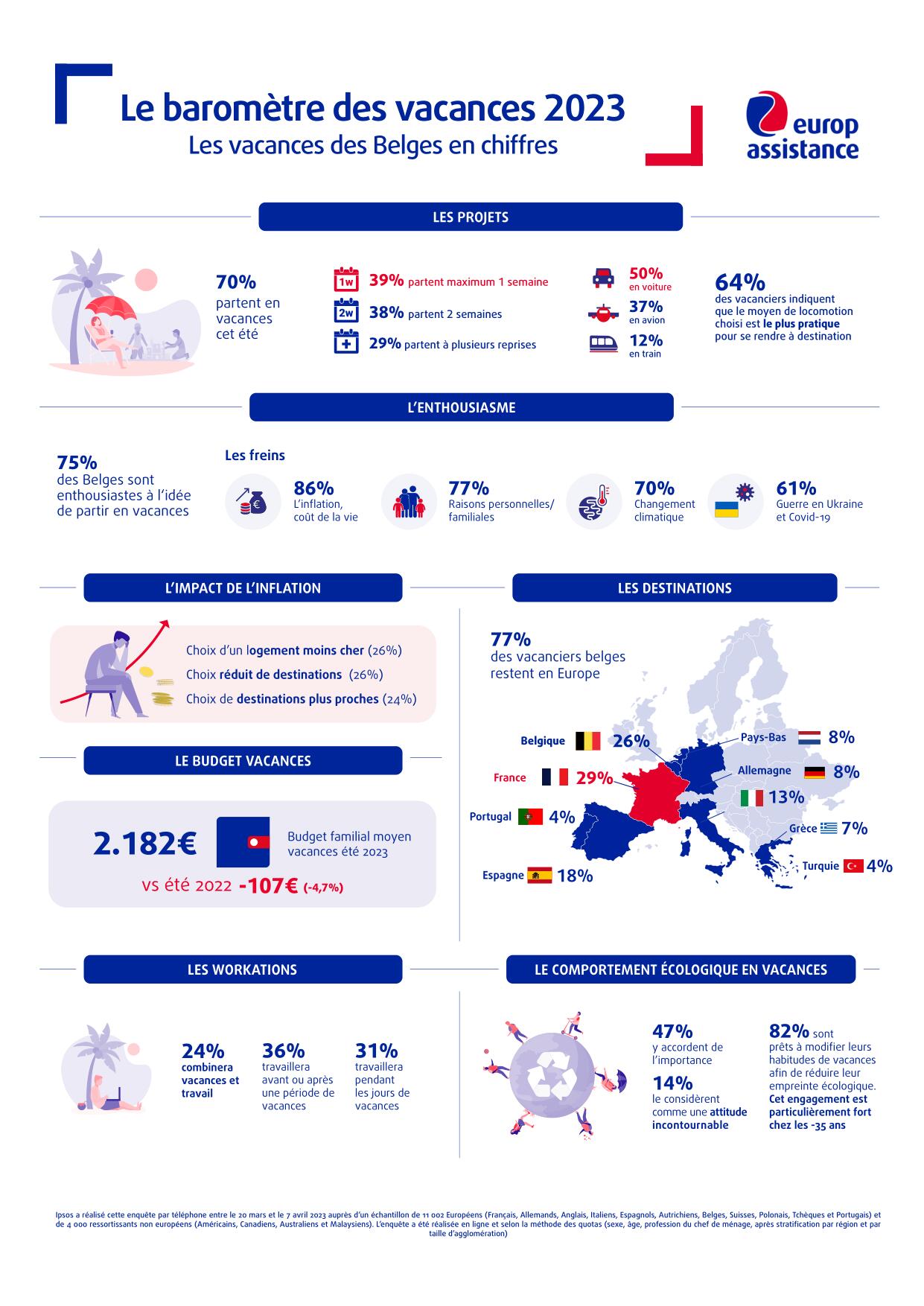
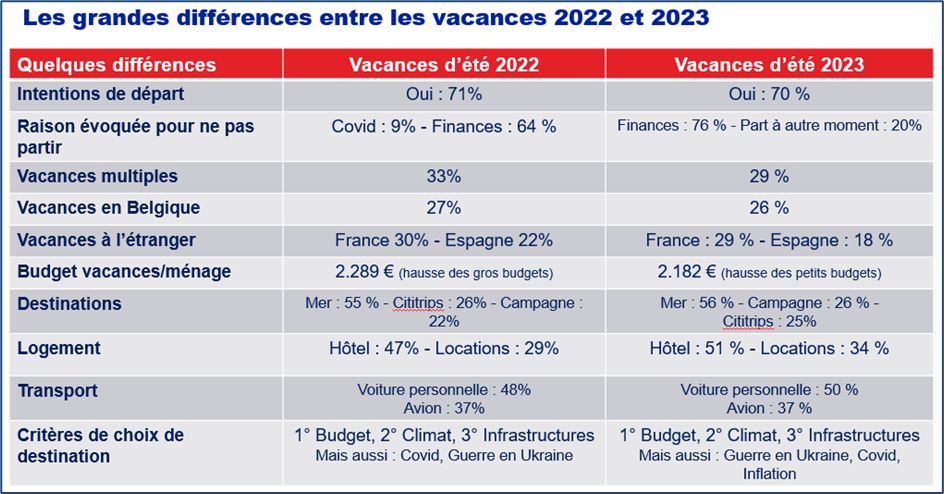
Travel intentions: 70% of Belgians say they will be travelling this summer, a slight decrease of 1 point compared with 2022. As a reminder, last year saw a sharp increase following the Covid-19 crisis. The current rate is one of the highest of recent years.
-
Holiday destinations: 77% of Belgians say they will spend their summer holidays in Europe, 2 points down on 2022. Destinations such as Asia or the Middle East are up by one point (10%). North America attracts 2% of travellers. Among the most popular destinations for Belgians, we consistently find France (29%), Belgium (26%), Spain (18%), Italy (13%) and the Netherlands (8%).
-
Belgian holidaymakers' enthusiasm for going on holiday: 75% of Belgians say they are (very) enthusiastic about going on holiday this summer, 4 points up on 2022. The European average stands at 78%. However, some factors have a direct impact on this enthusiasm, including the cost of living/inflation (86%), personal or family reasons (77%) or climate change (70%). The war in Ukraine and Covid-19 affect the enthusiasm of 61% of holidaymakers.
-
Types of holiday destinations: Belgians still prefer to holiday by the sea (56%). This year, countryside holidays attract 26% of holidaymakers, as do touring holidays (22%).
-
Modes of transport for reaching the holiday destination: The personal car remains the most popular means of transport for half of Belgians (50%). As a reminder, in 2021, at the end of the Covid-19 crisis, the car was chosen by 62% of holidaymakers. Air travel holds steady in popularity at 37%, train at 12% and bus at 5%.
-
The average holiday budget of Belgians for this summer (i.e. the average across all types of household composition) falls by 4.7% (after a 15% rise last year) to stand at €2,182 (vs. €2,289 in 2022). This stands at €2,218 among Dutch speakers and €2,146 among French speakers. One notable fact: the average holiday budget of Belgian households is the only one to fall compared with those of other European countries. The budget of European countries taking part in the survey rises by an average of 6% (€1,918).
-
The effect of inflation on Belgians' holidays: While inflation/the cost of living has an effect on Belgians' enthusiasm, this factor influences around a quarter of Belgians in their choice of number of destinations or type of accommodation (26%), the distance of the trip (24%), or the budget set aside for activities and outings (21%).
-
Environmental footprint: 14% of Belgians say the environmental footprint plays a crucial role in choosing their destination, and 47% consider it to play an important role. More and more Belgians, especially younger people, are gradually adopting more eco-friendly behaviour: for example, choosing eco-friendly accommodation, respecting natural resources, anti-waste behaviour, etc.
-
"Workations": 76% of Belgians (in the working population) don't intend to keep working during their holidays. So 24% practise "workations" during their holidays. Some will spend time working at their holiday destination before really making the most of their holiday (36%), others will do the opposite by working after a period of holiday (36%), and 31% will work while also enjoying their holiday at the same time.
About the study: Ipsos carried out this online survey between 20 March and 7 April 2023 among a sample of 11,002 Europeans (French, German, English, Italian, Spanish, Austrian, Belgian, Swiss, Polish, Czech and Portuguese respondents) and 4,000 non-European nationals (American, Canadian, Australian and Malaysian respondents). The survey was carried out online using the quota method (gender, age, occupation of the head of household, following stratification by region and by size of urban area).
The full press release and the presentation are available on request.