At a glance
Redion presents its third Mobility Barometer: Belgians' buy-in to alternative mobility remains held back
Redion presents its third Mobility Barometer
"Despite new incentives, several obstacles and reservations still hold back Belgians' buy-in to the transition towards alternative mobility."
Since launching its first "Mobility Barometer" in March 2022, Redion Belgium has aimed to gauge Belgians' perception of sustainable mobility and their buy-in to the transition towards alternative modes of transport. Each year, Belgians' attitudes evolve in line with economic events, technological advances and initiatives put in place by public authorities. How have Belgians changed their perceptions and thinking since the last barometer?
Where do Belgians stand on sustainable mobility?
A few results in brief
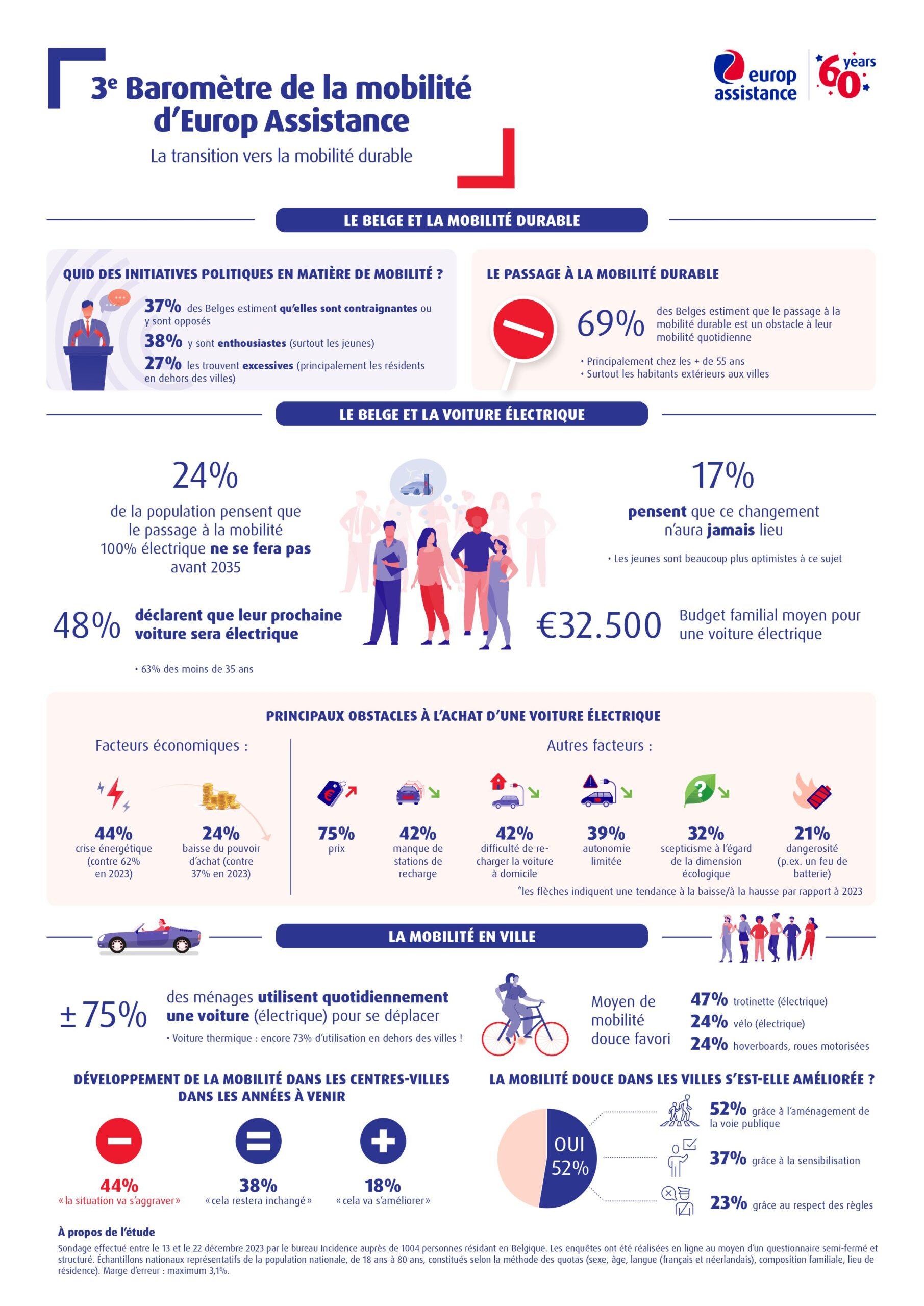
- Only a quarter of Belgians believe the shift to 100% electric mobility will happen between 2035 and 2040. For the others, this transition will happen (much) later, or never.
- For 71% of Belgians, living without a car for all their daily journeys seems an unrealistic solution.
- 48% of Belgians say their next vehicle will be electric. For 22%, "certainly not". However, the energy crisis has less impact on this decision than last year.
- As in previous years, the obstacles to buying an electric vehicle are lower prices and better road infrastructure. The scarcity of electric charging points is less of a problem.
- More than half of Belgians are willing to devote the same budget as for buying a petrol/diesel vehicle when buying an electric vehicle, i.e. on average €500. The idea of benefiting from a purchase incentive for an electric vehicle in 2024 is far from appealing to the majority of Belgians.
- 44% of Belgians expect mobility in urban centres to worsen in the coming years, even though 52% feel that soft mobility has improved in cities, mainly thanks to changes to public roads.
- The perceived danger of certain soft-mobility vehicles, such as (electric) scooters, segways and speed pedelecs, remains high.
Buying an electric car: obstacles and incentives
The main obstacles to buying an electric car remain by far its price (75%, +2 pts), followed by the lack of charging stations (42%, -6 pts, this obstacle is becoming less pronounced year on year), and the difficulty of charging the car at home (42%, -1 pt). It's worth noting that 21% cite the "danger" of an electric vehicle (e.g. a battery fire) as an obstacle. The energy crisis also remains an important factor (44%), but seems to have less impact on this decision than last year (-18 pts). On the question of purchase price: 81% of Belgians would set aside a budget similar to or higher than for a petrol/diesel vehicle when buying an electric vehicle, with 50% of them setting a maximum of €30,000. The average budget is €32,500.
The main incentive for taking the step towards buying an electric car is a lower purchase price (at the time the decision is made to change vehicle) for 47% of Belgians (+11 pts). They would be more inclined to buy an electric car thanks to government financial support (39%, +10 pts) and better road infrastructure (40%, +9 pts).
The effect of a purchase incentive: The Flemish Government has allocated a budget to financially support people who buy a new electric vehicle in 2024. These people can benefit from a €5,000 incentive. How is this incentive perceived in the different regions of the country? Will it encourage many people to buy a new electric vehicle this year?
The answer is "yes" for 18% of Flanders residents ("no" for 52% and no opinion for 20%). A similar incentive would only encourage 30% of Walloons to buy an electric vehicle this year, and 45% of Brussels residents.
100% electric mobility by 2035: not realistic!
24% of Belgians believe the shift to electric mobility for new vehicles will not happen before 2035. The other respondents expect this transition to happen much later (2040: 16% / 2045: 8% / 2050: 14% / "never": 17%). Young people are significantly the most optimistic.
However, the next car for 48% of Belgians will be electric (+7 pts vs. 2023). 51% of Belgians say the purchase of an electric vehicle is motivated by their environmental convictions, 37% by a legal obligation.
Belgians' dependence on their cars remains high: 71% of the population who own a car say they cannot do without one. And 47% do not (yet) envisage making a long trip (such as for holidays) in an electric vehicle.
Given the high prices caused by inflation, drivers are changing their behaviour. 64% say they are reducing their driving speed, 48% are using alternative transport more often, 32% are postponing urgent trips, and 18% are considering car-sharing to boost their income. This behaviour has not changed since last year.
About the study
Survey conducted between 13 and 22 December 2023 by the Incidence agency among 1,004 people residing in Belgium. The surveys were carried out online using a structured, semi-closed questionnaire. National samples representative of the national population, aged 18 to 80, drawn up using the quota method (gender, age, language (French and Dutch), family composition, place of residence). Margin of error: maximum 3.1%.
This barometer also takes into account certain results from the "Mobility Barometer 2024 among Europeans" survey, conducted by Ipsos for the Redion Group among 8,000 people, including 1,000 in Belgium, France, Germany, Austria, the Czech Republic, Italy, Spain and Portugal, from 14 December 2023 to 18 January 2024.
The full press release and the complete presentation are available on request.