At a glance
In this article, our blogger Alain Dierckx explains in more detail what car hacking is, how it works and how best to protect yourself against it.
The connectivity of modern cars has many advantages. But unfortunately, it also comes with drawbacks. One of the most significant is the vehicle's vulnerability to hacking. In this article, we take a closer look at the topic.
What is vehicle hacking?
Vehicle hacking, also called automotive hacking or cyber-carjacking, is an increasingly common phenomenon. A vehicle is hacked when third parties access the car's electronic systems and networks without the owner's authorisation.
Criminals can have several motivations for hacking a vehicle:
- Stealing the vehicle
- Stealing the vehicle's data
and then selling it or misusing it
- Sabotaging the vehicle
for example by taking control of critical functions such as the brakes, steering or transmission.
Why are modern cars vulnerable to hacking?
Many modern vehicles are equipped with internet connections and cloud services. They use wireless protocols which, if poorly secured, can give access to internal systems.
New autonomous functions such as automatic parking and driver assistance systems increase reliance on software, which also increases the risk of hacking.
How can a car be hacked?
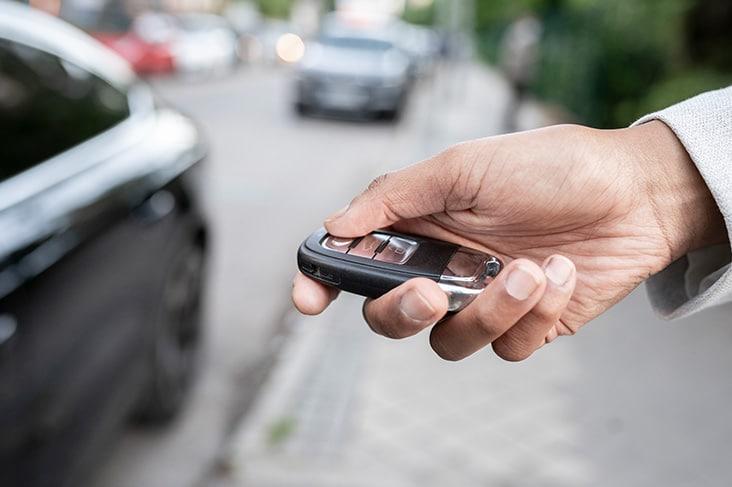
- Via the car key (keyless entry)
Criminals intercept or amplify the wireless signal from a car key to open and start the vehicle.
- Hacking via connected systems
Systems such as Bluetooth, WiFi, 4G/5G, and infotainment or navigation modules can contain vulnerabilities that criminals exploit to access the vehicle remotely.
- Attacks via charging stations
For electric cars, hackers can intercept data or install malicious software via an unsecured charging station.
How many vehicles are hacked in Europe?
There are no global figures on the number of vehicle hackings. Police services in several EU countries report that a large proportion of recent car thefts are now carried out digitally, particularly in countries where modern, connected cars are most popular.
- In Germany: a large number of luxury SUVs equipped with keyless systems are on the road, making hacking frequent. Stolen vehicles are moved on to Eastern Europe.
- In France: many modern SUVs and crossovers with keyless systems are also hacked. Stolen cars are shipped to North Africa.
- In the Netherlands: the number of hackings is estimated at 35 per day. The proximity of the port of Rotterdam plays a major role in stolen vehicles disappearing.
What can be the consequences of vehicle hacking for manufacturers?
- Costs linked to identifying flaws in the software
- Costs linked to fixing these flaws
- Fines, claims and reputational damage
What are manufacturers doing to combat car hacking?
- They separate critical systems such as brakes and steering from infotainment and connectivity functions
- They encrypt communication between the vehicle and the cloud
- They comply with the two official European standards on automotive cybersecurity (see below)
What are the authorities doing to combat car hacking?
The United Nations Economic Commission for Europe (UNECE) imposed two cybersecurity standards on car manufacturers in 2022. Since July 2022, these standards have applied to all new vehicle types approved in the EU, and since July 2024, to all newly produced vehicles.
In practical terms:
- UNECE R155: New vehicles must have a cybersecurity management system that identifies, monitors and manages risks throughout the vehicle's lifecycle.
- UNECE R156: Manufacturers must be able to provide secure software updates (remotely or via the dealer), with testing, validation and documentation procedures for updates.
A second European measure is the introduction of the SERMI certificate. Since April 2024, this certificate has been mandatory for all garages and repairers wishing to work on vehicles' anti-theft components. The parts concerned include, for example, keys, key programming, immobilisers and ignition or door locks.
Both the company and the technician must be certified.
What can you do yourself to avoid hacking?
- Regularly check whether security updates are available for the software. This can be done in three ways: in the car, via the manufacturer's app, or at the dealership.
- Let updates install automatically (recommended)
- Store the keyless key as far away as possible from where the car is parked. Criminals can indeed amplify the signal to unlock the vehicle.
- Even better: keep keyless keys in a pouch that blocks wireless signals (known as a Faraday pouch).
- Check that the doors actually lock when using the keyless key, as the signal can be disrupted.
- Consider disabling the keyless function (if your vehicle allows it)
- Don't use public WiFi when your smartphone is connected to your car
- Turn off WiFi and Bluetooth when you're not using the vehicle
- Park in a safe, well-lit place if possible to discourage attacks
- Install a mechanical anti-theft device (such as a steering wheel lock) and don't leave any valuables in the vehicle
What should you do if you become a victim of vehicle hacking?
- File a report with the police
- Contact your insurer
- Contact your travel assistance insurance.
Read our article on this topic about vehicle theft abroad and the steps to take.
If you're travelling with your caravan or motorhome, read our tips here.
What can assistance insurance do for you?
If your vehicle is stolen while travelling, Redion's travel assistance insurance can help you, provided you have taken out the "vehicle assistance" cover.
- If the vehicle is found damaged and you're waiting for it to be repaired on site, accommodation and transport will be arranged for you.
- If the vehicle isn't found, your return home will be arranged and covered.
- If your vehicle is found in a roadworthy condition after a theft and you're no longer on site, a travel ticket will be provided for you to go and collect it, along with, if necessary, a night's hotel stay (€125).
- If your vehicle is found broken down or damaged after a theft, assistance will help you with accommodation, your return, repairs and transport of the vehicle.