At a glance
What are e-fuels? What are their advantages and disadvantages? Could they replace fossil fuels?
In early 2023, the European Commission and the European Parliament voted to ban the production of internal combustion engine vehicles from 2035 onwards. However, countries such as Germany and Italy opposed this proposal. They want an exception to be made for cars running on synthetic fuels ("e-fuels").
What are these e-fuels, and what are their advantages and disadvantages compared with electricity and hydrogen?
Our blogger Alain Dierckx explains.
What is an e-fuel?
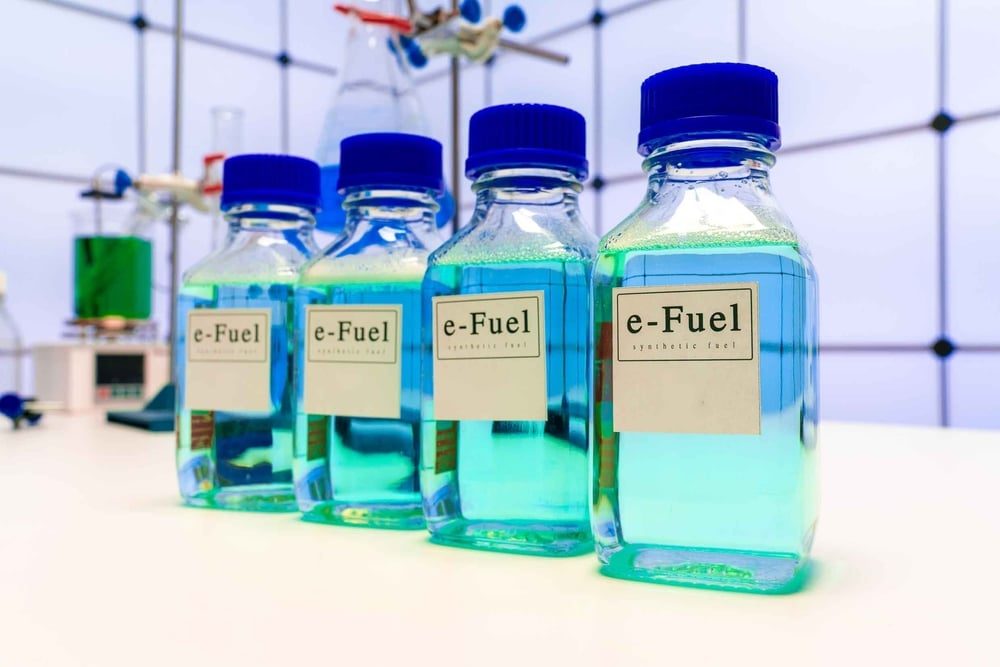
E-fuels are fully synthetic fuels that can be produced in various ways. For example, by combining CO2 and hydrogen, with the CO2 extracted from the air and the hydrogen obtained using wind and solar power.
But they can also be produced from animal and plant waste, or even used frying oil.
What are the advantages of e-fuels as fuels?
Synthetic fuels are, in principle, climate-neutral and therefore help reduce greenhouse gases in the atmosphere. This is because the CO2 they emit is offset by the CO2 extracted from the air during their production.
They also have the huge advantage of being usable in cars fitted with a fossil-fuel combustion engine. Thanks to the use of e-fuels, you'll therefore still be able to drive your old car after 2035. You'll simply need to install software that stops you from filling up with petrol or diesel "on the sly".
Another advantage: there's no need for charging infrastructure, as is the case with electric cars. All you need to do is fill up with e-fuel at the pump.
Its use on a large scale would therefore mean that carmakers would still be allowed to produce new combustion-engine cars after 2035 (something they are, incidentally, continuing to do for markets outside Europe).
What are the drawbacks of e-fuels as fuels?
E-fuels don't yet exist on a large scale today, so their future is still highly uncertain.
A lot of research still needs to be carried out, which makes it very doubtful whether enough of it can be produced by 2035. What's more, producing e-fuels is highly complex and energy-intensive.
In terms of research, this type of fuel is well behind the progress already made for electric cars.
As a result, how accessible it will be to consumers still remains unknown at this stage.
Are e-fuels expensive?
Prices are very high today, but if innovation continues, they will likely fall. The goal is to reach a price of around one and a half euros per litre.
Which car brands are developing e-fuels?
Porsche has already invested a great deal of time and energy in this new fuel. In Chile, this car brand built a plant, in partnership with Siemens and other companies, where e-fuels are produced on the assembly line.
Mazda carried out an experiment with one of its models. A 1,600 km journey was completed using a synthetic fuel made from agricultural waste. The subsequent assessment was positive. No difference in performance compared with regular petrol was observed, and fuel consumption was also normal (6.1 litres per hundred kilometres).
Do e-fuels have a future?
At present, it's generally accepted that e-fuels have a future as an alternative energy source, but only for certain forms of transport that are hard to electrify. These are mainly heavy goods vehicles, ships and aircraft.