At a glance
What is the real cost per kilometre of an electric car, taking all factors into account: purchase, consumption, insurance...?
Electric driving still stirs up debate today. This is also reflected in the results of Redion's 2026 Mobility Barometer.
Belgians remain clearly sceptical about electric cars. For 77% of respondents, the higher price is the main obstacle.
But what happens when you compare the "total cost of ownership" of electric cars with that of plug-in hybrids and fossil-fuel vehicles? Does the high price remain a deterrent?
Our blogger Alain Dierckx looked into the question.
What does total cost of ownership (TCO) consist of?
The total cost of ownership of a car (TCO), whatever its type, is made up of several elements: the purchase price, consumption, maintenance and repair costs, insurance, any tax benefits, and finally the resale value.
The purchase price of an EV
The purchase price of electric vehicles (EVs) is generally still higher today than that of fossil-fuel cars. However, a reversal of this trend is emerging. According to the "EV Progress Report 2026" by "Transport & Environment", the average price of new EVs in Europe fell by 4% in 2025.
The gap is gradually narrowing, notably thanks to the introduction of cheaper, more compact models.
Compared to a plug-in hybrid vehicle, the purchase price of an EV is in many cases already lower.
The tax benefit when buying an electric vehicle
To encourage the switch to electric driving, the Belgian government previously introduced certain measures, such as a purchase premium for an electric or plug-in hybrid vehicle, as well as an exemption from road tax and registration tax. These measures have since been withdrawn.
In Wallonia and Brussels, there was never an exemption, and new owners paid a reduced road tax and registration tax. This system remains in force today.
However, fully electric new vehicles purchased in Flanders before 1 January 2026 will remain permanently exempt from road tax and registration tax.
Fully electric new vehicles purchased after that date are subject to road tax and registration tax, but the amount is a flat fee and lower than that applied to petrol and diesel vehicles.
The authorities' aim is to eventually make electricity cheaper than fossil fuels, so that electric driving also becomes less expensive.
Consumption
The consumption of a vehicle, whatever its type of engine, naturally depends on the model and the driver's driving style.
It is not so easy to compare refuelling with charging an electric vehicle's battery. Indeed, the price of charging an electric vehicle can vary considerably depending on the circumstances: charging at home or at a public station, charging at home with or without solar panels, fast charging or standard charging.
When it comes to filling up with petrol or diesel, drivers are subject to fluctuating fuel prices, especially since these have been soaring since the escalation of the geopolitical situation in the Middle East.
As for plug-in hybrids, the share of driving in electric mode is generally limited, which leads to higher consumption than would otherwise be possible.
Generally speaking, charging a fully electric vehicle is always cheaper, whatever method is used.
Since an EV consumes less, the effect of the higher purchase price is offset as the vehicle covers more kilometres. You can check this on the website of the Department of Mobility and Public Works.
Maintenance
Electric cars require less maintenance than plug-in hybrids and petrol or diesel cars. This is because they have far fewer moving parts, and some parts, such as the exhaust pipe, engine oil, clutch, etc., are simply absent.
The brakes of an electric vehicle do not need to be replaced as often on models equipped with a regenerative braking system, which reduces strain on the brakes.
On the other hand, some parts of an electric vehicle are more expensive to replace, for example the battery and the charging module.
But overall, an electric vehicle is therefore less costly in terms of maintenance.
Insurance
Insurance for an EV is currently slightly more expensive than for a fossil-fuel or plug-in hybrid vehicle. There are several reasons for this: the higher purchase price, potentially higher repair costs (battery), and stronger acceleration, which increases the risk of accidents.
For these reasons, comprehensive insurance for an electric vehicle generally costs 10 to 20% more.
But there is also an opposite effect. The study entitled "Study on the impact of electric cars on road safety in Belgium" (VIAS Institute, 2024) shows that electric vehicle drivers drive more calmly and cause fewer accidents, which leads some insurance companies not to apply a surcharge. Some companies even offer a discount because of the eco-friendly nature of this type of vehicle.
We can therefore conclude that insurance for an electric vehicle is not necessarily more expensive than for another type of vehicle.
Resale value
The resale value of an EV is under pressure. Several factors explain this situation. The falling prices of new EVs play a role. But above all, there is an oversupply of used EVs, as the first fully electric utility vehicles have reached the end of their leasing contracts and entered the market.
As private buyers remain reluctant about used electric vehicles, demand is very low and prices have fallen sharply. It is only at the end of the first quarter of 2026 that we will see a first increase in purchases of used electric vehicles.
Finally, the residual value of a petrol or diesel vehicle could fall in the future if the electrification of the market continues.
Comparing total cost of ownership (TCO)
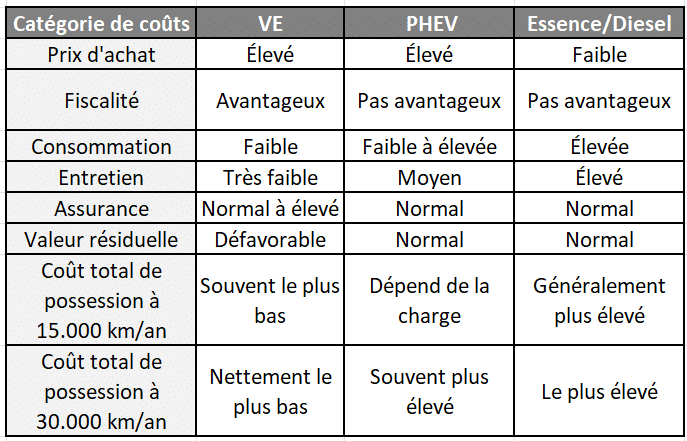
If we take into account all the costs mentioned above (see table below), we see that a fully electric vehicle is already an economical choice today. Moreover, the purchase price of a new electric vehicle shows a downward trend, and very recently we have observed an increase in purchases of used electric vehicles. This trend further boosts the transition to electric cars.
FAQ - The cost of owning electric vehicles
Yes, in many cases. Although the purchase price is higher, lower consumption and maintenance costs mean that the total cost per kilometre often turns out to be lower over time.