At a glance
Discover the results of Redion's 5th Mobility Barometer, with the latest trends in how Belgians get around.
Every year, Belgians' mobility habits change under the influence of economic trends, technological innovations and measures adopted by public authorities. Since launching its first "Mobility Barometer" in March 2022, Redion has set itself the mission of measuring how Belgians perceive sustainable mobility and their willingness to adopt alternative modes of transport.
The 2026 edition analyses not only the overall view of the population, but also the differences between residents of urban and non-urban areas, as well as between generations.
A few figures from the 2026 Mobility Barometer
- 40% of Belgians are rather opposed to the political decisions made about alternative mobility.
- 21% think the shift to 100% electric mobility won't happen by 2040.
- 23% of Belgians used their car less in 2025 for financial reasons.
- 62% say their next car will not be electric.
- 74% of Belgians would not buy a used electric car.
- 43% notice that the number of public charging points has increased in Belgium, 32% still find the number insufficient.
- 53% of Belgians find that road layouts are often inadequate or even dangerous for active mobility users.
- 40% believe that mobility in cities will get worse in the coming years.
The transition to electric cars
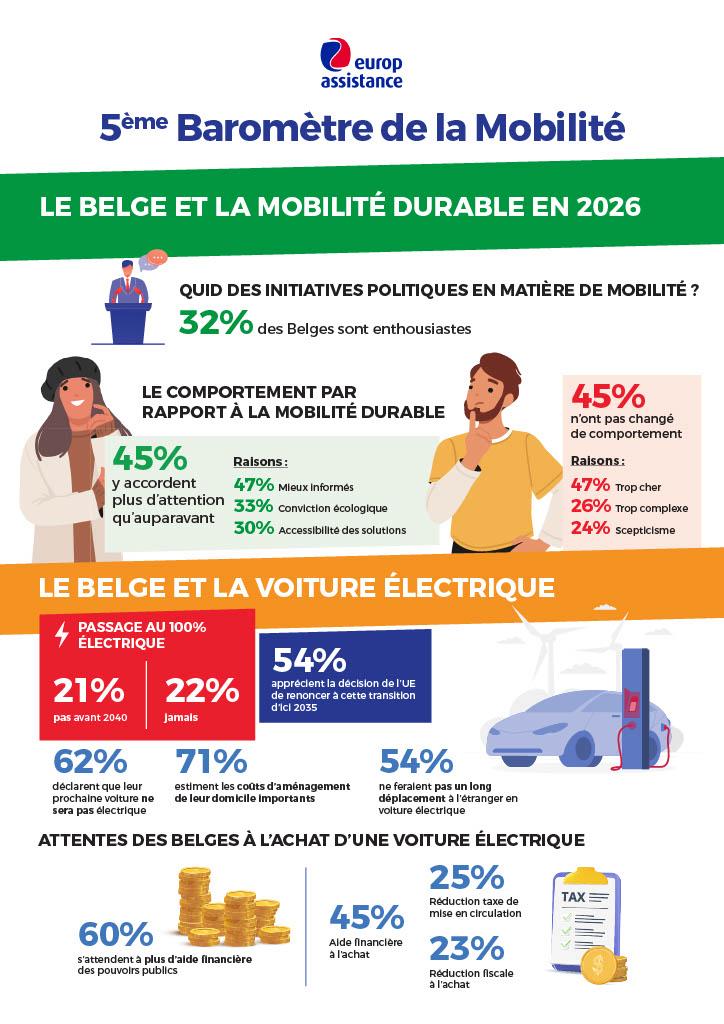
The shift to 100% electric mobility: 19% of Belgians think the shift to electric mobility won't happen before 2035 for new vehicles. The other respondents expect this transition to happen much later (2040: 21% / 2045: 12% / 2050: 15% / "never": 22%). Young people are significantly the most optimistic.
The European Union's decision to drop the 100% electric requirement for manufacturers by 2035 is welcomed by 54% of Belgians. 25% regret this decision.
Belgians' next car: the next car for 38% of Belgians will be 100% electric. The majority will therefore continue to opt for a combustion or hybrid vehicle for their next purchase (62%). Note that Dutch speakers are more inclined to make this switch (42% vs. 33% of French speakers).
Another notable point: 87% of those currently driving a 100% electric vehicle plan to keep using this type of vehicle, 70% of plug-in hybrid drivers are ready to make the switch, but 71% of combustion-engine drivers say they're not interested in an electric vehicle next!
Belgians' dependence on their car remains high: 75% of the population who own a car say they cannot do without it. And 54% don't (yet) consider taking a long trip (such as for a holiday) in an electric vehicle.
Buying an electric car: obstacles and incentives
The financial obstacle: the main barrier to switching to an electric vehicle is financial. Indeed, 60% of Belgians feel that public authorities aren't doing enough to give them financial help. 45% would like financial help towards the purchase, 25% a reduction in the registration tax and 23% a tax reduction on purchase. Note that, aside from the purchase price, considered significant, other expenses such as installing a charging point or adapting the home would represent a significant cost for 71% of potential buyers of this type of vehicle.
Charging points: another decisive factor is the presence of charging points. The population is pleased to note that the number of charging points has increased since last year (43%), though 32% find this improvement insufficient. Positive reactions on this point mostly come from Flanders, where 50% of the population notices and appreciates the increase in charging points (vs. 33% of French speakers). This same positive trend is observed abroad.
Used electric vehicles: when asked "Would you buy a used electric car?", 74% of Belgians say "no". 47% simply don't want this type of vehicle, 46% are wary of the battery's condition, 19% don't have a sufficient budget and 16% never buy used cars.
The 26% of Belgians who answer "yes" do so for budget reasons (85%), 26% out of habit of buying used cars and 22% out of trust in their garage/dealer.
Changes in urban mobility
A few findings from the survey:
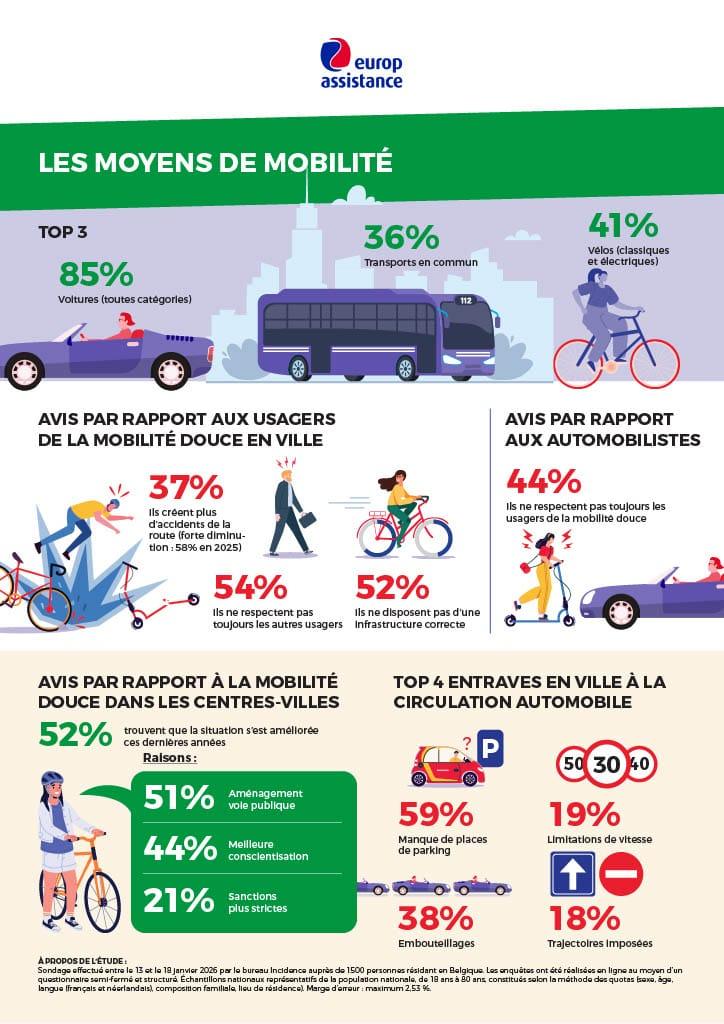
Half of the Belgians surveyed (52%) feel that active mobility has improved in cities in recent years. 35% disagree. Those who note an improvement attribute it to changes to public roads (51%), greater driver awareness (44%), stronger enforcement against offenders (21%) and safer modes of transport (20%).
However, safety in cities remains a sensitive issue that deserves a great deal of attention from decision-makers.
- 25% of people do not feel safe in cities when using active mobility.
- 37% say they have to constantly watch out for drivers' behaviour.
- Only 11% have a genuine sense of safety.
- 52% of users claim that the current layout of city roads doesn't allow active mobility users to travel safely, and 53% say that the improvements made are inadequate or even dangerous for active mobility users.
- While 54% of respondents feel that active mobility users don't always respect other road users, 44% of respondents feel that drivers don't sufficiently respect active mobility users.
As for drivers travelling in cities, the biggest obstacles to their journeys are the lack of parking spaces (59%), traffic jams (38%), having to drive through (heavily) speed-restricted zones (19%) or having to follow imposed routes (18%). Overall, 40% of respondents believe that mobility in cities will get worse in the coming years.
Redion's 2026 Belgian Mobility Barometer: FAQ
This is an annual survey launched in 2022 by Redion Belgium to analyse how Belgians perceive sustainable mobility, electric cars, changing transport habits and related public policies.
- What are the main findings of the 2026 edition?
- Slightly declining support for sustainability issues.
- The 100% electric vehicle only appeals to 38% of Belgians.
- 62% say their next car will not be electric.
- Active mobility is growing but the feeling of insecurity in cities persists.
- 40% of Belgians remain opposed to political decisions on mobility.
- How do Belgians view sustainable mobility?
Nearly two thirds consider sustainable mobility important, but this proportion is decreasing year after year.
Those who place less importance on it mainly cite:
- cost (47%),
- the complexity of adapting to it (26%),
- scepticism about its real impact (24%).
- Are Belgians changing their transport habits?
Yes, but only moderately:
- 33% are reducing their use of combustion-engine cars,
- 20% are increasingly using active mobility,
- 11% are travelling less.
However, 75% of people who own a car feel they cannot do without it.
- How do Belgians react to political decisions on mobility?
The population is divided:
- 32% are enthusiastic,
- 40% are opposed or reluctant. Young people are notably more in favour than those over 55.
- What is the perception of the transition to 100% electric mobility?
Belgians expect a slower transition than planned:
- 19% think the shift will be possible before 2035, 21% by 2040,
- 54% approve of the European decision to push back this deadline,
- 22% even believe it will "never" happen.
- Are Belgians considering buying an electric car?
- 38% plan a 100% electric vehicle for their next purchase.
- Dutch speakers are more inclined to do so (42% vs 33% of French speakers).
- 74% would not buy a used electric car, mainly out of fear about the battery's condition.
-
What are the main obstacles to buying an electric vehicle?
-
The purchase cost (main obstacle).
-
Additional expenses: charging point, home installation (71%).
-
Perceived lack of financial support (60%).
-
Doubts about range or the battery.
-
Are charging points considered sufficient?
Perceptions are improving but remain mixed:
- 43% notice an increase,
- 32% consider this progress insufficient,
- Positive reactions are stronger in Flanders (50%).
- Do Belgians feel safe using active mobility in cities?
The feeling remains a concern:
- 52% feel that current layouts don't allow safe travel,
- 37% say they constantly have to watch out for drivers,
- 25% don't feel safe in cities.
Road infrastructure is often seen as inadequate or dangerous (53%).
- What trends have changed over the past five years?
- The priority given to sustainable mobility is decreasing.
- The feeling of being able to live without a car is falling sharply.
- More marked regional disparities (greater reluctance in Wallonia than in Flanders towards mobility policy and certain aspects of sustainable mobility).
- Anxiety linked to active mobility has stabilised and has been decreasing since 2025.
The full press release and the complete presentation are available on request.