At a glance
Discover our tips for driving your electric vehicle safely in winter (charging, tyres, driving...)
Electric cars are becoming more and more common on our roads, and more and more drivers of these vehicles have to deal with winter conditions.
If this applies to you, to what extent should you adapt your driving to guarantee the best range for your vehicle?
Is it true that an electric vehicle's battery weakens faster in winter?
What about winter tyres?
Our blogger Alain Dierckx gives us some tips.
1. The range of an electric vehicle in winter
Why is the range of an electric vehicle lower in winter?
The range of an electric vehicle (i.e. the maximum number of kilometres an electric vehicle can travel before it needs to be recharged) can drop by 25 to 30% in winter compared to summer. Several reasons explain this:
- First of all, a lithium-ion battery is sensitive to cold temperatures, especially below 10°C. The battery's chemical processes then run more slowly.
- The energy needed to heat the cabin of an electric vehicle significantly reduces its range. Unlike a combustion-engine car, which uses residual heat, the heating (very energy-intensive) of an electric vehicle must be generated entirely from its battery. Some models on the market today offset this by offering an optional heat pump.
- The system that manages the battery's operation can also play a role, as it aims to extend the battery's lifespan.
- Finally, when braking at low temperatures, the system that recovers energy is less active, precisely in order to protect the battery.
How can you reduce the range loss of an electric vehicle in winter?
- If possible, park your electric vehicle indoors or as sheltered as possible from low temperatures. When the temperature is close to 0°C, the battery tends to discharge slightly.
- Before setting off, use your smartphone app to heat your car for about an hour while it is connected to its charging point. This way, the energy used for heating won't come directly from the battery, and you won't have to start off cold. It will also defrost your windows.
- While driving, it's best to switch on the seat heater, as it uses up to a quarter less energy than heating the cabin. If you use the car's air conditioning, avoid switching it on and off constantly, and instead set it permanently as low as possible. This will save energy.
- While driving, limit the use of electronic devices, such as plugging in and charging smartphones.
2. Charging an electric vehicle in winter
What's the best way to charge an electric car in winter?
- The battery should be charged to at least 20%, a percentage needed to heat the inside of the car.
- Remember that charging your electric vehicle at low temperatures will take longer than usual.
- If you don't use your electric car for several days in winter, make sure the battery stays at least half charged.
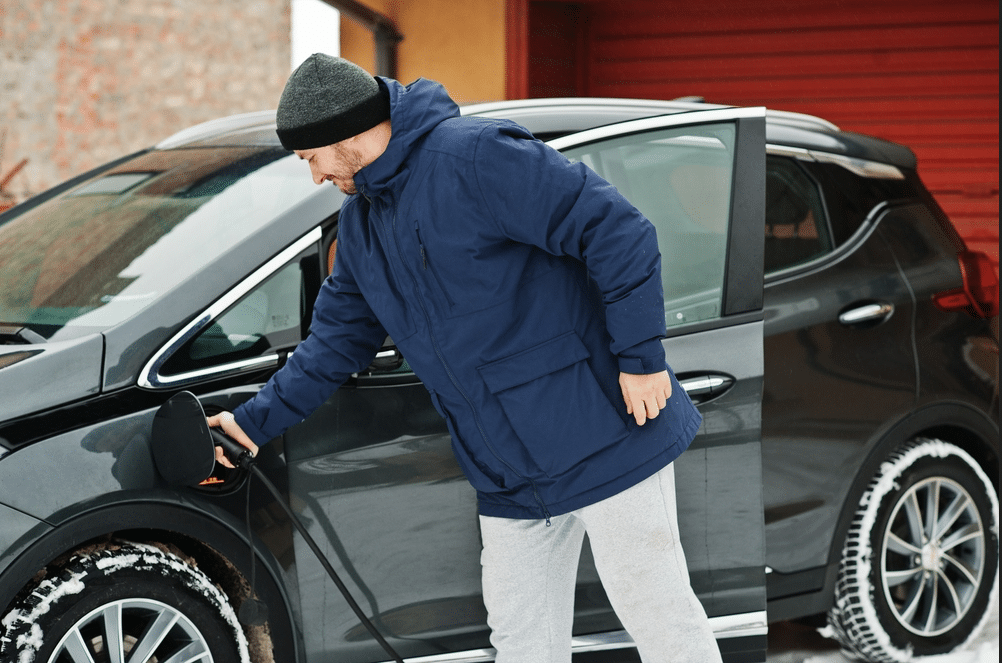
- When temperatures are low, it's best to store the charging cable somewhere that isn't too cold. If your charging cable stays outside, make sure it doesn't freeze. If it does, defrost it with a hot water bottle rather than pouring a bucket of hot water over a cable that's under voltage!
- Always keep a charging cable in your car "just in case"...
3. Driving an electric vehicle in winter
How should you adapt your driving in winter?
- As with combustion-engine cars, it's not advisable to accelerate quickly on slippery or snowy roads. Read our tips here for driving well on a snowy road.
- Drive at a constant speed and reduce your speed by at least 10 or 15 km/h compared to normal.
- Activate "eco" or "winter" mode (if available) to save energy and also to reduce the risk of skidding.
- Adjust your driving behaviour and save energy, for example by proactively slowing down when approaching a busy traffic area.
4. Electric vehicles and winter tyres
Is it a good idea to fit winter tyres on an electric vehicle?
Since electric cars are heavier, have higher power output and accelerate quickly, the risk of skidding on wet or slippery roads is higher than for combustion-engine cars.
In addition, the tyres of an electric vehicle are generally larger, and "all-season" tyres don't perform as well as winter tyres.
As a result, thanks to better grip and shorter braking distances, winter tyres are always recommended, especially if the outside temperature drops below 7°C. Car tyres need to stay flexible whatever the weather conditions. This is the case with winter tyres in cold weather. Some countries make the use of winter tyres compulsory.
5. What about the batteries of light four-wheeled electric vehicles?
The batteries of light electric vehicles such as scooters, pedelecs, motorcycles or quads are very sensitive to cold. During the winter period, it is therefore best to use and regularly recharge such a vehicle. In freezing weather, it's best to park these vehicles indoors (in a heated space) or, at the very least, in a sheltered spot.