At a glance
Discover our tips to help you cycle as safely as possible and avoid being the cause of an accident.
Various recent studies from Ghent University, the VUB, Utrecht University and Vias, among others, have looked into the most common causes of bicycle accidents.
At the same time, the Brussels-Capital Region has calculated that the number of bicycle accidents on its territory rose by 123% between 2011 and 2019.
External factors, but also cyclists' own behaviour
These studies show that some accidents are due to factors external to cyclists, such as other road users — in particular motorists and lorry drivers — the condition of the road surface, a lack of suitable cycle paths, or weather conditions.
But other factors are directly influenced by cyclists themselves, such as whether or not they wear a helmet and appropriate clothing, their visibility (reflectors), failure to follow traffic rules (observing road signs, riding alongside cycle paths instead of on them…) and reckless riding (speed, running a red light, drinking alcohol...).
During the lockdown periods, many people took up cycling as a (new) way of getting around. But some cyclists aren't used to sharing the road with other users, especially in urban areas where cyclists often have to make their way through traffic.
How can you reduce the risk of a cycling accident?
Based on the findings of the studies mentioned above, here are a few tips and points to bear in mind to help you share the road with other users as safely as possible:
- Make sure your bike is in good working order (brakes, bell, tyres, e-bike battery, etc.), that it complies with the highway code and that it's sufficiently visible (lights, reflectors, etc.).
- Wear appropriate clothing (sturdy shoes, reflective clothing, a bike helmet).
- Follow the highway code and the direction of traffic, and don't run red lights (unless a specific sign allows cyclists to do so).
- Respect other road users: watch out for pedestrians and those using another form of soft mobility (e.g. scooters, unicycles, hoverboards, etc.). Make yourself heard by ringing your bell in good time when overtaking a vulnerable road user.
- Always stay alert when riding alongside or between cars, buses and lorries. Studies show that both motorists and cyclists have trouble correctly judging each other's speed.
- Anticipate other drivers' behaviour.
- Get to know the route you'll be taking regularly, for example to get to work or to school. Watch out for dangerous spots, busy intersections, etc.
- Be careful if you have to cycle in winter conditions.
- Autumn is generally a dangerous season for cyclists: days get shorter and the weather can change quickly. Make sure you stay visible.
- As a road user, don't drink alcohol and don't take drugs or narcotics.
- Make sure you can see and hear the traffic around you clearly. Don't use earphones or headphones that make it hard or impossible to hear the traffic around you.
- Watch out for low, blinding sun or moments of poor visibility (fog or mist).
- It goes without saying that riding without holding the handlebars, or taking photos or browsing your smartphone while cycling, is forbidden!
- Don't forget the blind spot of cars and especially lorries. Be particularly careful when these road users change direction.
- (New) cycle paths on public roads aren't always well known to drivers — not even those who live in the area or pass through it regularly. So they don't automatically provide extra protection for cyclists!
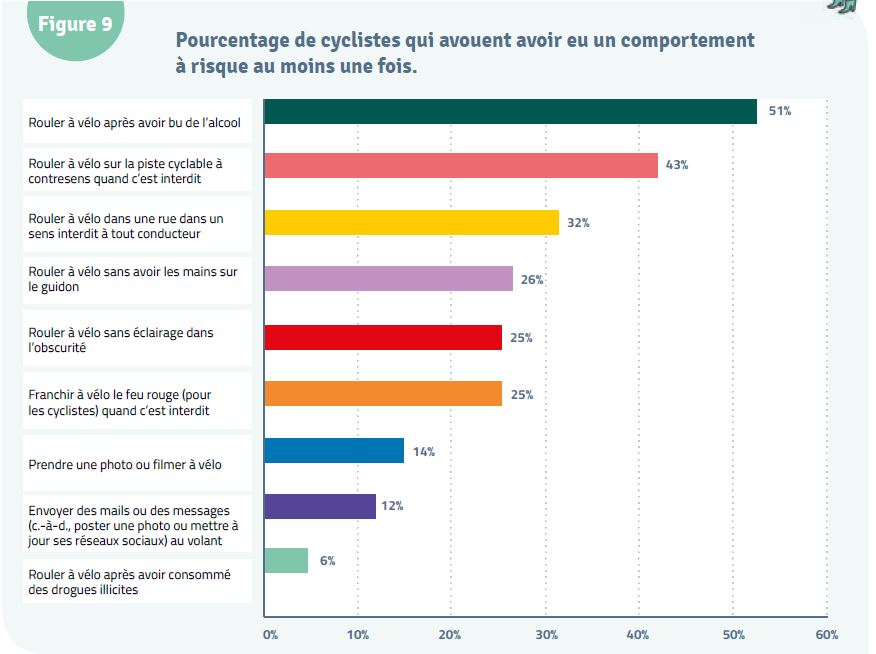
Table taken from Vias's 2020 national road safety survey: