At a glance
Did you know that eco-driving affects not only your car costs but also your CO2 emissions?
Do you drive regularly? For work, to take your children around, or on holiday down south? You probably have some idea of what all those kilometres cost. The budget they represent is probably fairly substantial.
What if there was a way to significantly reduce these costs without much effort?
Our blogger Alain Dierckx explains the (ecological and economic) benefits of eco-driving (also known as economical or sustainable driving).
What is eco-driving?
Eco-driving, or sustainable driving, means that as a driver you take targeted measures regarding your vehicle and your driving behaviour. These measures have a positive effect on three important points:
- reducing energy and/or fuel consumption
- increasing road safety
- reducing air pollution through lower particulate matter and CO2 emissions.
How can you adopt eco-driving?
You can optimise your driving behaviour in several ways.
- Departure time: to avoid traffic jams and therefore delays, you should think about the ideal time to leave. Obviously, this means avoiding everyone's usual peak hours, and if you're travelling, it's best not to leave on days flagged in advance as heavy-traffic days. Sunday morning is usually a good time to set off. Driving at night is not recommended due to the lack of safety.
- Avoid sudden braking and acceleration: try to drive at a constant speed as much as possible. Use cruise control when possible and allowed. Drive proactively and brake gradually. This driving behaviour is particularly crucial in cities, since that's where the gains are greatest.
- Change gear at the right time: for diesel vehicles, that's between 1,500 and 2,000 rpm; for petrol vehicles, between 2,000 and 2,500 rpm.
- Adapt your speed: drive at 100 km/h instead of 120 km/h, for example. This reduces fuel consumption and makes for greater safety. Road accidents at lower speeds have less serious consequences than at high speed.
- Air conditioning: only switch on the air conditioning when the temperature inside the car is too high, since an overly hot cabin can have a negative effect on safety. Indeed, the driver's attention decreases and reaction time increases. When doing so, avoid too large a difference between the outside temperature and the temperature inside your vehicle. If your car has been sitting in the sun for a long time and the inside of the cabin is "scorching", first open the windows for the first few kilometres to bring the interior temperature down, and only switch on the air conditioning afterwards.
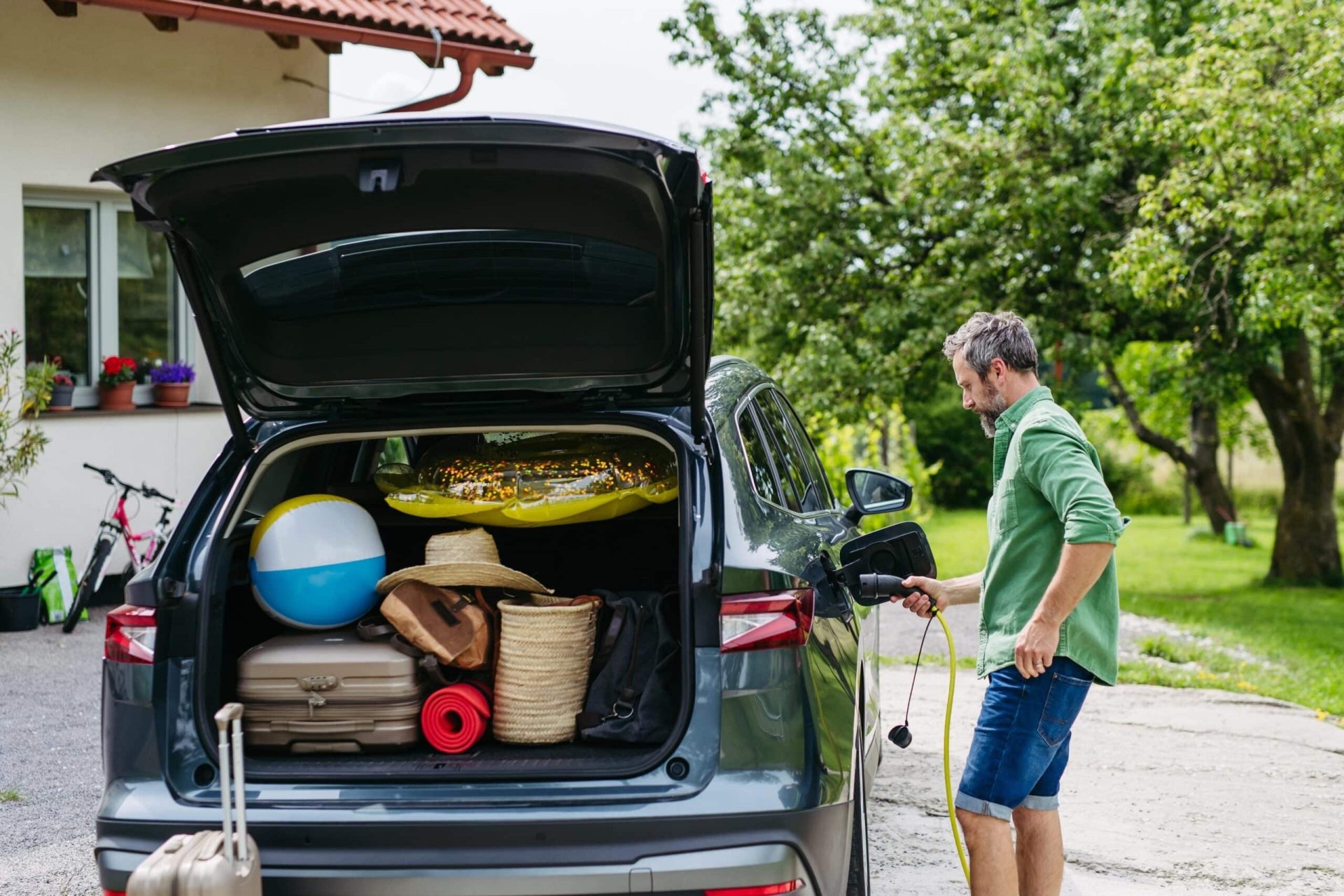
- Charging the battery (electric vehicle): choose your charging moments wisely. Charge your battery when it's between 20% and 80%, as this is the most efficient and reduces your energy consumption. Your GPS can help you plan your charging sessions.
How to prepare your vehicle for eco-driving
The way you drive matters, but the condition of your vehicle also plays a role.
- Maintenance: make sure your vehicle is properly and regularly maintained so that everything works perfectly. The brakes and exhaust system in particular need to be in good condition, otherwise you'll emit too many particulates.
- Tyres: under-inflated tyres increase fuel consumption and wear. If you're expecting a heavier load (more passengers, more luggage), inflate them a bit more.
- Roof boxes: only consider a roof box if it's really necessary, as it increases fuel consumption due to greater air resistance. Once you've reached your travel destination, if you're only driving in the immediate surroundings, remove the roof box until you set off again. The same applies to bike racks.
How much can you save through eco-driving?
The scale of the savings depends on the type of vehicle, the type of route and, above all, the driving behaviour before switching to eco-driving.
For already "normal" usual driving behaviour, the overall saving can be 5%. If you usually display a "sporty driving style" and switch to eco mode, savings can reach 15%, meaning eco-driving can save several hundred euros a year.
Here's an overview of the savings different measures can achieve:
- Properly inflating your tyres can save you up to 10% in fuel consumption if you set off on a heavily loaded trip.
- Cleaning or replacing a clogged air and/or oil filter achieves a 3% saving.
- Not using a roof box will reduce your vehicle's fuel consumption by around 18%.
- Controlled and measured braking and acceleration saves 20%, especially in town.
- Driving more slowly can achieve very significant savings. For example, driving an electric car at 100 km/h instead of 120 km/h saves (according to some studies) between 20% and 36% on consumption.
CO2 reduction through eco-driving
The percentage reduction in CO2 and particulate emissions achieved by eco-driving is difficult to calculate, but some sources give the following values (see https://www.hellocarbo.com/blog/calculer/co2-voiture/):
CO2 emissions per litre of fuel:\
- petrol: 2.28 kg of CO2\
- diesel: 2.67 kg of CO2\
- unleaded 95 (E10): 2.21 kg of CO2
Generally accepted overall figures are hard to find in the specialist literature. This is due to the wide variety of vehicle types, fuels and drivetrains (petrol, diesel, LPG, hybrid, electric). For now, it's clear that the choice of fuel is essential.
Electric cars clearly emit less CO2, even though their CO2 emissions were higher when their battery was manufactured. Indeed, an electric car emits around 60% less CO2 than a petrol car over its lifetime.
This does not, however, apply to a vehicle with a hybrid system (petrol engine and electric motor). Compared with a petrol car, these better performance figures are certainly presented in an exaggerated way, since in practice the electric motor is used very little.
Some factors you don't control
As a driver, you obviously have no control over traffic. Traffic jams, roadworks and the behaviour of other drivers are beyond your control, but they do affect your consumption and the time you spend in your vehicle. However, you can try to use your car during quieter times on the roads.
Weather conditions are another external factor you unfortunately can't fight against. Heat, cold, snow and other phenomena can make driving on the road difficult.
A mountain journey will have a negative effect on your consumption.
Checklist for eco-driving
Below, we've put together a few questions you should ask yourself if you want to adopt eco-driving:
- Is my car well maintained?
- Are my tyres properly inflated?
- Do I really need this roof box?
- Am I leaving and coming back at the best time?
- Am I not driving too fast?
- Am I driving proactively and braking gradually?
- Do I switch off the engine if I'm stopped for a long time?
- Am I changing gear at the right time?
- Am I charging my battery properly and at the right time?