At a glance
Plenty of people snowboard, but some prefer sandboarding or sandsurfing.\ What is it? Where can you try it?
Plenty of people snowboard, but some prefer sandboarding or sandsurfing!
What is it? Where can you try it?
Sandboarding and sandsurfing
As the name suggests, sandboarding or sandsurfing means surfing on sand.
The activity was born near Malibu, California, in the 1960s. Back then it was seen as the ideal alternative when the waves weren't good enough for surfing in the sea.
Since the 2000s, "dune surfing" has earned its stripes as a new leisure activity and sport. It's now practised in high-dune spots all over the world. International sandsurfing competitions have existed since 2006.
Sandboarding remains less popular than snowboarding though, and for good reason: it's harder, if not impossible, to build ski lifts in the dunes! Surfers therefore have to climb back up the dunes on foot, often in places where it's very hot. So they need to be in excellent physical shape, both for the climbs and the runs down.
The sandboard, the board used for this kind of surfing, isn't quite comparable to a snowboard. It's stiffer and made from different materials that hold up better against contact with sand. The wax used to make the board slide is specially designed for use on sand.
Where can you go sandsurfing?
To practise this sport, you need high dunes with no vegetation and no rocks. There's no shortage of places, though: the best known are in Brazil, Little Sahara in Australia, Egypt, Morocco, the Namibian desert, South Africa, Oregon (USA), Peru, Chile, Nicaragua, France (the Dune of Pilat), ... and plenty of other spots besides.
Sandsurfing is a great alternative for fans of the thrill of sliding down a slope ... who can't stand the cold!
And for those who aren't so keen on sandboarding, there's also sand skiing!
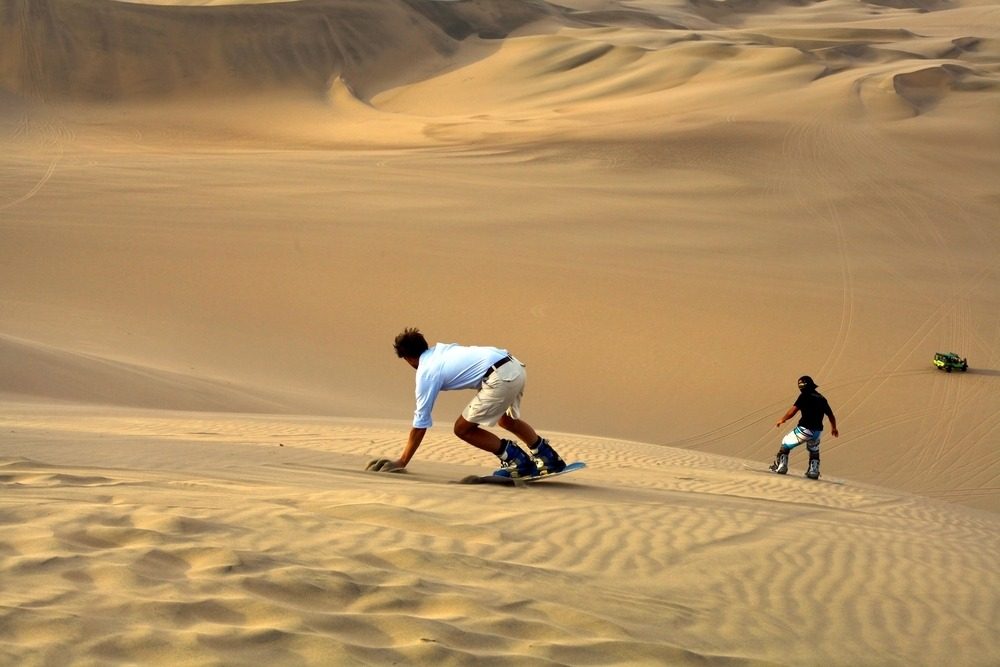
Below, a sandboarding athlete in action in Peru: