
At a glance
The internet is divided into 3 layers: the surface web, the deep web and the dark web. Each layer has its own features and uses.
Did you know?
The internet is divided into 3 layers: the surface web, the deep web and the dark web.
Each layer has its own features and uses.
The web isn't just content pages, emails, social networks and the occasional interesting blog. To borrow a widely used image, the web is like an iceberg. The surface web is the visible ice you can see with the naked eye. The deep web and the dark web are the huge submerged parts.
Surfing the "surface web"
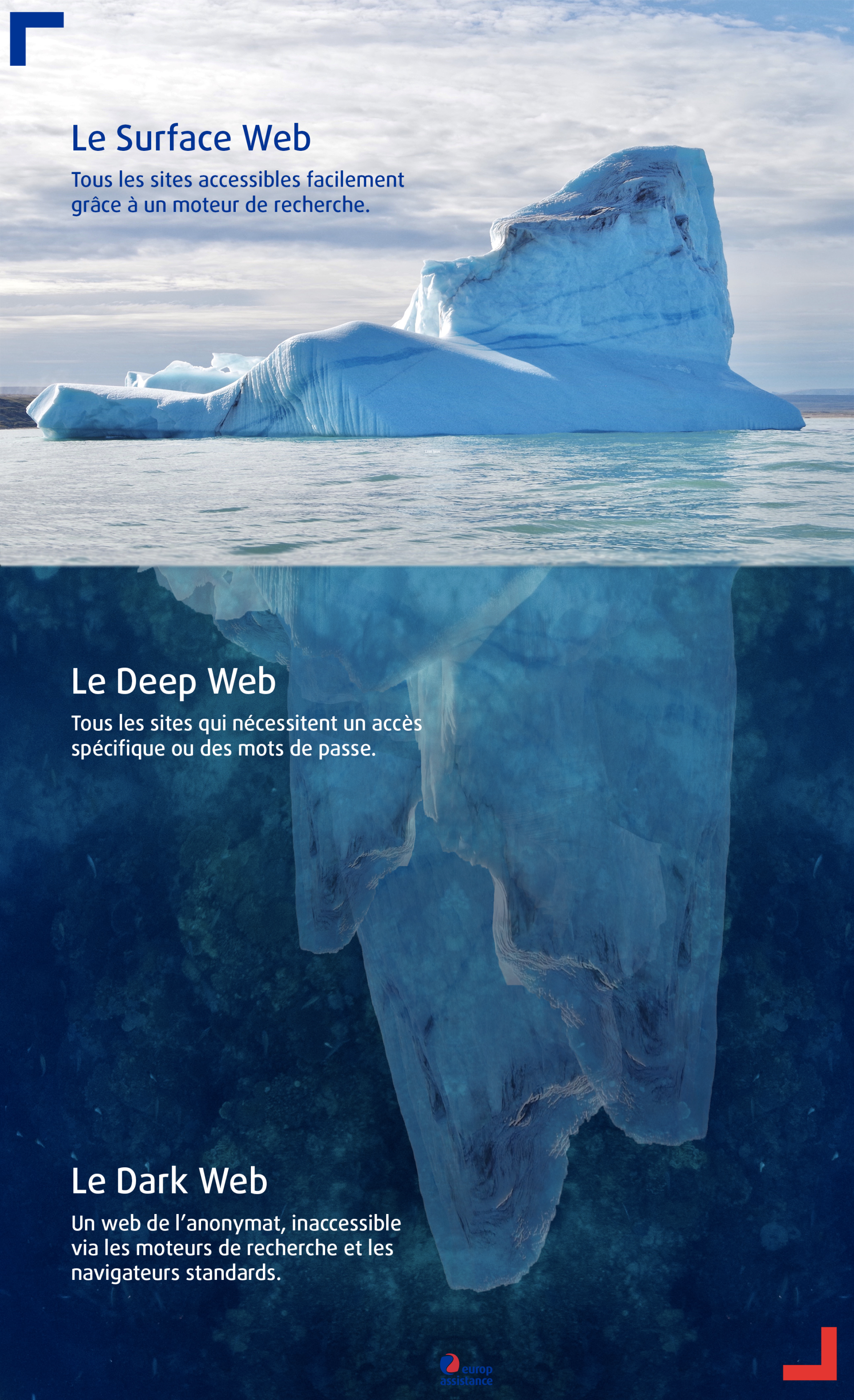 Definition of the surface web
The surface web includes all the sites that are indexed by search engines and findable with a simple keyword search. This is, for example, the page you're currently reading. This blog you visit regularly. It's Facebook, Wikipedia, your national rail operator's website or a recipe site, to name just a tiny fraction of the 800,000 sites that spring up on the web every day.
Who uses the surface web?
In principle, every internet user. According to a study by Hootsuite and We Are Social, there were 4.66 billion internet users in 2021! Most of these visitors are said to be online for almost 7 hours a day.
How do you access the surface web?
All you have to do is open a browser (Edge, Chrome or Safari, among others) and type a query into a search engine to browse the surface web. That's what you do every day.
A dive into the "deep web"
Definition of the deep web
Unlike the surface web, the deep web covers all the pages and websites that are not indexed by search engines. For example, this is where you'll find a site's admin pages, your online banking interface or YouTube videos you've chosen to publish privately.
Who uses the deep web?
Even though the statistics are rather fuzzy, it's estimated that the deep web accounts for between 70 and 95% of the web's content. So we all use the deep web at least once a day. We log into our online bank, into a secure remote-work space, into Redion's client area, into a data storage system like the Cloud ...
How do you get into the deep web?
The deep web is a protected space, because it's not accessible to just anyone. You need specific codes or links to access it ... But there's nothing illegal about it.
There are several ways to access the deep web. For example:
- A hyperlink you were sent to access a video or a PDF document
- Personal, specific codes, like the ones you enter on your bank's portal to view your bank accounts.
What about data on the surface web and the deep web?
Data stored on the web, whether on the surface web or the deep web, theoretically has an unlimited lifespan. But the reality is often more complex: data depends on the storage spaces that hold it and on any sharing that may take place.
A piece of data can be lost or destroyed (during a physical incident, such as a fire) or, conversely, redistributed following a server change.
The underground world of the "dark web"
Definition of the dark web
The dark web is a network of sites that are inaccessible to traditional browsers and search engines. The dark web escapes all control and censorship. It guarantees anonymity and data encryption that go even further than on the other layers of the web.
Who uses the dark web?
People who use the dark web precisely want to remain anonymous.
The dark web obviously has a shady reputation. It's home to a huge number of illicit sites and resources, ranging from drug sales to illegal pornography, as well as ultra-violent extremist sites and directories of contract killers.
But the dark web can also be used for nobler causes. For instance, activists, political opponents or whistleblowers, persecuted in their own country, can use the dark web to get around a locked-down surface web.
How do you get into the dark web?
You access it via specific links and steps, and certainly not by chance. The main tool for getting into the dark web remains the TOR system - The Onion Router.
In summary: the differences between the deep web and the dark web
The deep web represents the largest part of the web: it's accessible via hyperlinks you already know, or via personal codes. The dark web is an underground network, focused on people's anonymity, which is not accessible via search engines or traditional browsers.
As you can see, we all use the surface web and the deep web almost every day. We watch videos there, post our personal information there ... In fact, do you know how to react to the theft of your personal data?
Article written in collaboration with We are the Words.