At a glance
-
An ear infection doesn't always stop you from flying: it all depends on the type.
-
Acute middle ear infection (otitis media) is a formal contraindication to flying.
-
Children are more vulnerable to cabin pressure changes.
-
If in doubt, see a doctor before departure.
-
If the trip has to be cancelled, travel insurance can cover you.
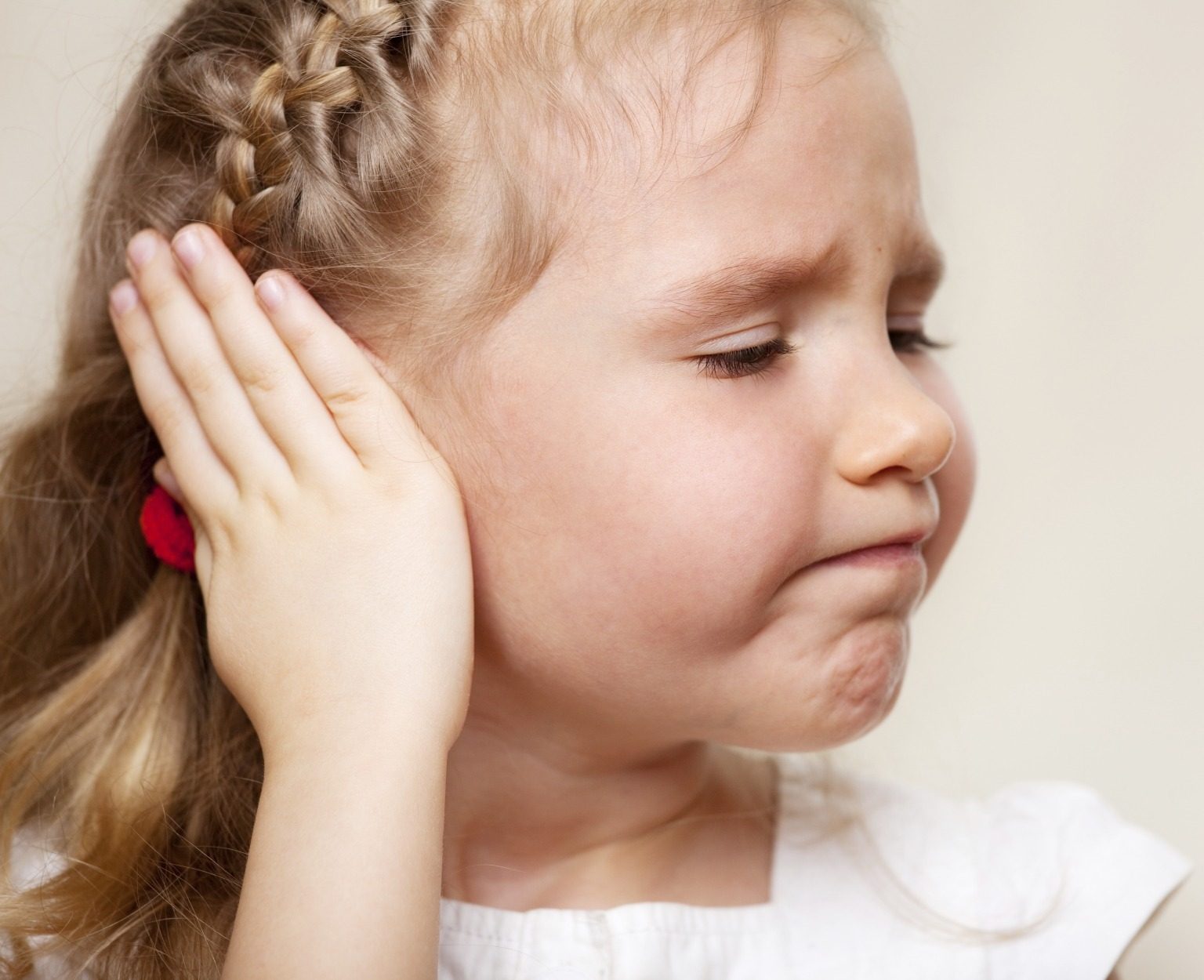
It's the day before departure. Bags are packed, tickets are printed. And your child wakes up in tears, hand on their ear. The doctor mentioned an ear infection. And the flight takes off in less than 24 hours. Should you cancel? Can you still go? Is there a real risk, or just discomfort?
While 80% of children have an ear infection before the age of 3, 45% of them even have up to three during this period of their life. So the question arises as to whether flying might tear the sick child's eardrum or cause them severe pain.
The issue can also arise in adults. Every year, Redion opens dozens of medical files following an ear infection that occurred before or during a holiday abroad.
Some forms of ear infection allow you to fly safely. Others expose you to severe pain, or even eardrum damage. This guide gives you the keys to understanding what happens in your ears at altitude, and to making the right decision before boarding.
The effect of flying on an ear infection
The Eustachian tube: the conductor of pressure
Inside your ear, a small canal connects the middle ear to the back of the nose and throat: this is the Eustachian tube. Its role is discreet but essential: it constantly balances the pressure between the inside and outside of the ear.
Normally, it opens briefly with every swallow or yawn, letting air circulate freely. This mechanism is enough to compensate for the slight everyday pressure changes.
With an ear infection, this tube is inflamed, swollen, sometimes blocked. It can no longer properly perform its function. And that's where flying becomes a problem.
What actually happens during take-off and landing
In flight, cabin pressure is maintained at a level lower than at ground level, equivalent to an altitude of around 2,000 to 2,500 metres. These pressure changes are handled without difficulty by a healthy ear.
At take-off, the air contained in the middle ear expands. The excess is normally released through the Eustachian tube, without pain.
At landing, the opposite happens: pressure increases sharply. The ear has to absorb this influx of air. If the Eustachian tube is blocked, pressure builds up against the eardrum. It bulges, retracts, and can cause intense pain, or even tear. This is known as ear barotrauma.
Why are children more vulnerable?
In young children, the Eustachian tube is shorter, more horizontal and narrower than in adults. It swells more easily under the effect of inflammation and struggles more to rebalance pressure. A child under 3 also doesn't yet have the instinctive reflex to swallow to relieve pressure.
The result: for the same type of ear infection, a young child will feel more intense pain than an adult, and the risk of complications is higher.
The 4 types of ear infection: what each one means for flying
Not all ear infections are alike. Before deciding whether you can board, it's essential to identify the type of ear infection involved. Here is a clear overview of the four most common situations.
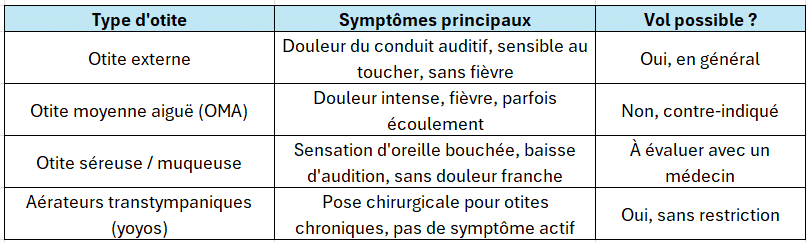
Outer ear infection (otitis externa), also known as "swimmer's ear", is an inflammation of the outer ear canal, before the eardrum. The middle ear and Eustachian tube are not affected. Pressure equalisation therefore remains possible. Flying is allowed, even if the pain when touched can be uncomfortable.
Acute middle ear infection (acute otitis media) is the most common form in children. A bacterial or viral infection causes a build-up of pus behind the eardrum. The Eustachian tube is blocked. Flying is formally contraindicated: cabin pressure can worsen the infection, cause unbearable pain and, in the most severe cases, lead to a perforated eardrum. It is recommended to wait at least two weeks after the end of treatment before flying again.
Serous or mucoid otitis media is characterised by a build-up of fluid behind the eardrum, without active infection or marked pain. It can sometimes be difficult to detect in children, who may simply seem less attentive or hear poorly. If the eardrum has already been opened by the doctor, flying is generally possible. Otherwise, caution is advised: consult your paediatrician or ENT doctor before departure.
Transtympanic ventilation tubes, better known as "grommets" or tubes, are small devices surgically placed on the eardrum to allow air to circulate freely between the inner and outer ear. They perform precisely the function of the Eustachian tube. Pressure equalisation therefore happens naturally, and flying poses no particular problem.
Cold, sinusitis: just a bit of congestion?
 No diagnosed ear infection, but a blocked nose, ears that "pop", slight pressure in the sinuses. Can you fly without risk?
The answer is nuanced. This is precisely where many travellers get it wrong.
A simple cold is not, in itself, a contraindication to flying. But it only takes enough congestion to partially block the Eustachian tube for the situation to turn. The mechanism is identical to that of an ear infection: if air can no longer circulate freely, pressure builds up against the eardrum on landing. The pain can be sharp, sudden, and in some cases lead to barotraumatic otitis, i.e. inflammation of the middle ear directly caused by pressure changes during the flight.
The same risk applies with sinusitis: the inflamed sinus cavities communicate with the Eustachian tube, and heavy congestion can compromise ear pressure equalisation.
These situations don't automatically mean the trip has to be cancelled. But they deserve medical advice before departure, especially if symptoms are intense or the flight is long. Your doctor can assess the risk and, if necessary, prescribe a decongestant to take before boarding to help the Eustachian tube open during the flight.
This advice also applies to children with colds. A very congested infant on board a plane can suffer intensely without being able to express it other than through prolonged crying.
The right reflexes during a flight
The doctor has given the go-ahead, or the trip is unavoidable. In any case, a few simple actions can make a real difference in getting through the flight without too much suffering.
Equalisation manoeuvres
The Valsalva manoeuvre is the best known: pinch your nose, close your mouth, and gently blow through your nose as if trying to unblock your ears. This action forces the Eustachian tube open and rebalances pressure. Practise it especially on landing, the trickiest phase.
If it feels too forceful, the Toynbee manoeuvre is gentler: pinch your nose and swallow at the same time. Less powerful, it's often enough for mild discomfort, and better suited to young children able to cooperate.
Generally speaking, yawning, chewing gum or swallowing regularly encourages the Eustachian tube to open naturally. Always keep a bottle of water within reach during descent.
Decongestant medication
On prescription or medical advice, a nasal decongestant spray taken 30 to 45 minutes before landing can significantly reduce congestion and make equalisation easier. Do not use it without medical advice, especially for infants and young children.
Ceramic filter flight earplugs
These special earplugs, available at pharmacies, slow down the pressure change in the ear canal. They don't replace medical treatment, but are a useful complement for people sensitive to pressure changes, even without a diagnosed ear infection.
Specific advice for babies and young children
An infant cannot perform an equalisation manoeuvre. The most effective solution remains to breastfeed or bottle-feed them during take-off and especially landing: repeated swallowing naturally stimulates the Eustachian tube to open. For an older child, a pacifier, a sweet or a glass of water produces the same effect.
Avoid letting the child fall asleep just before landing: the swallowing reflex is less active during sleep, which increases the risk of pain during descent.
Does the trip need to be cancelled or postponed?
If the ear infection is too severe, flying is contraindicated. Or you've made the decision yourself, as a precaution. In any case, cancelling a trip represents a real cost: plane tickets, accommodation, car rental, prepaid activities.
This is precisely where travel insurance proves its worth.
Good cancellation insurance covers non-refundable costs incurred before departure, as long as the cancellation is justified by a recognised medical reason. An acute middle ear infection diagnosed by a doctor, together with a written contraindication to travel, generally constitutes a valid reason.
To find out more, check our Redion travel insurance page.
Ready to travel with peace of mind?
Compare our plans in two minutes.
To prepare your next trip with peace of mind:
- Discover our Redion travel insurance plans
- Also check our practical guide: Flying with a baby or young child
- And if you're travelling with medication: Travelling with medication
Your questions about ear infections and flying
It depends on the type of ear infection. Outer ear infection does not stop you from flying. Acute middle ear infection, on the other hand, formally contraindicates flying: cabin pressure can worsen the infection and cause intense pain, or even a perforated eardrum. If in doubt, see a doctor before departure.