At a glance
How does a bike computer work? What's the advantage of a GPS system? What should you look out for when buying one?
Do you love cycling and covering long distances? Don't want to get lost on the way, and want to know your performance during your ride so you can share this data with friends? If so, you need a speedometer suited to your bike.
How does such a system work, and what should you look out for when buying one?
Our blogger Alain Dierckx sheds some light on the subject.
What is a bike computer?
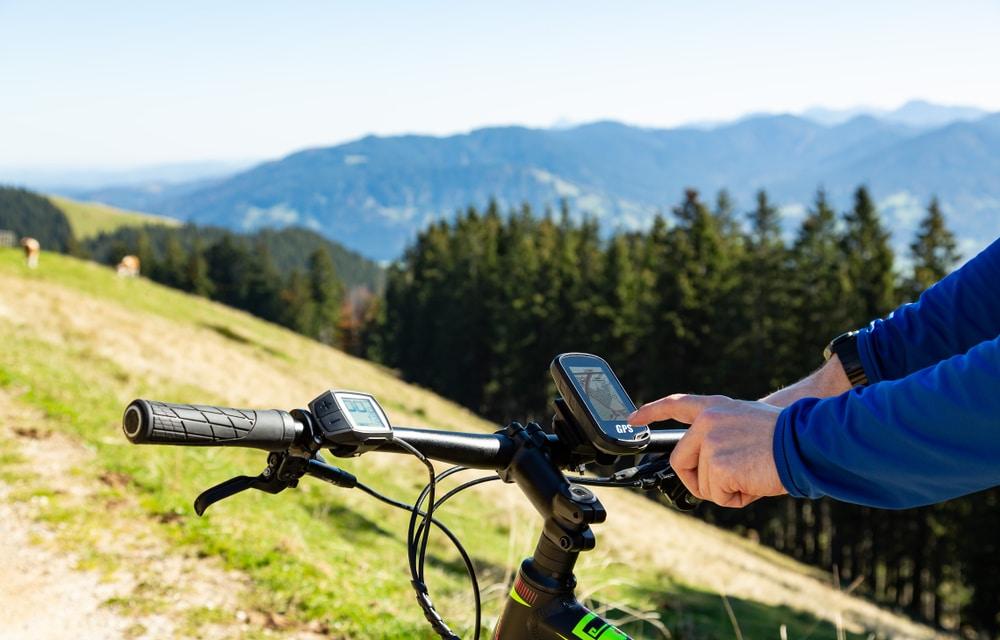
A bike computer is a device you attach to your handlebars that records data about your bike rides, such as speed, distance, time, and so on.
How does a bike computer work?
Basic models usually work with a cable connected to a magnetic sensor on the front wheel. They only offer basic functions such as measuring speed and distance and are therefore also the cheapest (starting from 12 euros).
However, a bike computer can also work wirelessly. This is much easier to install and more practical for mountain bike rides, as there's no cable that can get tangled in bushes or between branches (starting from €20).
Wireless bike computers with built-in GPS show you the way thanks to a connection with satellites, and are therefore the most accurate in terms of data collection. Prices are higher, ranging from 60 to 750 euros.
What are the most common features of a bike computer?
Besides navigation, the most common feature is collecting data on your rides, either separately for each ride or across all your rides. This lets you analyse your performance, compare it with others' and improve.
Beyond the usual data on distance covered, maximum speed, average speed, cadence and duration, a bike computer can also collect other data via a link with other devices or apps, such as your average heart rate.
Why choose a bike computer with GPS?
The great advantage of fitting GPS to your bike is, of course, that you can no longer get lost on your rides. Most systems also let you import waypoints for cycling routes (either user-created or official).
Keep in mind that bike computers with GPS are heavier and more expensive.
How do you choose the right GPS for your bike?
Think carefully before buying, as the features (and therefore the prices) vary considerably depending on the options on offer.
For example, cheaper models don't offer navigation based on a map of the area, only arrows pointing you in the right direction. In more expensive models, navigation performs better and works better in rural and wooded areas as well as in busy towns between tall buildings.
The bike computer's screen plays an important role. It needs to be big enough, as a small screen crammed with numbers and arrows isn't very practical. It's also better if it's waterproof, has a touchscreen, and doesn't reflect the sun (or stays readable in bright sunlight).
Connecting to your smartphone gives you access to several options that vary depending on the brand and model. The most popular option is, of course, sharing all the data from your rides and your performance with other people via well-known sports apps on your smartphone (Strava, Komoot, Map my Ride, etc.). It's up to you to judge whether you need all these options. Some systems let you, among other things, display incoming messages and calls on the bike computer's screen. But watch out, being distracted by such a device while riding can result in a fine!
Connecting to devices other than your smartphone is also possible. This is done via Bluetooth, for example for heart rate monitors, or with your earphones if you want to receive voice navigation instructions.
One interesting navigation option offered by several brands is "route recalculation". This is a handy feature that brings you back to your original route if you've been on the wrong path for a while. Other GPS models offer suggestions for possible nearby routes, or offer a "surprise me" feature that suggests an unfamiliar route.
Another handy option is "crash detection": in the event of an accident, pre-set phone numbers are automatically called.
Finally, as with other mobile devices, the battery of GPS-equipped bike computers is a crucial factor. Battery life is generally between 16 and 20 hours. On some models, you can activate a battery-saving mode that will let you travel a little further.
Should you buy a bike GPS or use a smartphone on your bike?
Many people attach their smartphone to a mount on their bike in order to use its GPS function.
However, this solution has a number of drawbacks, including
- a smartphone can easily be damaged in a fall or in extreme weather conditions (heat, cold, rain, etc.), whereas a bike GPS is designed to cope with them;
- a smartphone's battery will run out faster than that of a bike GPS;
- incoming messages can distract you, and you can be fined for using your mobile phone while riding;
- using a smartphone with cycling gloves isn't easy;
- a smartphone's screen can become unreadable in bright sunlight.
So it's better to carry your smartphone in your bag or pocket rather than on the handlebars. That way, you'll be sure you can always make urgent phone calls or answer calls or messages.