At a glance
Every year, Redion runs its "Snow Planes" operation to bring home skiers injured on the slopes. What does it involve?
During the last weekend of the Carnival holidays, Redion organises a large-scale repatriation of unlucky skiers, who are flown back to Belgium on its "Snow Planes".
Let's take a closer look at this major operation.
Since 1978
Since 1978, Redion Belgium has chartered one (or more) plane(s) every year to bring home Belgians injured in a skiing accident in the Alps.
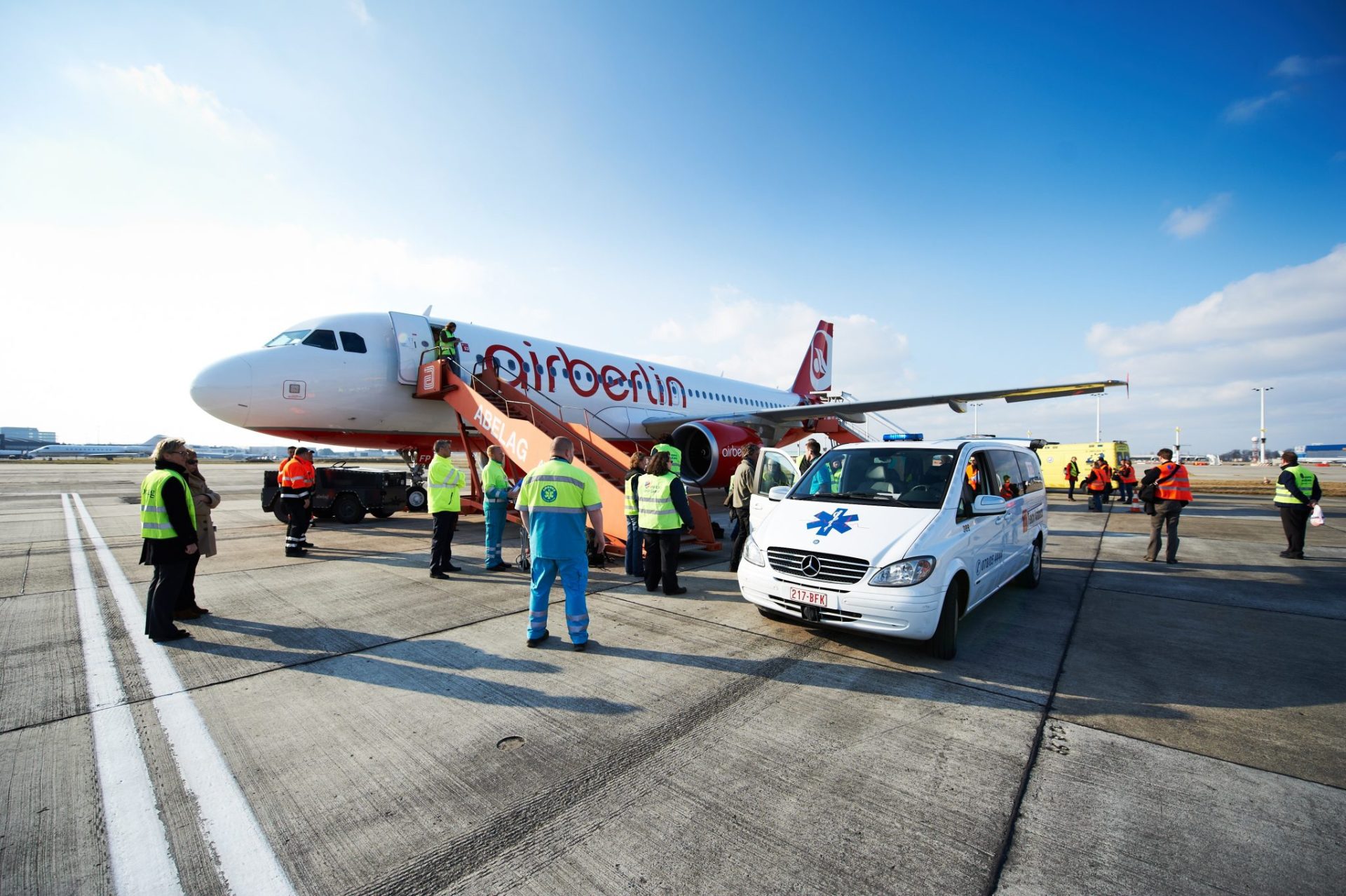
This year, as in previous years, two planes — nicknamed the "Snow Planes" — will fly to and from the Alps on the last weekend of the Carnival holidays. The first, an Airbus A320 (174 seats), will fly to Grenoble, while the second, a Dornier 328 (40 seats), will bring back victims from the Austrian Alps and their families from Innsbruck.
The "Snow Planes" operation
This large-scale operation draws on several decades of experience and follows a proven, highly precise procedure:
A few weeks before "D-Day", Operations staff travel to the Alps to prepare the repatriation with service providers and the airport authorities. At the same time, further contacts are made from the operations centre in Brussels with local providers (mainly ambulance and transport services) to guarantee a return home as quickly as possible and under the best possible conditions.
During Carnival week, Redion's Operations department follows every medical case that comes in very closely, as usual, and decides jointly with the medical team and the clients (and their companions) whether repatriation by "Snow Plane" is advisable or desired.
The day before "D-Day", an operations team travels out to set everything up and welcome the clients who will arrive the next day from their holiday resort (or a local hospital) by ambulance, coach or taxi.
On "D-Day" itself, around thirty Redion staff members, including doctors, nurses and stretcher-bearers, fly out to Grenoble and Innsbruck on the "Snow Planes". These planes are specially fitted out according to the types of injuries to carry stretchers, adapted seating and medical equipment.
A small press team has the privilege of covering the event.
A few "relief drivers" also join the trip: their job is to bring back to Belgium the vehicles of accident victims who are no longer able to drive themselves home.
A few hours after being taken in charge in Grenoble or Innsbruck and boarding under the close direction of the Operations department, the victims and their families land at Brussels airport, where an ambulance or taxi service takes over. From there, the returning passengers are either driven home or, if their state of health requires it, taken to a hospital close to home.
Every year, dozens of unlucky skiers
The number of people repatriated varies from year to year depending on skiing conditions. In some years, conditions are perfect for winter sports, the slopes are in good shape and the resorts aren't overcrowded (thanks to Carnival holidays falling on different dates in our neighbouring countries).
But in other years, conditions are poor or unpredictable, causing more problems on the slopes and therefore more accidents and medical interventions.
Follow our Snow Plane every year on this blog.
Watch the film Redion made in 2009 below:
.