At a glance
Getting back on your motorcycle after winter? Discover our best spring maintenance tips for your bike, plus our checklist.
After winter, it's essential for every rider to think about servicing their motorcycle before getting back on the road. This lets you make sure your bike is ready for the warmer season without any bad surprises. Tires, oil, brakes, battery... this article walks you through the points to check to get back on the road safely. It also gives you the good advice of Serge, a "die-hard" rider, long-time contributor to Redion's traffic report on the radio, and riding-school instructor.
As a bonus: a full checklist for carrying out these checks.
Essential checks before you ride
Can't wait for your first spring rides? First make sure your motorcycle is in perfect working order! Several checks need to be carried out to ride safely and avoid any surprises. Here are the essential points to check before setting off.
Checking the tires: pressure, wear, balancing
Tires are a crucial element for your safety. Start by checking that they show no signs of irregular wear or cuts. If they're in good condition, move on to checking their pressure with a pressure gauge. Under-inflated tires can affect road grip and increase wear. As a general rule, for optimal riding, the front tires of road motorcycles should be inflated to between 2.25 and 2.5 bar, while the rear ones prefer a bit more pressure, namely between 2.5 and 2.9 bar. If necessary, have them balanced to ensure stable handling.
 Tip from Serge, riding-school instructor: If you don't have a pressure gauge, go to a nearby service station and make sure the pressure recommended by the manufacturer is respected. Note: the check must be done cold!
Checking fluid levels: engine oil, coolant, brake fluid
Checking fluid levels is another essential step. Start with the engine oil: it must be at an optimal level and not too old. Degraded oil can damage engine parts. Also check the coolant, especially if you've ridden in cold conditions. Finally, make sure the brake fluid is at a sufficient level to guarantee effective stopping. Levels that are too low can affect braking, which is a major risk.
Battery: testing and recharging
After a winter of rest, your motorcycle's battery may have lost some of its charge. Test its voltage with a voltmeter. If it's too low, recharge it or replace it if necessary. A dead battery could leave you stranded at the most inconvenient moment. So don't skip this essential step!
Tip from Serge, riding-school instructor: "Ideally, you should disconnect the battery before winter. If you didn't, the bike might not start in spring. If you have a charger, charge it for as long as needed. Otherwise, you'll have to push-start it (ignition on and 2nd gear)! Then ride for several minutes keeping the revs high. If it shows no sign of life, or if it discharges quickly after a first start, the battery may be dead and will need to be replaced."
Motorcycle upkeep and maintenance
Once the essential checks have been carried out, it's time to move on to maintaining your motorcycle. This involves simple but important steps that will extend the life of your bike and ensure optimal performance throughout the season.
Full cleaning and lubricating the chain
The chain is one of the most heavily used parts of your motorcycle. After several months of inactivity, it can be dirty and slightly stiff. A thorough cleaning is therefore necessary. Use a special chain cleaner to remove dust, grease, and rust. After cleaning, apply suitable lubricant to prevent premature wear and ensure good power transmission. Be sure to spread the oil evenly along the whole length of the chain without overdoing it.
Tip from Serge, riding-school instructor: "The chain should be lubricated from the inside, on the part in contact with the sprockets. Also check that the chain is properly tensioned (2 to 3 cm of play) and not too worn. When it can be pulled away from the rear sprocket, it's time to replace the 'sprocket-and-chain' kit!
Checking the brakes and transmission system
Before every return to the road, check the condition of the brake pads, their thickness, and make sure they're neither too worn nor too contaminated. Also test the braking system to make sure it responds perfectly, with no unusual noises or loss of power. At the same time, inspect the transmission, checking the wear of the sprocket and rear wheel gear, and adjusting the chain tension if necessary to avoid any unpleasant surprises.
Tip from Serge, riding-school instructor: "If oil is leaking and running down the fork, it means the seals need replacing. Watch out, this oil can run onto the brake discs and greatly reduce braking power!"
Testing the lights and indicators
Lighting is an often overlooked but crucial element for your safety. Before setting off, check all your motorcycle's bulbs: headlights, rear lights, indicators, and position lights. Faulty lighting can not only make you less visible, but can also result in a fine. Also check the indicators to make sure they work properly and are correctly positioned, as they're essential for signaling your intentions to other road users.
Tip from Serge, riding-school instructor: "Also remember to go over everything electrical to make sure it all works: the front light (low and high beam), the rear light (red light and brake light), the indicators, the horn, and also, something we rarely think of, the license plate light (mandatory)! Also check for any screws that may have come loose during the previous season due to vibration."
Rider safety and equipment
A rider's safety largely depends on the gear they wear. Make sure everything is in order before setting off, so you can enjoy the road with complete peace of mind.
Checking the helmet and protective gear
The helmet is the crucial element of your safety. Inspect it carefully for any cracks or deformation on the shell. If you had an impact last year, it's best to replace it, even if the damage doesn't seem visible. Also check the condition of your gloves, jacket, trousers, and boots: no tears, intact seams, and working zips. If you wear additional protection such as back protectors or elbow guards, make sure they're properly fastened and not damaged. Quality equipment in good condition is essential for riding with peace of mind.
Updating your insurance and vehicle documents
Another important point: take a look at your insurance cover to check whether it's still valid. Use this moment to check the details of your contract and consider extensions, such as breakdown assistance. It's also a good opportunity to make sure your registration certificate and other documents are up to date. If you've moved or changed your details, it's essential to update them with the relevant authorities.
Taking out motorcycle assistance cover is often seen as a simple precaution, but it's actually a guarantee of peace of mind on the road. It can save you a lot of hassle in the event of a mechanical problem or unexpected incident. That's why this cover shouldn't be overlooked.
Also make sure your motorcycle complies with current standards! In some cases, a technical inspection is essential. Specifically, if you've had an accident, made modifications to your bike, or recently bought it secondhand, the law requires you to undergo this inspection.
The ultimate rider's checklist for a great start to spring
Just want a list of the various tasks to complete to get back on the road safely? Download our checklist by clicking here!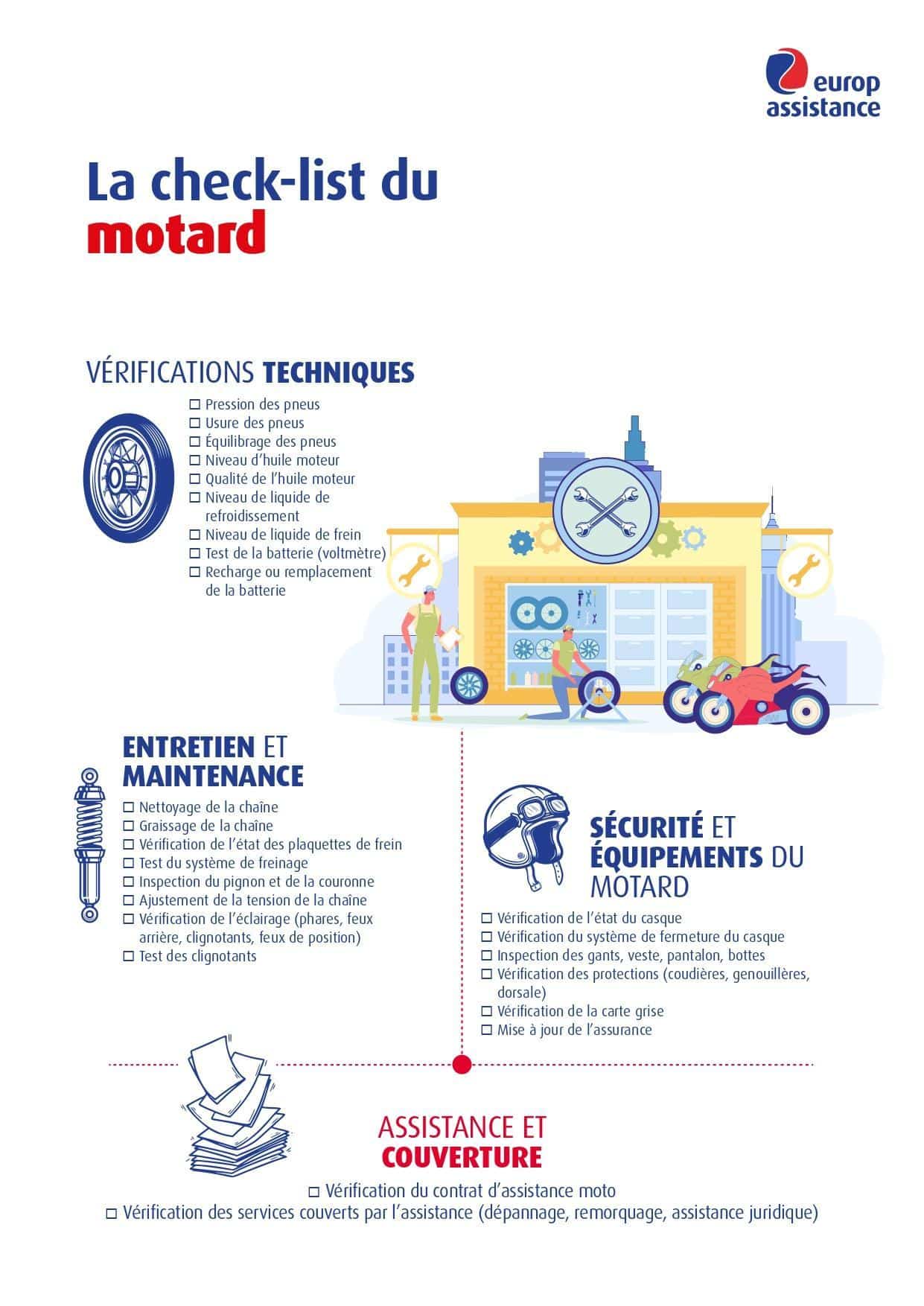
The benefits of assistance cover
Redion's motorbike assistance guarantees a fast response, anywhere in Belgium. In the event of a breakdown, accident, or even a simple flat tire, you can count on roadside assistance within 45 minutes in 90% of cases. If the motorcycle can't be repaired on site, it will be towed to the garage of your choice. What's more, the assistance isn't limited to motorcycles: if you're also a cyclist, you can benefit from assistance for your bicycles (electric or other three-wheeled cycles) in Belgium, which can be an extra advantage for those who also get around by bike.
PS: Discover our other tips in the "Riders" Dossier
First published: 01/2016 - Updated: 02/2025