At a glance
Do you keep your tyres at home? What's the best place, and how should you arrange them?
The vast majority of drivers know this ritual that happens twice a year: replacing winter tyres with summer tyres at the start of spring, and replacing summer tyres with winter tyres in autumn.
Changing tyres like this isn't just a legal obligation in many countries; it also allows you to drive more safely in specific weather conditions, in hot weather (summer) and in winter conditions. Read the article "Driving with winter tyres" on this topic.
That leaves the question of storing these tyres during the period when they're not in use.
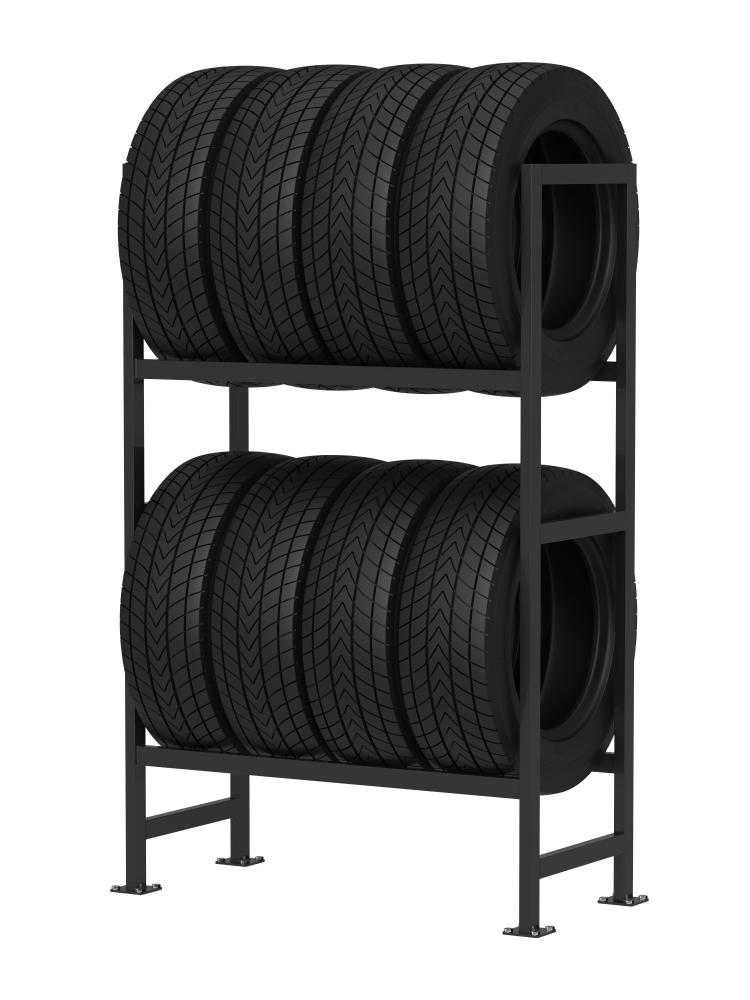 Keep them at your garage, at a tyre centre, or at home?
A large number of drivers hand over their tyres (often for a fee) to their garage or to a tyre centre, which has a specific place to store them optimally.
However, not everyone has this option or chooses it, and many drivers therefore keep their wheels or tyres at home.
The best way to store tyres at home
Storing tyres or wheels yourself shouldn't be improvised. The chosen spot must meet a number of criteria so as not to damage the tyres over time: ideally you need a place that's not too damp, ventilated but without too many draughts, without too much temperature variation and without too much dust!
A cellar or a workshop often meets these criteria better than a garage set apart from a home.
If you're storing your mounted tyres (with the rim), it's recommended to store them either stacked on top of each other, or hanging up, but not standing vertically side by side.

If you're storing your unmounted tyres (without the rim), it's recommended to store them standing vertically side by side, without stacking or hanging them. If they touch the ground, it's best to turn them every 2 to 3 months. The goal is to prevent the tyre from deforming as much as possible during the storage period and to stop the rubber from degrading.
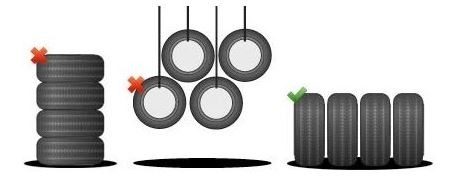
A tyre resting on the ground and staying still for more than 6 months risks becoming deformed or damaged once it's put back on the vehicle.
A few tips
- If the storage area is prone to dust, you can store your tyre in a plastic bag from which you remove as much air as possible.
- Follow the tyre pressure recommended by the manufacturer during the storage period.
- Put a label on the tyre showing where it was mounted on the vehicle (front left / front right / rear left / rear right). This will make it easier to (re)fit after the storage period.
- Check the condition of your tyres before putting them back on the vehicle (wear, pressure…). Change them as soon as they no longer guarantee safe driving.
What if the tyres stay mounted on a vehicle that's parked for several months?
In that case, note that being stationary will eventually have a negative impact on the tyres, which have to bear the weight of the vehicle. In this case, make sure to move the vehicle (thereby shifting the tyre's contact point with the ground) every 2 to 3 months. Regularly check the pressure (keeping it slightly higher than when driving) and park your vehicle under cover as much as possible.
Ideally, in this case, raise the vehicle (possibly on a support) to prevent it from resting on the tyres touching the ground.
Also read
- Driving with winter tyres
- Under-inflated or over-inflated tyres: what are the risks?
- Do you have a spare wheel?
- Snow chains