At a glance
How do you handle corners well on a motorbike? What should you pay attention to? Serge, Redion's "Traffic Info" biker, gives us his tips.
Every biker rides on roads where there are potentially dangerous corners. Think, for instance, of certain roads in our Ardennes or the winding little roads in mountainous areas abroad. Handling corners well is therefore essential and requires a certain mastery of your bike.
Serge, Redion's biker for Traffic Info and a motorbike instructor, shares his best tips on the subject.
Here are 10 points to focus on to best handle dangerous corners on a motorbike:
1. Your gaze
The bike will always go in the direction you're looking. So, in a corner, even if you're tempted to look at the tree you don't want to end up in, you have to force yourself to fix your gaze on the solution and not on the problem, the solution being the exit of the corner.
Don't confuse "seeing" and "looking": you should look at a point as far ahead as possible, but you should see everything around the bike, meaning in front, behind, in the mirrors and in the blind spots.
2. Your position on the bike
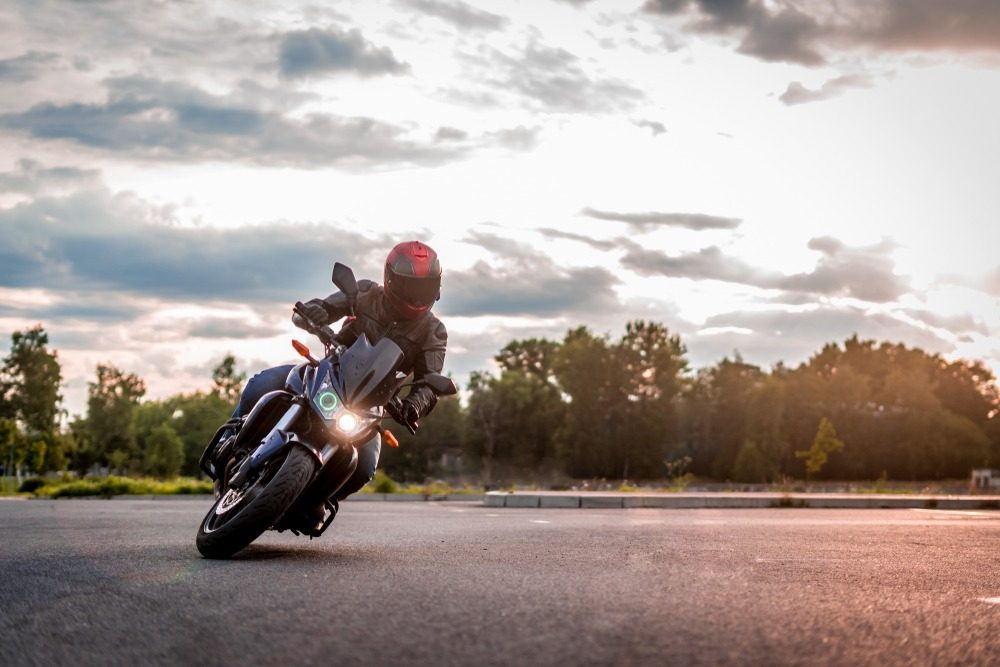
The lower body, meaning the knees and legs, should grip the bike to become one with it. The upper body, on the other hand, should stay relaxed and supple, with bent arms and "broken" wrists. It's the movement of the body that turns the bike, helped by your gaze and by point 3 below.
3. Counter-steering
A wheel's first instinct is to go straight ahead. By turning the handlebars to the left, the wheel will "try" to get back to a straight line, and as a result, pull the bike to the right, and vice versa. In plain terms, this means that at the start of a corner, you need to push the handlebars in the opposite direction. When I was a beginner, I didn't understand this principle, as is the case for most of my students, until the moment I tried it and saw that it worked. And once you've tested this principle, you feel much more at ease approaching a corner.
On YouTube, you'll find videos explaining this technique, including this one:
4. Speed
On a motorbike, it's very important to anticipate in all circumstances, and especially when approaching a corner: it's not IN the corner that you should think about slowing down, but BEFORE it.
Once you're in the corner, accelerate slightly while keeping your gaze fixed on the exit.
Speed should also be adjusted based on the danger and obstacles you might find on the road: an accident, a bulky object or anything else. If, for example, visibility is 50 m and your speed requires a stopping distance of 100 m, you absolutely must slow down so you can stop no matter what happens along the way.
In hairpin bends, anticipation is even more important, since you can't see the end of the corner or any potential obstacles, potholes and so on. This brings us back to the principle of adapting your speed to visibility so you can react and stop if needed.
5. Your line
The line to take when riding on the road should be the same as on a track, except that on a road outside a track, you don't have the whole width of the roadway available. Every biker knows the "outside-inside-outside" concept. This means you approach the corner from the left for right-hand corners, and vice versa. In the corner, you move closer to the apex (the inside of the corner), and coming out, you find yourself back on the outside.
All while looking, of course, always as far ahead as possible.
6. Your passenger
What matters is "training" your passenger well. Riding with a passenger is no harder, provided they adopt the right posture.
They need to stay as still as possible and, above all, not try to stay upright when the bike leans, which is what scared passengers often do. The passenger should lean into corners along with the bike, just as the rider does.
7. Stress and fear
You should know that fear and motorbikes don't mix well. In a state of stress or panic, you tense up, and that's when you do everything you shouldn't: stiff arms, looking in the wrong place, etc. With fear, you can chase away instinct, but it always comes galloping back…
8. The road surface
It's clear that the speed at which you approach a corner should also take into account anything that could be slippery, such as road markings, a manhole cover, dead leaves or anything else. Once again, it's only by looking far ahead that you can anticipate this type of situation.
In any case, I strongly advise against riding if the weather forecast announces a chance of snow or ice.
9. Junction or corner?
Don't confuse a junction with a corner.
A junction is where several public roads meet, where, most of the time, traffic flows in both directions. There, we don't talk about a corner, but about a change of direction.
At a junction, you hug the right to turn right and take a tight turn; to turn left, you take as wide a turn as possible.
10. On a track versus on the road
And finally, although riding in these two situations has things in common, the approach and the goal are very different.
On a track, the goal is to go as fast as possible while trying not to crash, but knowing that the consequences of a fall will rarely be serious.
On the road, however, safety needs to be given much more weight. The smallest mistake can be catastrophic for the biker, but also for other road users. This doesn't stop you from "enjoying yourself", but let's keep in mind that danger is ever-present on the road.
Let's remember that 78 bikers lost their lives in Belgium in 2020! It's likely that several of them would still be alive thanks to better riding technique…