At a glance
You're driving along and suddenly you have a flat tyre, a puncture or a blowout. What do you do? Do you have a spare wheel?
Picture this: you're driving along and suddenly, disaster strikes: a flat, punctured or burst tyre!
What do you do?
Do you have a spare wheel?
Punctured tyres: 15% of breakdowns
Over 15% of the breakdowns Redion's roadside assistance has to attend to involve flat, punctured or burst tyres. Yet, in many cases, this type of problem can be avoided by regularly checking the condition (wear) of your tyres as well as their pressure. It's also advisable to switch summer tyres ↔ winter tyres in good time according to the season.
Read our articles "Driving on winter tyres" and "Where and how to store your tyres?" on the topic.
Unfortunately, these preventive measures aren't always enough to guard against a puncture or a blowout. In that case, it's important to have a good backup solution so you can continue your journey.
Fewer than 15% have one!
Fewer than 15% of cars are still fitted with a "real" spare wheel! Other cars only have an alternative solution: a spare "donut" wheel, a run-flat tyre or a repair kit. These emergency solutions will let you drive a few kilometres to reach your garage or a garage near the site of the incident, but they're not designed for continuing a long journey of several (hundred) kilometres, such as on holiday trips.
Types of spare wheels
- The classic spare wheel, identical to the vehicle's other wheels This lets you continue your journey with no limit on the number of kilometres or maximum speed. However, make sure the tyre is sufficiently inflated. (Read our article "Under-inflated or over-inflated tyres, what are the risks?" by clicking here.) This solution is becoming rarer due to the space and weight this type of wheel takes up in a vehicle. You can of course anticipate the risk and buy a spare wheel in advance.
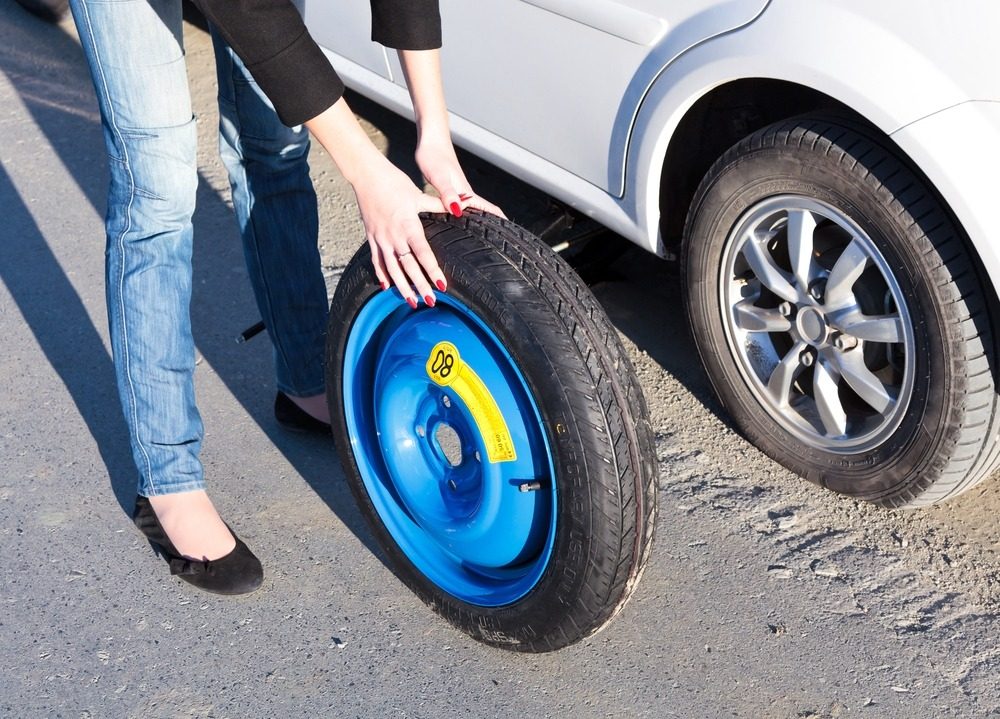
- The spare "donut" wheel This is a lighter wheel fitted with a narrower tyre than a traditional tyre. Not all car makes offer this system. It lets you continue on your way for a few dozen kilometres. The maximum speed for the donut wheel is limited to 80 km/h (see photo at the top of the article).
- The repair kit More and more car manufacturers are including a repair kit. This system seals the tyre using a chemical sealant injected through the valve. It lets you travel a few dozen kilometres at a limited speed (no more than 80 km/h) to reach the (nearest) garage to have the tyre repaired or replaced. However, if the puncture is too large or the tyre too damaged, this emergency solution won't be enough. Repair kits aren't always effective at low temperatures (in winter), and their shelf life is limited. There are several types of repair kits. We recommend not waiting for a problem to happen on the road, and reading the kit's instructions carefully beforehand.
- The run-flat tyre These are specially designed tyres that let you travel a few dozen kilometres after a puncture. Their range is therefore also very limited. This system is not widely used due to its high price.
And finally...
Even if you have a spare wheel, for many drivers changing a wheel is difficult or dangerous, particularly along a busy road. Calling a roadside mechanic therefore often remains the most obvious and cautious solution.
The app and assistance in just a few clicks
For this kind of problem, you can request immediate assistance from Redion using our app, and in just a few clicks, you can track our mechanic's arrival on site.
Useful links:
- Fast, in case of a breakdown on a motorway in Flanders
- A breakdown on a motorway in Wallonia
First published: 07/2014 - Updated: 09/2021