At a glance
You're driving your car and suddenly smoke or flames start coming from the bonnet or the grille. How should you react?
You're driving your car and suddenly smoke or flames start coming from your bonnet or grille.
How should you react?
Fighting a car fire
1. Park the vehicle in a safe place
- Are you driving on a motorway? Park the vehicle on the emergency lane, switch off the engine, put the gearbox in neutral and pull the handbrake. Put on your high-visibility vest and get the other passengers to safety (behind the safety barrier, wearing high-visibility vests). Warn other road users (warning triangle).
- Are you driving on a national or local road? Park the vehicle in an open area where a possible fire won't cause damage nearby: so not under a tree, not along a fence or in a field/meadow that could catch fire, not next to another car or the front of a house... Switch off the engine, put the gearbox in neutral and pull the handbrake. Put on your high-visibility vest and make sure your passengers also get to safety. Warn other road users (warning triangle). Obviously, if there are injured people, you must get them to safety first and call the emergency services straight away.
2. Putting out the fire
- Most of the time, fighting a car fire is only possible during the initial phase of the fire (the first few minutes); after that it will probably be too late or too dangerous to try to control it without the help of firefighters.
- Release the bonnet catch from inside the vehicle, but don't open it fully: letting air in could make the flames worse. Grab your fire extinguisher and fight the flames through the gaps around the bonnet or grille. If other motorists stop around you, they can help fight the flames using their own extinguishers too.
- If the fire has started somewhere other than the engine compartment: aim the extinguisher jet at the base of the flames. Avoid letting air in as much as possible.
- Check whether the fire has started underneath the vehicle. Do you see oil or fuel leaking? Try to stop it from spreading by using sand or earth. Keep in mind that the fuel itself can catch fire.
- Stay calm.
3. The fire won't go out?
If the fire persists or becomes too dangerous: call 112 (fire brigade) straight away and specify your location and the fuel type of your vehicle. Take shelter somewhere upwind of the fire.
Be very careful if your car runs on LPG (gas). It can cause an explosion on contact with flames.
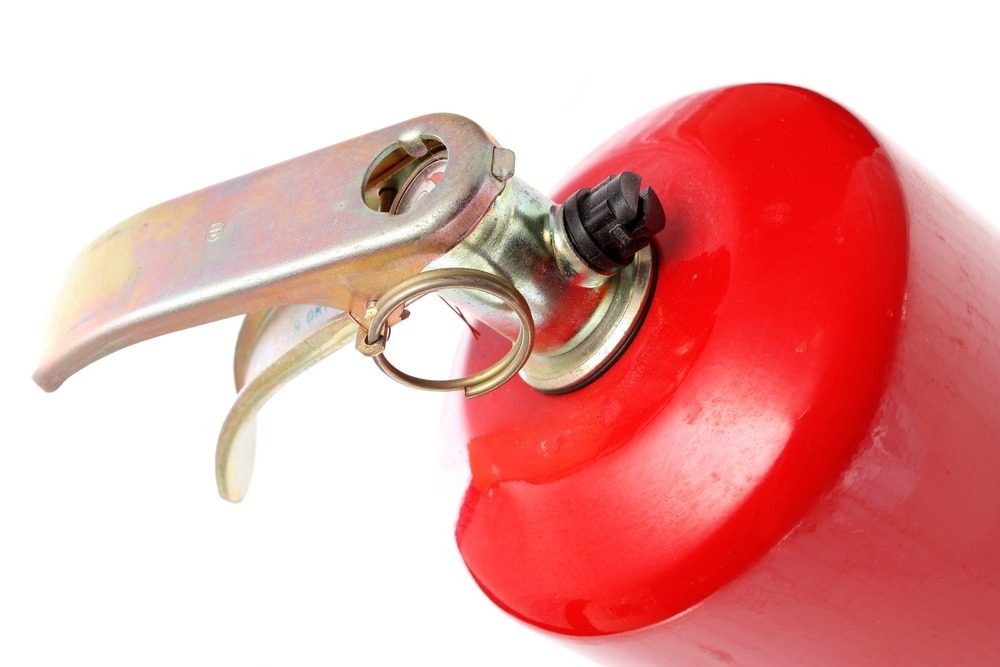
Do you know how your fire extinguisher works?
- In Belgium, every vehicle must carry a fire extinguisher that meets safety standards.
- They come in different sizes (1 kg for vehicles with a maximum authorised mass (MAM) under 3,500 kg, 2 kg for a MAM of 3,500 to 7,500 kg, and 3 kg for a MAM over 7,500 kg). Every extinguisher contains a fire-suppressing agent, either powder or foam (foam is the recommended type, as it causes less damage — but it isn't frost-resistant!)
- The extinguisher has an expiry date: make sure the one you carry is still valid.
- Place the extinguisher in the spot designated for it in the vehicle by the manufacturer, in its mounting bracket.
- Check and memorise the extinguisher's instructions (usage is often described on the device itself) so you know immediately how to use it in an emergency.
.\