At a glance
Discover our guide to worry-free travel in Egypt: entry requirements, safety, health and practical tips for Belgian travelers.
As with any trip outside the European Union, careful preparation remains essential. This guide brings together all the practical information you need to travel to Egypt: emergency numbers, entry requirements, health, safety, driving rules, seasonal activities, culinary specialties, and a few useful phrases in Arabic.
Egypt… So Much More Than the Pyramids!
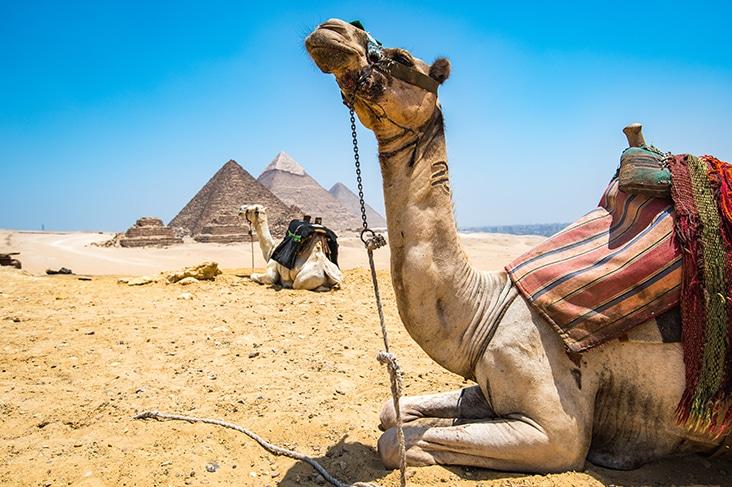
From the pyramids of Giza to the temples of Luxor, from Nile cruises to Red Sea beaches, Egypt is a destination that has combined historical grandeur with extraordinary landscapes for millennia. As a bridge country between Africa and the Middle East, it welcomes millions of travelers from around the world every year.
Just three to four hours away by plane from Belgium, Egypt appeals just as much to lovers of ancient history as to fans of diving, the desert, or Middle Eastern cuisine. From the bustling bazaars of Cairo to sunsets over the Nile, every trip here tells its own story.
Emergency Numbers: Who to Call in Case of a Major Problem?
- Emergency number: 112 (police, ambulance, fire department)
- Police: 122
- Ambulance: 123
- Tourist police: 126
- Belgian Embassy in Cairo (consular emergency): +20 122 210 34 33
- Card Stop (lost or stolen credit cards): +32 78 170 170
- Doc Stop (lost or stolen Belgian ID card or passport): +32 2 488 21 23
Assistance: Redion (Belgium)
In an emergency, contact local emergency services first!
– Want to contact Redion for a medical or technical problem (e.g., a car breakdown)? Do so via the Redion Belgium app (downloadable from the App Store or Google Play).
– Want to contact Redion for an administrative request or a contract change? Do so via the Customer Area on the website: https://www.redion.be
How Can You Travel Safely in Egypt?
Before departure, a few checks are necessary: travel documents, visa requirements and insurance coverage. On the ground, Egypt offers a generally welcoming environment for tourists, provided you follow a few precautions related to the local context.
What Travel Documents Are Needed to Visit Egypt?
To enter Egypt from Belgium, you must hold a passport valid for at least 6 months after your entry date. Belgian nationals can also enter with their national identity card, provided it's valid for at least 6 months after the planned return date.
Unlike some European destinations, a tourist visa is mandatory for Belgian citizens. It can be obtained:
- On arrival at the airport ("Visa on arrival"): about €25-30 per person, payable in cash in euros or dollars.
- Online (e-visa) via visa2egypt.gov.eg, at least 7 days before departure.
- At the Egyptian consulate in Belgium before departure.
If you're traveling with an identity card, bring 2 passport photos for the visa to be affixed. The tourist visa allows a stay of up to 30 days. Exception: stays of less than 15 days in Sharm El Sheikh, Taba, or Saint Catherine don't require a visa.
Before you leave, register your trip on the Travelers Online website of the Belgian Federal Ministry of Foreign Affairs, which can then keep you informed and offer support in the event of a major problem.
What Is Healthcare Like in Egypt?
Egypt has both public hospitals and private clinics. The latter, generally better equipped and staffed with English-speaking personnel, are preferred by foreign travelers. In tourist areas such as Hurghada, Sharm El Sheikh, or Cairo, care is generally of good quality. Outside the major cities, quality can vary greatly.
No vaccinations are mandatory to enter Egypt. It's nonetheless recommended to check your basic vaccinations, particularly against hepatitis A and DTP (diphtheria, tetanus, polio). Consult your doctor or the Institute of Tropical Medicine (www.itg.be) before departure.
For more information, see our guides on tropical diseases and recommended or mandatory vaccinations for travelers.
Warning: Egypt applies zero tolerance for drugs. Some medications that are common in Belgium are considered controlled substances in Egypt. If you take regular medication, bring a medical prescription translated into English or Arabic. See our article Traveling with medication on this topic.
Medical costs can be high for foreign travelers, particularly in the event of hospitalization or repatriation. It's strongly recommended to take out travel insurance before departure.
If you need medical care abroad, Redion can arrange your care or repatriation 24/7.
Redion recommends taking out travel insurance covering medical costs and repatriation. Note that annual contracts offer a higher reimbursement cap than temporary ones.
How Safe Is Egypt?
Egypt's major tourist destinations, such as Cairo, Alexandria, Luxor, Aswan, Hurghada, and Sharm El Sheikh, are generally accessible and well secured. Major tourist sites benefit from enhanced protection.
However, certain regions are strongly discouraged by the Belgian Federal Foreign Affairs Department: northern Sinai (north of the Suez/Taba line), the Libyan desert and border areas with Libya and Sudan, as well as the area from Port Said towards El Arish/Gaza. Particular caution is recommended in Middle Egypt (Minya, Qena, Asyut) and in certain cities in the Delta.
Also stay alert regarding the regional conflict involving Iran, which, in the event of escalation, could have repercussions throughout the region.
A few practical precautions:
- Avoid photographing military buildings, bridges, or airports.
- Drones are strictly forbidden in Egypt, including at tourist sites.
- Female travelers should be particularly alert to harassment in public places and on public transport.
- Keep your valuables out of sight and make copies of your official documents.
Tip: Before you leave, check the travel advice from the Belgian Federal Foreign Affairs Department and register your trip on travellersonline.diplomatie.be.
What Are the Driving Rules in Egypt?
Assistance contracts do not cover vehicles in Egypt.
If you want to get around by car in Egypt, you'll therefore need to either travel by taxi or coach, or rent a vehicle locally. Avoid covering long distances in uninhabited areas without being accompanied by a guide who knows the region and whom you can trust.
Driving in Egypt is an experience that requires heightened vigilance. The main road network is generally well developed, but certain local driving habits (constant honking, unpredictable overtaking, signage sometimes only in Arabic) can throw off foreign drivers. In major cities like Cairo, traffic is particularly chaotic.
Driving License
An international driving license is required to drive in Egypt. It's recognized for a maximum of 6 months from the date of entry into the country. Beyond that, a local license is required.
Speed Limits
- In built-up areas: 60 km/h
- On roads outside built-up areas: 90 km/h
- On highways and desert roads: 100 km/h
Mobile and fixed speed cameras are common on major routes. Fines are generally payable on the spot.
Practical Tips
- Night driving: strongly discouraged. Highways are not lit, and many vehicles drive without lights.
- Gas stations: spread out on certain routes. Fill up before leaving a city.
- Car rental: choose recognized agencies and carefully check the insurance terms.
- Alternatives: the Uber, Careem, and Didi apps are available in major cities. They're generally safe and affordable options.
- Tolls: present on certain routes, such as the Cairo–Alexandria road, payable in cash.
- Avoid driving through desert areas or areas far from urban centers.
What Can You Visit in Egypt Depending on the Season?
Egypt can be visited all year round, but the climate varies greatly by region and time of year. The inland archaeological sites and the Red Sea beach destinations don't follow the same rhythms. Each season offers distinct advantages depending on the itinerary chosen.
Winter (October to March): High Season
This is the ideal time to explore historic Egypt. Temperatures are mild (15 to 25°C) and conditions are perfect for visiting Cairo and its surroundings, sailing up the Nile to Luxor and Aswan, or discovering the temples of the Theban region.
- Cairo: the Giza pyramids, the Egyptian Museum, and the bazaars of Islamic Cairo.
- Luxor and Aswan: the Valley of the Kings, the Temple of Karnak, Abu Simbel.
- Nile cruises: ideal conditions between October and March.
Spring (March to May): The Transition Season
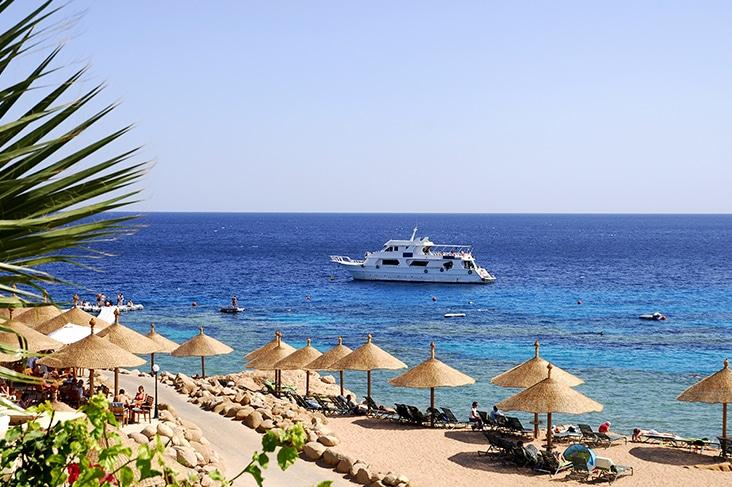
Hurghada
Spring still offers mild temperatures before the intense summer heat. It's a pleasant time to combine cultural visits with beach relaxation.
- Alexandria: the Library of Alexandria, the Citadel of Qaitbay, and the Mediterranean beaches.
- South Sinai and the Red Sea: Dahab, Hurghada, and Sharm El Sheikh for diving. Bring sunscreen, a hat, and plenty of water, even in April-May: the sun is strong and temperatures can exceed 30°C.
Summer (June to September): The Beach Resorts
Summer is very hot throughout the country (40°C and above in the desert). Visiting archaeological sites is exhausting. On the other hand, the Red Sea and Sinai beach resorts remain very popular: the sea is warm and water activities are at their peak.
- Hurghada and El Gouna: diving, kitesurfing, snorkeling.
- Sharm El Sheikh: renowned coral reefs, all-inclusive stays.
- It's best to visit ancient sites early in the morning or late in the afternoon.
Fall (September to November): A Good Transition Period
Fall marks the return of more pleasant conditions for cultural visits. Temperatures gradually drop, and sites are less crowded than during high season. It's also the best time for a Nile cruise combined with a beach stay.
- Aswan and Nubia: visits to the Temple of Philae and the Aswan Dam.
- Desert sites: the Bahariya oasis, the White Desert: plan for adequate preparation and an official guide.
Did You Know?
The Giza pyramids are the only one of the Seven Wonders of the Ancient World still standing today. Built more than 4,500 years ago, they continue to challenge the understanding of architects and archaeologists alike. And the country's Arabic name, Misr (مصر), is one of the oldest country names still in use in the world. It appears in biblical texts and on papyri more than 3,000 years old. A single glance from the Giza plateau at sunset — the desert on one side, the city on the other — is enough to understand why Egypt has fascinated people for millennia.
Other Practical Information About Egypt
The capital of Egypt is Cairo (القاهرة), one of the largest metropolises on the African continent. The official language is Arabic, although English is commonly spoken in tourist areas. The currency is the Egyptian pound (EGP): 1 EGP is worth approximately €0.018 (variable rate). ATMs are available everywhere, and major credit cards are accepted at upscale hotels and restaurants. Importing or exporting Egyptian pounds is limited to 5,000 EGP.
The country covers 1,001,449 km² and has a population of approximately 107 million. The time zone is UTC+2, the same time as Belgium in summer and one hour ahead in winter. For official tourist information, visit experienceegypt.eg.
The Belgian embassy in Egypt can be reached via egypt.diplomatie.belgium.be. The honorary consulate in Hurghada is available at +20 122 391 00 32.
What Are Egypt's Culinary Specialties?
Egyptian cuisine is generous, fragrant, and deeply rooted in a millennia-old tradition. Influenced by Mediterranean, Middle Eastern, and African cultures, it offers a range of flavors that surprises and delights. You can't visit Egypt without stopping to taste its iconic dishes.
The Must-Tries
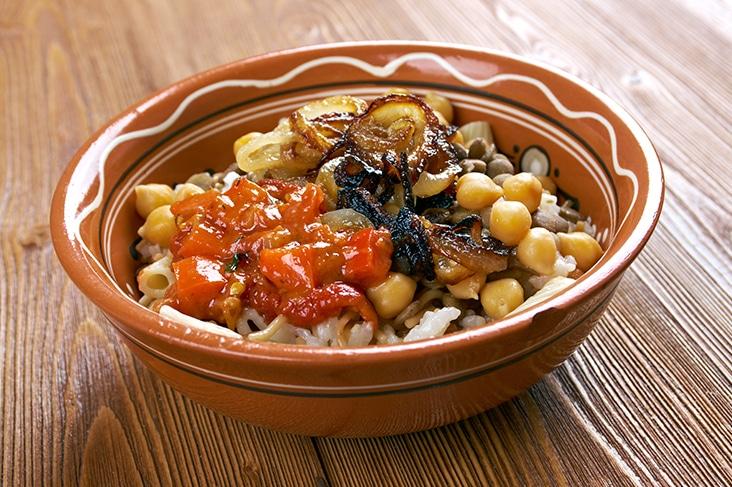
Koshary
Koshary: considered the national dish, this mix of lentils, rice, pasta, and spicy tomato sauce is served at stalls on virtually every street corner.
- Ful medames: fava beans simmered with olive oil, garlic, and lemon — a staple of the Egyptian breakfast.
- Shawarma: marinated meat roasted on a spit, served in a sandwich with vegetables and spicy sauces.
- Baba ghanoush: grilled eggplant purée mixed with tahini, garlic, and lemon, served as a starter with pita bread.
- Om Ali: a warm dessert made from puff pastry, milk, nuts, and raisins — the Egyptian equivalent of bread pudding.
- Mahshi: stuffed vegetables (zucchini, peppers, vine leaves) with spiced rice and aromatic herbs.
Typical Drinks
- Karkade: an infusion of red hibiscus, served hot or iced, lightly sweetened — refreshing and rich in vitamin C.
- Chai bi na'na': black tea with fresh mint, served sweetened in small glasses, at any time of day.
- Ayran: a refreshing drink made from yogurt, water, and salt, ideal for staying hydrated during sightseeing.
The generosity of the Egyptian table reflects the hospitality of its people. Accepting a cup of tea or sharing a meal is often the best way to connect with the local culture.
A Few Basic Words and Phrases
Because a simple "ahlan" can open doors, here are a few Egyptian Arabic phrases worth remembering before you leave. Egyptians always appreciate visitors making the effort to speak their language.
- Ahlan (أهلاً): Hello
- Masaa el-kheir (مساء الخير): Good evening
- Shukran (شكراً): Thank you
- Min fadlak (من فضلك): Please
- Aywa (أيوا): Yes
- La (لأ): No
- Ana aasif (أنا آسف): Excuse me / Sorry
- Bekam da? (بكام ده؟): How much does it cost?
- Fein el-hammam? (فين الحمام؟): Where's the bathroom?
- Ma'a salama (مع السلامة): Goodbye