At a glance
Travelling to Thailand takes good preparation so you can enjoy your trip with complete peace of mind. Check out our guide here.
In this article we give you essential information for a smooth trip to Thailand: emergency numbers, travel documents, health precautions, safety, driving rules, seasonal activities, plus a few culinary specialities and useful phrases.
Thailand, nicknamed the "Land of Smiles", charms visitors with its varied landscapes and rich culture, from Bangkok to the gulf beaches, from the temples of Chiang Mai to the Andaman islands. Thailand is an accessible destination, but one that requires good preparation on the traveller's part.
Emergency numbers: who to call in a major emergency
- 191: General emergency (police, ambulance, fire) – available 24/7
- 1155: Tourist police (English-speaking staff)
- 199: Fire brigade
- 1669: Medical emergencies and ambulance (1646 in Bangkok, 1554 as an alternative)
- Belgian Embassy in Bangkok: +66 2 108 18 00
- Consular emergency (outside opening hours): +66 81 833 99 87
- Card Stop (lost or stolen credit cards): +32 78 170 170
- Doc Stop (lost or stolen Belgian ID card or passport): +32 2 488 21 23
Assistance: Redion (Belgium)
In an emergency, contact local emergency services first!
– Want to reach Redion for a medical or technical problem (e.g. a car breakdown)? Do so via the Redion app (downloadable from the Apple Store or Google Play)
– Want to reach Redion for an administrative request or a change to your policy? Do so via the Client Area on the website: https://www.redion.be
How can you travel to Thailand with peace of mind?
Thailand can be visited all year round, although the ideal period runs from November to March, during the dry season, with pleasant temperatures and little rainfall. The monsoon mainly affects the country from May to October, with intense but often brief tropical downpours.
Careful preparation will let you fully enjoy your stay: check the entry requirements, plan ahead for health precautions and familiarise yourself with local driving rules. Buddhist culture runs through everyday life in Thailand: respect for temples, appropriate dress and courtesy are essential for travelling in a way that respects local traditions.\
What travel documents do you need to visit Thailand?
Before boarding the plane, make sure your paperwork is in order — that's the first key to a stress-free trip.
Belgian nationals benefit from a visa exemption for tourist stays of up to 60 days. Your passport must be valid for at least 6 months from your date of entry into Thailand and must not be damaged.
New mandatory requirement: since 1 May 2025, all foreign visitors must fill in the Thailand Digital Arrival Card (TDAC) online within 72 hours before their arrival, regardless of how they enter the country (by air, land or sea). This form replaces the old paper TM6 document. Allow time for this administrative step before you leave, to avoid any hassle on arrival.
If you're planning a stay of more than 60 days, apply for your tourist visa ahead of time on the official website thaievisa.go.th, ideally several weeks before your departure.
Check the website of the Federal Public Service Foreign Affairs for more information on the formalities and documents required by clicking here.
What is healthcare like in Thailand?
Medical facilities are of good quality in major cities and tourist areas (Bangkok, Phuket, Chiang Mai, Pattaya), with modern international hospitals. However, treatment can be very expensive, particularly in the event of hospitalisation or medical repatriation. Plan ahead for this by taking out travel insurance before you leave.
In rural areas, access to healthcare is more limited and staff don't always speak English. In addition, medical transport can sometimes be very difficult, especially in remote areas or when weather conditions make long journeys difficult.
No vaccination is mandatory to enter Thailand if you're travelling from Belgium, except for yellow fever if you've spent more than 12 hours transiting through a country where the disease is present.
Recommended vaccinations for safe travel are: diphtheria-tetanus-polio (DTP), hepatitis A, typhoid (for longer stays), hepatitis B (for long or frequent stays), Japanese encephalitis (for rural stays during the monsoon) and rabies (for remote areas or contact with animals). See the Wanda website run by the Antwerp Institute of Tropical Medicine for more on this.
Plan a consultation at an international vaccination centre 6 to 8 weeks before you leave to set up a vaccination schedule suited to your itinerary.
Redion strongly recommends taking out travel insurance covering medical expenses and repatriation. Medical costs can, in some cases, quickly reach several thousand euros.
If you need medical or technical help abroad, Redion can arrange your care or repatriation 24/7. You can choose either a temporary plan or annual insurance, depending on your needs.
How safe is Thailand?
Thailand is generally a safe destination, provided you take a few sensible precautions. Petty crime (pickpocketing, tourist scams) is common in heavily touristy areas such as Bangkok, Pattaya or the southern islands.
Keep your belongings secure and avoid wearing valuable jewellery or showing outward signs of wealth.
Certain geographical areas call for extra vigilance or are best avoided:
- Not recommended unless essential: the provinces of Songkhla, Narathiwat, Yala and Pattani (deep south), as well as the districts bordering Cambodia in the provinces of Ubon Ratchathani, Si Sa Ket, Surin, Buriram, Sa Kaeo, Chanthaburi and Trat, due to ongoing tensions and the presence of landmines.
- Extra vigilance needed: border areas with Myanmar and non-border districts of the provinces mentioned above.
Before you leave, find out about sensitive areas and adjust your itinerary accordingly. Strictly respect local traditions, particularly the respect owed to the Thai monarchy (any criticism is severely punished by law) and to representations of the Buddha.
Sex tourism: Certain towns or regions are unfortunately known for sex tourism. The risks associated with this type of tourism are particularly serious: the exploitation of vulnerable people, including minors, leading to significant physical and psychological trauma, human trafficking, as well as public health crises (such as HIV and STIs among sex workers and tourists). This phenomenon also fuels organised crime and corruption, while exposing tourists to dangers such as sexual assault, drugs, scams and legal problems, despite efforts by Thai authorities to put a stop to it.
For up-to-date safety advice, check the website of theFederal Public Service Foreign Affairs before you leave, and register your trip on Travellers Online.
A few simple precautions:
- Keep your valuables out of sight and favour card payments.
- Always make copies of your official documents.
- Avoid large gatherings or political demonstrations.
- When driving, stay alert to traffic, which is often heavy and unpredictable in big cities.
What are the driving rules in Thailand?
Driving licence and regulations
A Belgian driving licence alone is officially not enough. An international driving licence is essential and must always be carried together with your Belgian licence. Apply for one at your local municipality several weeks before you leave. Without an international licence, you risk a fine of 1,000 baht (around €25-30) at a checkpoint and, more importantly, your insurance could refuse to cover damage in the event of an accident.
Key point: in Thailand, driving is on the left, as in the UK. The vehicle's controls are mirrored (gear lever on the left, handbrake on the left), but the pedals remain the same. Allow yourself time to adjust before setting off.
Speed limits
- In town: 50-60 km/h
- National roads: 90-100 km/h
- Motorways: 110-120 km/h
Speed cameras are present on motorways. If you're caught speeding, the fine is sent by post. Stick strictly to these limits: road safety in Thailand is a real concern.
Mandatory equipment
- Seatbelt: mandatory for all occupants
- Helmet: mandatory for both the driver and passenger on two-wheelers (fine of 500 baht for non-compliance)
- Blood alcohol limit: maximum 0.05% (as in Belgium). Severe penalties if exceeded (fines of up to 10,000 baht and possible imprisonment of up to 6 months)
Specific points and risk prevention
Major point of concern: Thailand ranks among the countries with the highest road accident rate in the world. Around 20,000 deaths are recorded each year, 90% of which involve two-wheelers.
Local driving can seem chaotic, with frequent disregard for the highway code, dangerous overtaking and heavy traffic.
Essential precautions for your safety:
- Avoid driving in Bangkok (extremely heavy and chaotic traffic)
- Favour taxis, tuk-tuks or public transport in town
- If you rent a two-wheeler, always wear a helmet that meets international standards (check its condition before renting)
- Absolutely avoid driving at night, especially on poorly lit country roads
- Before signing any rental agreement, always check that the insurance covers: the driver, passengers, third-party liability and material damage
- Take photos of the vehicle's condition before setting off and keep all documents
Please note, Redion does not cover vehicles outside Europe.
In the event of an accident without valid insurance, you could face legal proceedings, be personally liable for compensating victims and the rental company, or even be banned from leaving the country.
What can you visit in Thailand depending on the season?
Cool season (November to February)
 This is the most pleasant time to travel, with mild temperatures (20-30°C) and little rainfall.
This is peak tourist season, ideal for exploring the whole country: the temples of Bangkok and Ayutthaya, the southern beaches (Phuket, Krabi, Koh Samui), the northern mountains (Chiang Mai, Chiang Rai) and the national parks. The Loy Krathong festival (November) lights up the country with floating lanterns.
Book your accommodation ahead of time, as prices are higher and availability limited.
Hot season (March to May)
Temperatures climb to between 30 and 40°C, with particularly intense heat peaks in April. The mountainous northern regions stay cooler and more pleasant.
This period suits fans of diving or snorkelling in the southern islands, as well as other water activities.
The Songkran festival (Thai New Year), in April, turns the country into one giant, festive water fight.
Bring strong sun protection and stay hydrated regularly.
Rainy season / monsoon (May to October)
Intense but often brief tropical downpours, mainly in the afternoon.
The landscape turns lush green, the waterfalls are impressive, and prices drop (low season).
Favour morning outings and bring a light raincoat.
Cultural activities (temples, museums, covered markets) remain accessible.
Some islands such as Koh Tao and Koh Phangan remain worth visiting.
Find out before you go: the east coast (Gulf of Thailand) has its best period from October to March, while the west coast (Andaman Sea) is more pleasant from November to April.
Did you know?
Thailand is the only country in Southeast Asia never to have been colonised by a European power.
The name "Thailand" literally means "land of the free" ("Thai" = free). This historical independence partly explains the deep national pride and unwavering respect shown towards the monarchy, a central institution of Thai identity.
Other practical information about Thailand
- Capital: Bangkok
- Official language: Thai
- Currency: Thai baht (THB)
- Area: 513,120 km²
- Population: around 70 million
- Tourism office: Tourism Authority of Thailand (TAT) – www.tourismthailand.org
- Belgian Embassy: Bangkok – Tel.: +66 2 108 18 00 – thailand.diplomatie.belgium.be
What are Thailand's culinary specialities?
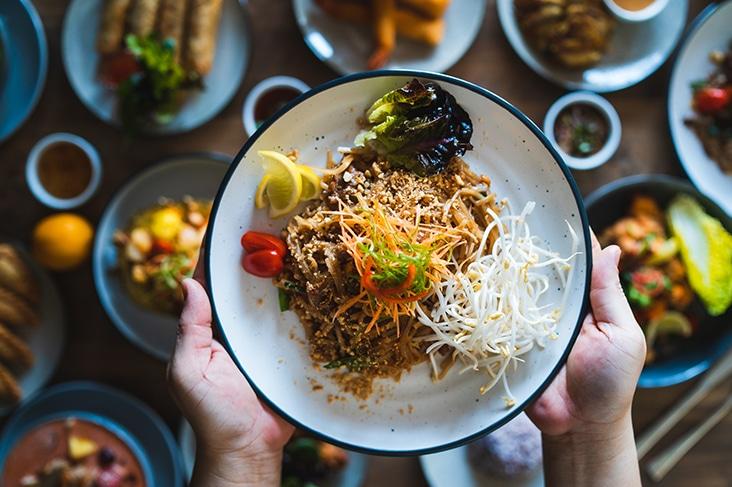
Pad Thai
Pad Thai: stir-fried rice noodles with shrimp or chicken, peanuts, lime and bean sprouts, the kingdom's signature dish
- Tom Yum Goong: hot and sour soup with shrimp, lemongrass, galangal and chilli, a perfect balance of Thai flavours
- Som Tam: spicy green papaya salad with garlic, chilli, tomatoes, peanuts and fish sauce, fresh and full of kick
- Massaman Curry: mild curry with peanuts, potatoes and meat (beef or chicken), influenced by Muslim cuisine
- Khao Pad: fried rice with vegetables, egg and meat or seafood, served all over Thailand
- Mango Sticky Rice: sweet coconut-milk sticky rice served with ripe mango, a must-try dessert
- Satay: grilled marinated meat skewers, served with peanut sauce and pickled cucumber
- Green Curry: coconut-milk curry with Thai basil, aubergine and chilli, creamy and fragrant
A few basic words and phrases
- Sawatdii (สวัสดี): Hello / Goodbye
- Khop khun (ขอบคุณ): Thank you
- Khop khun khrap (male) / Khop khun kha (female): Thank you (polite form)
- Chai (ใช่): Yes
- Mai (ไม่): No
- Khor thot (ขอโฎษ): Excuse me / Sorry
- Tao rai (เท่าไร): How much does it cost?
- Hong nam yuu tii nai (ห้องน้ำอยู่ที่ไหน): Where is the toilet?
- Mai phet (ไม่เผ็ด): Not spicy
- Aroy (อร่อย): Delicious
Note: In Thai, men add "khrap" (ครับ) and women add "kha" (ค่ะ) at the end of a sentence as a mark of politeness.
Travel well insured to Thailand