
At a glance
- AI is an excellent starting point for research. It helps find destination ideas, rough out a budget, and sketch out an itinerary in a few minutes;
- A good prompt changes everything. A precise prompt (dates, budget, constraints) gives a far more useful answer than a vague request;
- It doesn't know entry requirements in real time. Visa, ESTA, or electronic authorization must always be checked on the official website of the country in question;
- It treats schedules as if they were fixed. A cable car, a museum, or a bus may have different hours than what it states;
- Human verification remains an essential final step. Official sources, recent reviews, and thorough checks remain your best allies.
Using AI to prepare a trip can save you valuable time on inspiration, budgeting, or early itinerary ideas. However, it guarantees neither an opening time, nor an entry requirement, nor even the actual existence of a place it recommends to you, as illustrated by several documented cases further in this guide.
We take stock of what artificial intelligence genuinely does well when organizing a trip, its documented limitations, and the best practices for using it without unpleasant surprises.
How Can You Use AI to Prepare a Trip?
Understanding AI
A generative AI is a model capable of producing text, itineraries, or personalized answers based on a request formulated in natural language, such as "plan me a weekend in Porto". To do so, it synthesizes the information it deems relevant from search results.
Used as a starting point rather than as an official source of information, AI provides real value to anyone preparing a trip.
AI-Assisted Trip Preparation
Here are a few situations where using AI can be considered when preparing your vacation:
- Inspiration. AI helps find destination ideas suited to a specific budget, preferences, and constraints, for example to rough out options before refining a trip to Europe;
- Itinerary. It structures a day-by-day program according to a chosen pace, with must-sees and secondary options to refine;
- Budget. It provides an indicative estimate of your trip's costs, broken down by category (be careful to cross-check with actual prices when booking, to avoid any unpleasant surprises);
- Translation. It can help you understand a menu, a rule, or a local custom, both on site and beforehand, and can also search for information in the original language before translating it for you;
- Comparison. It compares several destinations or options against your precise criteria, to offer you a 100% personalized program;
- Entry requirements. It gives an initial indication of the visas or authorizations needed, which must always be verified on official websites;
- Booking. Some dedicated platforms allow you to book flights and hotels directly, although you should always interpret their results with caution;
- Assistance. It answers practical questions once you're on site, a bit like a pocket guide.
These uses generally follow the same sequence: finding ideas, building an itinerary, estimating a budget, checking sensitive information, then booking. Each step is detailed further in this guide, along with the method and verification habits that should accompany them. For organizing a last-minute trip, AI can also be very useful for quickly narrowing down options.
Three Prompts to Customize to Get Started
Definition:
A prompt is the request, written in natural language, that you address to an AI to get a response. The more precise it is, the more relevant the answer.
The quality of the response therefore depends almost entirely on the precision of the prompt (even though the chosen model also plays a role in the result obtained). Here are three examples that can help you in planning your own trip:
- For destination inspiration, a good habit is to set a specific duration, budget, and travel style rather than asking an open-ended question like "where should I go in Europe?": "Suggest a destination in Europe for an 8-day trip in late September, with a budget of 900 euros per person, excluding flights. We're two adults without children, we enjoy moderate hiking, local cuisine, and small historic towns, and we want to avoid large tourist crowds. Give me 4 destinations, each with one strength and one point of caution."
- For a draft itinerary, setting a pace and a travel-time limit prevents programs that cram in every highlight without accounting for fatigue: "Build me a day-by-day itinerary for 6 days in Porto, departing from Brussels. We want a moderate pace, with a maximum of two main activities per day, a free morning every other day, and no more than 45 minutes of travel time between two consecutive activities." Change the city, the number of days, and the travel-time threshold according to your travel style.
- Finally, for a budget estimate, ask for a breakdown by category rather than a single figure. This will help you spot the most uncertain items, which often involve accommodation and activities: "Estimate an indicative budget for 6 days in Porto, for two adults, in mid-range accommodation. Break down the result by category (accommodation, meals, local transport, activities) with a 10% contingency for unforeseen expenses, and present it as a table with a low and a high range. On each line, indicate the name of the accommodation or activity with an indicative amount drawn from 'official' sites." Specify your desired comfort level (minimal, mid-range, upscale) to refine this last result, and then check each amount against official sites before booking anything: AI can certainly give a plausible estimate, but never a guaranteed price.
General-Purpose LLM or Dedicated AI Trip Planner?
Definitions:
- An LLM (Large Language Model) is an artificial intelligence specialized in understanding, interpreting, and generating human language. It's the component that powers tools like ChatGPT, Copilot, Claude, Gemini, and others.
- An AI trip planner is an application built around a language model, but specifically dedicated to trip preparation: it directly generates a structured itinerary, and sometimes handles bookings as well.
Two families of tools therefore coexist today. On one hand, general-purpose chatbots like ChatGPT, Gemini, or Claude are capable of answering almost anything, but without any particular travel expertise. On the other, we find dedicated planners like Layla. These often present results in a more readable way, but they remain built on the same language models: they therefore have the same reliability limitations on certain points, such as schedules or entry requirements.
In practice, the line between "general-purpose without booking" AI tools and "dedicated with booking" ones is gradually blurring. The major general-purpose chatbots now offer booking via partners (often with a redirect to the merchant's site to finalize payment), without thereby becoming specialized travel tools.
These platforms are still fairly new. Travelers regularly report concrete issues, for example:
- The wrong airport. The itinerary systematically redirects to a distant airport rather than the one originally requested;
- The hotel in the wrong city. The app suggests accommodation dozens of kilometers from the requested city, rather than in the city itself;
- Incorrectly calculated time difference. An overnight flight arriving after midnight isn't placed on the correct day of the program.
None of this is surprising: it's a mechanism known as hallucination. General-purpose chatbots are progressing quickly on this front: ChatGPT, Claude, or Gemini increasingly integrate real-time search, which might be enough, in the coming months, to close the gap with dedicated tools. But at this stage, whether it's a general-purpose chatbot or a specialized planner, the verification habit remains the same: nothing replaces the user's own verification before paying for anything (see the method below).
The Real Limitations of AI in Trip Preparation
Definition:
A hallucination refers to content that AI presents as fact when it's actually made up, for example a place that doesn't exist or an incorrect visa requirement.
AI's limitations in travel aren't theoretical, and they've already ruined some very real trips.
When AI Invents an Entry Requirement
Real case: An Australian conference speaker was told categorically by ChatGPT that no visa was needed to travel to Chile. Arriving at the airport without the required document, he was unable to board and missed the very conference he was traveling for. This isn't an isolated case: general-purpose chatbots regularly confuse visa exemption rules with a total waiver of formalities, when an electronic authorization is often still mandatory.
When AI Gets the Time or Place Wrong
Real cases:
A Malaysian couple booked a trip and traveled 300 kilometers to visit a site featured in a viral video, before discovering on site that the location and the promised cable car were entirely made up.
A Japanese traveler, meanwhile, found himself stranded at the top of Mount Misen after a chatbot gave him the wrong time for the last cable car (a fairly telling example for anyone who needs convincing to always keep a plan B). These episodes illustrate the same mechanism: AI treats dynamic information — seasonal schedules, temporary closures, whether a place actually exists — as if it were set in stone once and for all.
The Good-Habits Checklist
What AI does fairly well:
- Give ideas for destinations and activities;
- Structure an itinerary;
- Estimate the required budget;
- Explain the cultural context of a place;
- Suggest a daily activity program.
What AI doesn't do well and that you need to check yourself:
- Confirm that a place actually exists (via its exact name, a map, recent reviews...);
- Check opening and closing times on the official website, or call or contact them yourself to verify;
- Know the actual prices applicable at the time of booking;
- Verify a country's entry requirements (visa, electronic authorization, passport, vaccinations...);
- Check actual travel times and any connections.
The "Redion Vacation Barometer" on AI Use
Redion's 2026 vacation barometer confirms that the use of AI in trip preparation is no longer marginal at all. Here are the key figures gathered from Belgian travelers:
- 59% of Belgians already use artificial intelligence in their daily lives, whether occasionally or often;
- 22% use it specifically to plan and book a trip, 5 points more than in 2025;
- Among those who use it for their vacations, the most common uses are as follows:
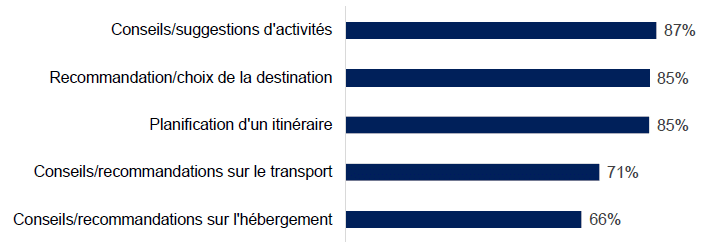
- The main perceived benefits are instant, personalized information (54%), a single platform to centralize research (49%), and better deals or terms (35%).
One figure deserves to be highlighted with caution: 26% of respondents would entrust the entire organization of their trip to AI, with no human verification at all. This is exactly the habit this guide advises against: AI remains a starting point for finding information, never a reliable source.
The Hybrid Method to Avoid Getting Caught Out
Using AI to prepare a vacation is no longer a novelty: more and more travelers rely on it, and some estimates already put the figure at close to a third of travelers, a number that should be taken with caution given how fast this field is evolving. Redion's 2026 vacation barometer precisely allows us to track, year after year, how Belgian travelers' preparation habits evolve. However, usage is progressing faster than the tool's reliability: rather than entrusting everything to AI or doing everything yourself, the hybrid method, combining both, is the ideal approach.
Here's how to do it:
- Researching information and ideas, 100% AI. Let the chatbot suggest freely, without holding back on ideas for destinations, activities, or trip structure. This is the point where AI is most useful and carries no risk at all;
- Sorting and structuring, 50% AI - 50% human. Keep the ideas that truly match your preferences, ask for a refined version with your own constraints, and start weighing the result against your own common sense;
- Critical validation, 100% human. This is the step that prevents mishaps: check entry requirements on the Belgian Federal Foreign Affairs Department's country-by-country advice, cross-check dynamic schedules (museums, cable cars, buses, boats) on the operator's website rather than on the AI's answer, confirm that a place exists through a quick search and recent reviews, and actually trace the route so your side trips don't require teleportation. For this step, always end your conversation with the AI with a safety prompt: "In the itinerary and budget you just suggested, which pieces of information depend on a seasonal schedule, a variable rate, or a visa rule that could have changed? List them clearly, and for each one, provide an official source where I can verify it myself before booking anything." This prompt forces the AI to point out its own areas of uncertainty, rather than leaving you to guess what needs checking. For flights and hotels in particular, no AI replaces a direct confirmation: a price, availability, or a flight time should always be checked on the airline's, hotel's, or booking platform's own website before any payment.
- Booking and departure, 100% human. Only book once the sensitive points have been checked, and complete your preparation with a classic vacation departure checklist, which often catches what no chatbot thinks to check. For a road trip, summer traffic forecasts also remain more reliable than a generic estimate provided by a chatbot.
Choose Redion, to Protect Yourself in Case of the Unexpected!
Even when cross-checking every piece of information against the right sources, a trip can still go wrong for reasons completely unrelated to how it was prepared: a health problem, lost luggage, a cancelled flight. This is particularly true for families using AI, for example to plan a trip with young children, where logistical mishaps weigh even more heavily on how the stay unfolds.
Good to know. Before you leave, check your travel assistance coverage. In the event of an accident, illness, or unexpected event during your trip, Redion arranges your care 24/7.\
FAQ on AI in Vacation Preparation
AI is reliable for giving you inspiration, suggesting itineraries, and providing an indicative budget, but it still deserves to be used with caution. This is especially true for information that's likely to change over time (such as schedules, actual service prices, or a country's entry requirements). It should remain a starting point, but should never be the only source consulted before booking a trip or leaving.