At a glance
- Documents: ID card or passport? Check whether you need a passport and its validity for every traveller: some countries require at least 6 months of remaining validity after the return date;
- Entry formalities. Find out about the visa or electronic authorisation (ESTA, ETIAS) required for your destination before finalising your booking;
- Health. See your doctor at least 6 to 8 weeks before departure: some vaccines require several doses spaced weeks apart;
- Travel insurance. Your Belgian health insurance fund doesn't always reimburse care outside Europe, and your bank card comes with significant exclusions: dedicated cover is essential;
- Home and data. Secure your home, digitise your essential documents and email them to yourself before you leave.
Getting ready for the holidays is not just about packing a suitcase. It actually means completing a set of concrete steps in the right order, so you don't spend your first hours abroad dealing with avoidable situations.
This guide brings together everything you need to check before travelling: administrative formalities, health, assistance cover, itinerary, digital security and managing the unexpected. Data from Redion's 25th 2026 Holiday Barometer runs through it as a common thread: this year, 72% of Belgians plan to go away, and safety is one of the major criteria in choosing their destination.
The context changes, and so does the preparation!
1. Travel documents: what to check well in advance
Checking your passport's expiry date should be one of your first reflexes, well before packing your bags.
1.1. Passport and ID card validity
Some countries require a passport. And if that's the case, the document sometimes needs to remain valid for six months after the planned return date. Check not only the expiry date, but also the physical condition of the document: a damaged or illegible passport can lead to refusal at the border. For children, the kids-ID has a shorter validity period, and a young child's face can change quickly, to the point of making the document unusable well before its expiry date.
1.2. Visa, ESTA and electronic authorisations
Depending on your destination, an online procedure is sometimes enough, such as the ESTA for the United States or the eTA for Canada. For other countries, a consular visa is required, sometimes with long processing times. Check the entry requirements for your destination on the website of the Belgian Federal Foreign Affairs Department well before your departure. Our article on the steps to obtain a visa, ESTA or ETIAS covers the procedures country by country.
1.3. Register on Travellers Online
Often overlooked, this step nonetheless takes less than five minutes. It allows the Federal Foreign Affairs Department to contact you in the event of a crisis in your destination country, including a natural disaster, a deteriorating security situation or an emergency repatriation. Registering on Travellers Online is recommended for any trip outside the European Union.
Travellers Online registration
1.4. Digitise and back up your documents before leaving
Scan your passport, ID card, tickets and insurance contract, and keep them in your email inbox. If your passport or ID card is lost abroad, these copies make consular procedures considerably easier and can save several precious hours.
2. Health and travel medicine kit: don't leave without thinking about it
Health is the step most people happily put off, and yet it's also the one that often requires several weeks of forward planning.
2.1. Vaccinations: see your doctor at least 6 to 8 weeks before departure
For many destinations, vaccines are recommended, or even required. Some require several doses spaced a few weeks apart: it is therefore essential to consult your doctor or a travel medicine centre well in advance. The Institute of Tropical Medicine in Antwerp (ITM) is the Belgian reference on the matter: its website lists recommendations by country and type of trip. Our article on vaccines required or recommended depending on your destination also guides you through the process.
2.2. Travel medicine kit: what to pack
A well-thought-out kit can prevent a lot of trouble. It ideally includes painkillers, antipyretics, anti-diarrhoeal medication, antihistamines, disinfectant, plasters, a thermometer, high-SPF sun protection, insect repellent and any medication you take regularly (always with its prescription). Check our guide to putting together your travel medicine kit based on your destination and type of stay.
2.3. Travelling with medication
If you're on regular medication, bring enough for the entire trip, plus a few extra days as a precaution. Keep it in its original packaging with the leaflet, and carry a prescription stating the international non-proprietary name of each active substance: it's this generic name that lets you find the equivalent abroad, where the brand name can be completely different. Our article on the rules for travelling with your medication covers the restrictions specific to cabin baggage.
2.4. The European Health Insurance Card (EHIC)
If you're travelling within the European Union, the EHIC gives you access to healthcare under the same conditions as residents of the country you're visiting. Request it from your health insurance fund before leaving: it's free and valid for two years.
Please note: it does not cover private care and is not valid outside the EU. Nor does it replace travel insurance for repatriation or unexpected logistical issues.
3. Travel insurance: the step that always gets put off
We think of it last, consider it superfluous, or rely on our bank card hoping it will be enough. Yet travel insurance is the one guarantee that really makes a difference when something unexpected happens far from home.
3.1. Why your health insurance fund and bank card aren't enough
Your Belgian health insurance fund reimburses little or nothing outside the European Union. As for premium bank cards, their travel cover is often partial, capped at insufficient amounts and comes with exclusions that only come to light when a claim arises. Our article on travel insurance and credit cards details what the most common Gold and Platinum cards in Belgium actually cover.
3.2. What good travel insurance really covers
Good travel insurance covers medical repatriation, hospitalisation costs abroad, early return, loss of documents and trip cancellation, with 24/7 assistance in French. These guarantees make the difference between an emergency you have to handle alone and a situation taken care of by professionals from the very first call.
According to Redion's 2026 Barometer, 81% of Belgians say they are insured in case of medical problems during their trip. This figure is encouraging, but it also means that nearly one in five Belgians travels without adequate medical cover.
3.3. Which travel insurance plan should you choose for your trip?
The right choice depends on the length of your stay, how often you travel and your destination.
- For a single trip of up to 45 days, Temporary Insurance covers medical costs up to €250,000 (worldwide).
- For several trips a year, Annual Insurance covers from €250,000 up to an unlimited amount, depending on the plan chosen.
- For a stay of more than 3 months, Long Trip insurance covers up to €1,250,000 (worldwide)
Before you leave, check your cover. In the event of an accident, illness or unexpected medical issue abroad, Redion arranges your care 24/7, in French, wherever you are.
3.4 Cancellation insurance: just as useful
Nobody hopes to have to cancel their holiday. But an unexpected event such as an illness, hospitalisation, the death of a loved one, or something affecting your job (your employer refusing leave, job loss), your studies (resit exams) or an administrative obstacle (visa refusal, vaccination issue...) and many other unforeseen circumstances can unfortunately prevent you from leaving.
Cancellation insurance lets you cover these risks and get reimbursed for booking and transport costs not refunded by your tour operator. Website
4. Destination safety: get informed
The 2026 Holiday Barometer confirms it: safety is a fundamental factor for Belgians when choosing a holiday destination. And in an unstable geopolitical context, it would be unwise to leave without first getting informed.
4.1. Check the Federal Foreign Affairs Department's travel advisories
Before any trip, check the page for your destination on diplomatie.belgium.be. It provides the current alert level, areas to avoid, health risks, entry rules and useful emergency numbers on the ground. These pages are updated regularly: a destination that is safe at the time of booking may be less so by the time you leave.
Our article is my travel destination safe? helps you assess the level of risk based on your profile.
4.2. What travel insurance covers in the event of an unexpected situation on site
If a security situation deteriorates after your departure, your travel insurer will do everything possible to help you on the ground in line with the cover set out in your contract. However, check your contract's general terms and conditions: some events already known before you took out the policy are excluded from cover. That's one more reason to take out insurance early, as soon as you book your trip.
5. Itinerary and transport: preparing the route before you leave
Whether you're travelling by car, plane or train, a few checks are needed before departure. The preparations differ depending on the mode of transport chosen.
5.1. Technical checklist for your vehicle before departure
Before hitting the road, check your tyre pressure, oil and coolant levels, the condition of the brakes and that the lights are working properly. These checks take less than an hour and can prevent a breakdown during the holidays on a congested motorway. Check our car checklist before departure so you don't forget anything.
5.2. Choosing the right departure day using traffic forecasts
Choosing your departure day is one of the most impactful decisions for the quality of your journey. The summer 2026 traffic forecasts published by Redion indicate the weekends and days to avoid on major European routes, country by country. A few hours' difference in departure time can save you several hours on the road.
5.3. Travelling by electric car: plan your charging stops
If you're travelling by electric car, planning your charging stops becomes a central part of your itinerary, especially on busy days when fast chargers can be in high demand. Our guide to travelling by electric car covers charging strategy, useful apps and precautions specific to summer.
5.4. If you're flying: take precautions
Rules on the size and weight of cabin baggage vary considerably from one airline to another: check them before arriving at the airport. Our article preparing for your flight covers all the points to watch out for, from booking to departure. In addition, EU Regulation EC 261/2004 protects you in the event of a flight delayed by more than three hours or overbooking, with a flat-rate compensation ranging from €250 to €600 depending on the distance. Our articles on your rights in the event of a delayed flight and on your rights in the event of flight overbooking detail the steps to follow in this situation.
Also be aware of the risks if you fly with an ear infection.
6. Digital security: protect your data before you leave
Devices and personal data are rarely top of mind before a trip. Yet a few simple precautions taken beforehand considerably reduce the risks in the event of theft or loss.
6.1. Back up your data before travelling
Do a full backup of your smartphone and computer before leaving. In the event of theft or loss, you won't lose your photos, contacts and documents. An online storage service (cloud) is the most practical solution: your data remains accessible from any device.
6.2. Turn on location tracking and remote locking
The "Find My Device" features on iOS and Android let you locate your phone, lock it remotely or wipe its content in the event of theft. Turn on these options before leaving, and note down your SIM card's PIN code, which is often forgotten until the moment you actually need it.
6.3. Avoid unsecured public wifi networks
Cybercriminals particularly target travellers in airports, hotels and public spaces. Don't access your bank accounts on an open network. Our article on protecting your devices against cybercrime while travelling lists all the reflexes to adopt before and during your stay.
7. Travelling with family: extra points to watch out for
Going on holiday with children involves more extensive preparation than a trip alone or as a couple. It's best to deal with these points in advance rather than discovering them at the airport.
7.1. Children's travel documents
Each child must have their own travel documents: kids-ID for stays in Europe, a passport for destinations outside the EU. If the child is travelling with an adult who does not have legal custody, many countries require a travel authorisation signed by both parents. Check the specific requirements for your destination with the Federal Foreign Affairs Department.
7.2. Flying with a baby or young child
Parents flying with a baby for the first time often run into the same questions: at what age can a baby fly, how do you manage pressurisation on landing, can you bring baby food in the cabin? Our article flying with a baby or young child answers these in detail.
7.3. Keeping children entertained during a car journey
For families travelling by car, the question of keeping the kids entertained inevitably comes up ten minutes after leaving. Word games with no equipment, audiobooks, age-appropriate hands-on activities: our complete guide to keeping children entertained in the car covers every profile, from babies to reluctant teenagers.
7.4. Medical preparation specific to children
Medical preparation for a family trip isn't just about slipping some paracetamol into the bag. Age-appropriate vaccinations, a paediatric medicine kit, motion sickness medication, extra sun protection depending on the destination: our article on preparing a trip with young children brings together all the health advice for a stress-free family trip.
7.5. What about pets?
Many families go on holiday with their dog. In that case, it's also worth properly preparing the trip and stay for your pet (vaccinations, preparation and activities on site).
If you decide to leave your pet at home, arrange care or a pet sitter.
8. AI as a trip-planning tool: useful, but use with discernment
22% of Belgians now use artificial intelligence to plan their holidays, according to Redion's 2026 Barometer. That's a five-point increase in a year, reflecting the growing integration of these tools into everyday life.
8.1. What AI can do to help you prepare
Generative AI tools can help build a tailor-made itinerary, compare destinations, suggest activities based on your interests or generate a checklist before you travel, tailored to your profile. They are particularly effective for organisational tasks, summarising information and getting a first sense of direction.
8.2. What AI cannot replace
Information on entry formalities (visas, ESTA, health rules) changes regularly: always check these points against official sources, even if an AI tool has already given you a first answer.
The general terms and conditions of a travel insurance policy cannot be reliably summarised by a chatbot: read your contract or contact your insurer directly. Finally, no AI can replace medical advice for vaccinations recommended based on your health and destination.
9. What to do at home before leaving on holiday?
We think about documents, the suitcase, insurance, but much less often about what we're leaving behind. Yet an unemptied fridge, an overflowing letterbox or a poorly secured house can spoil your return just as surely as any mishap on the trip itself.
9.1. Secure your home before your holiday
Close all windows and doors properly, including secondary access points (cellar, garage, back door). Turn on your alarm if you have one, and let a trusted neighbour know you'll be away. Avoid announcing your departure on social media before you're back: it remains one of the main sources of information for burglars.
If possible, set lights on a timer to simulate a presence.
9.2. Mail, plants and pets: delegate everything
Ask someone to empty your letterbox regularly: an overflowing letterbox signals a prolonged absence. Entrust watering your plants and looking after your pets to a relative or a professional. If you're travelling with your pet, check in advance which documents are needed (European pet passport, up-to-date vaccinations) and the transport rules depending on the mode of travel chosen.
9.3. Appliances and utilities to switch off
Unplug standby appliances (television, chargers, internet box if you don't need it remotely). Empty the fridge of perishable items and consider switching off the electricity. If you turn off the main circuit breaker, first check that the freezer or fridge you want to keep running is on a separate circuit, as should the alarm. Turn off the water supply if you're away for a long time, and lower the water heater's thermostat. These steps reduce the risk of water damage and significantly lighten the electricity bill when you get back.
9.4. Travel budget and payment methods abroad
Before leaving, check your bank card's conditions for payments and withdrawals abroad: exchange fees, daily withdrawal limit, countries covered. Some banks block unusual transactions abroad as a security measure: let your bank know you're travelling.
Always bring a bit of local cash for your first moments on the ground, when ATMs may be unavailable or charge high fees. Spread your payment methods across your luggage: never put all your cards in the same place.
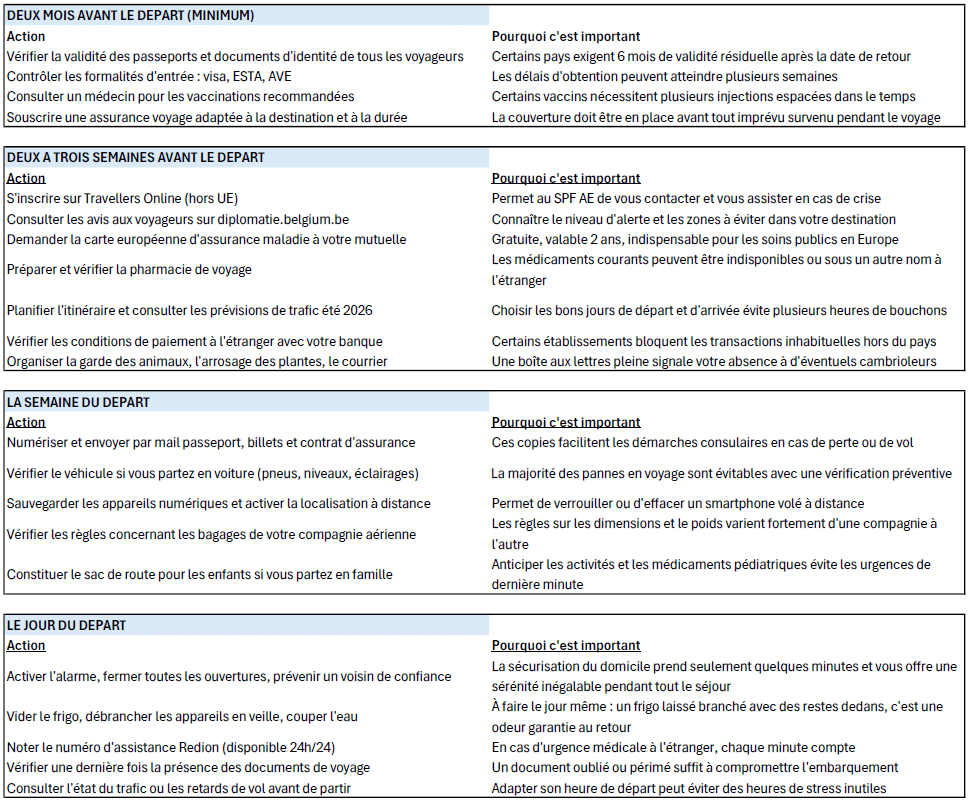
The complete checklist: what to do before leaving on holiday?
Here is a summary of all the steps to take, organised by key moment.
Travel with peace of mind. Whether you're going away for a week in Europe or three months on the other side of the world, Redion is with you 24/7 in the event of a medical problem, breakdown or unexpected situation.
FAQ — your questions about preparing for a holiday
Secure your home (alarm, windows, shutters), delegate your mail and plant watering to a trusted neighbour, empty the fridge of perishable items and unplug standby appliances. Turn off the water supply if you're away for more than two weeks. Set up an out-of-office message on your work email and bring a bit of local cash for your first moments on the ground. These steps, which take less than an hour, prevent most unpleasant surprises on your return.