At a glance
Are you planning to travel to France soon? Discover our practical tips and tricks for a hassle-free stay in this guide.
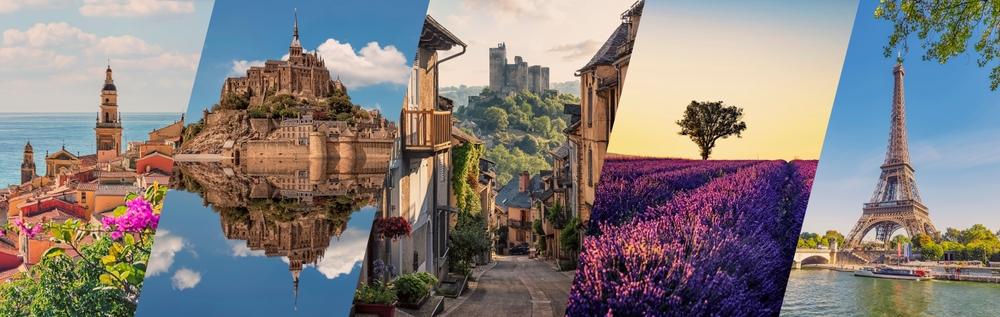
France continues to hold the top spot on the list of the world's tourist destinations. It's known for its rich architectural heritage, its cuisine and its varied landscapes, from beaches to hilltop villages, via majestic mountains.
To help ensure your stay goes smoothly, we give you some practical information for preparing your trip to France.
Emergency numbers: who to call in case of a major problem?
- General: 112
- Police: 17
- Ambulance (SAMU): 15
- Fire brigade: 18
- Sea rescue: 196
- Card Stop in case of a lost or stolen credit card: +32 (0)78 170 170
- Doc Stop in case of lost or stolen travel and/or ID documents: +32 2 518 2123
Assistance: Redion (Belgium)
In case of an emergency, always contact the local emergency services first!
– Want to reach Redion for a medical or technical problem (e.g. car breakdown)? Do so via the Redion app (downloadable via the Apple Store or Google Play)
– Want to reach Redion for an administrative request or a contract change? Do so via the Customer Area on the website: https://www.redion.be
How to travel safely in France?
Good preparation is needed to travel to France with complete peace of mind. That's why we help you below to learn about the administrative steps to take, the road regulations in force, and the country's climate.
What travel documents do you need in France?
France, like Belgium, is a Member State of the European Union. As a result, if you're an EU citizen, you benefit from free movement to this country.
To travel around France, however, you must have your ID card (the Kids-ID for young children) or your passport. These documents must be valid at the time they're presented.
What is healthcare like in France?
If you have a health issue during your trip to France, you can get the care you need by visiting a doctor or going to the nearest hospital.
You'll be reimbursed for all or part of your healthcare costs by presenting your European Health Insurance Card, and you'll benefit from optimal cover by taking out supplementary travel insurance. You can choose either a temporary plan or an annual insurance policy, depending on your needs.
How safe is France?
Even in the safest countries, small accidents can always happen. A few simple measures and precautions will let you enjoy your stay safely.
Here are a few general recommendations:
- always carry a valid ID document (passport, adult or child ID card);
- make a copy of essential documents and keep them in a safe place;
- never carry valuables or large amounts of cash; it's best to have only a small amount on you and keep the rest in a secure safe (at the hotel);
- be careful when paying with a bank card or withdrawing money;
- always be cautious on the road and at rest areas, as well as when driving at night;
- if you're driving on motorways, only stop at designated rest areas.
It's always wise to check the current security measures provided by the Belgian Federal Foreign Affairs Department. Terrorist alerts and demonstrations are reported there, and the information is updated regularly.
What are the driving rules in France?
Road regulations differ from one country to another. For France, the essentials to remember are as follows:
Speed limits
- motorway: 130 km/h (110 km/h in rainy weather);
- dual carriageway separated by a central reservation: 110 km/h (100 km/h if rainy);
- road section with more than two one-way lanes: 90 km/h (80 km/h if rainy);
- two-way road with no central divider: 80 km/h;
- built-up areas: 50 km/h.
- follow the road signs installed along the way, as they may indicate other values.
Regardless of weather conditions and road type, the speed on a section with visibility of less than 50 m is limited to 50 km/h.
Tolls
Many French motorways are managed by private companies. They're subject to tolls.
Depending on the type of motorway used, tolls can be paid in cash or by credit card, and on some sections via the free-flow system. Travellers can also use electronic toll badges to pay the amount due. This latter option lets you get through toll barriers more quickly.
It's possible to calculate the total toll amount before setting off. To do so, simply visit the French motorway network's website and enter the route you'll be taking.
Note that on toll motorways, breakdown assistance is only allowed from approved recovery services dispatched on site by the police. Read in this article what to do if you break down or have an accident on a toll motorway. \
Mandatory equipment and traffic offences
Click here to discover all the useful information on mandatory equipment via a downloadable application from the European Commission.
Have you committed a traffic offence in France and received the fine at home in Belgium? Are you required to pay it? Read our article on traffic offences committed abroad on this topic.
Electric cars
Like most European countries, France is increasingly equipping itself with charging points for electric vehicles. Plan your route carefully if you're driving an electric vehicle, and bear in mind that during the high tourist season, it's not always easy to immediately find a free charging point in very busy areas.
Several websites let you locate charging points, including this one: https://blog.chargemap.com/fr
What to visit in France depending on the season?
Like Belgium, mainland France has a temperate climate.
Winter
During this cold, snowy season, you can enjoy winter sports in the French Alps.
Spring
This season is ideal for enjoying sunny days without the crowds. Recommended French destinations include Brittany, the Côte d'Azur, Corsica and Normandy.
If you'd like to enjoy nature waking up after several winter months, one idea is to explore the mountainous and volcanic regions. The Alps, the Pyrenees and Auvergne are therefore good options.
Summer
This school holiday period is ideal for lazing by the sea. You can also choose to recharge in nature, on a hiking trip.
Autumn
Travelling to France in autumn is an opportunity to visit its famous tourist sites in peace and quiet. Among the places not to miss, we recommend the Gorges du Verdon or the Gulf of Morbihan, among others.
Did you know?
Did you know there's a town in France called "Y"? It's a municipality attached to the Somme department. Its inhabitants are called "Ypsiloniens" or "Yssois".
This village is a historic site, having been awarded the "Croix de guerre 1914-1918" in 1920. You can visit the church of Saint-Médard there, rebuilt in 1921 after suffering significant damage during the First World War.
Other practical information about France
- Capital: Paris
- Language: French
- Currency: euro
- Area: 551,695 km2 for mainland France, 641,184 km2 including overseas departments and regions, 672,051 km2 for France as a whole (excluding Adélie Land) and 1,104,051 km2 if the measurements include the area of Adélie Land
- Population: 68.37 million
- Tourist Office: https://www.adn-tourisme.fr
- Embassy and consulates: https://france.diplomatie.belgium.be/fr/ambassade-et-consulats
What are France's culinary specialities?
Travelling to France without taking the time to sample its famous cuisine would be a real shame. Indeed, its cuisine, considered refined and varied, is one of the country's strong points.
Note that culinary specialities vary from region to region. Below, we mention a few typical dishes not to be missed (but there are many more!)
- cassoulet, originally from Castelnaudary, but available in most French restaurants;
- quiche lorraine, a savoury tart typical of eastern France;
- garlic-parsley snails and beef bourguignon, specialities of Burgundy;
- Breton galettes, crêpes, Kouign-Amann, cider and salted butter caramel, to enjoy freely during your stay in Brittany;
- bouillabaisse, an iconic dish from Provence-Alpes-Côte d'Azur.
This is a non-exhaustive list; every region of France has its own culinary specialities. In fact, French gastronomy is included on UNESCO's list of the intangible cultural heritage of humanity!
Finally, don't miss out on treating yourself to French cheeses, of which there are more than 1,200 varieties. You'll surely find one to your taste among this array. The must-tries include Camembert from Normandy, goat cheese from Nouvelle-Aquitaine, Maroilles from Hauts-de-France and Brie de Meaux from the Île-de-France region, to enjoy with one of the countless regional wines France has to offer.